


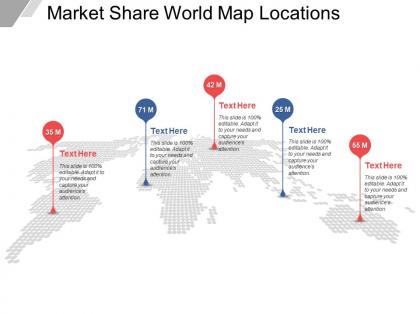
Market share world map locations





Try Before you Buy Download Free Sample Product
 Impress Your
 Audience
 100%
100% Editable
 Save Hours
 of Time


Deliver excellent guidance with our Market Share World Map Locations. Your team will develop beautifully.
People who downloaded this PowerPoint presentation also viewed the following :
Market share world map locations with all 5 slides:
Our Market Share World Map Locations will excite your grey cells. They will catch the best frequency.


FAQs for Market share
So market share really depends on a few key things. Wealthier areas usually buy more premium stuff - that's just how it works. Cultural preferences are huge too, plus you've got regulatory differences and infrastructure quality to think about. Population density obviously matters. Competition varies like crazy between regions, which directly affects what share you can grab. Honestly, local partnerships can totally make or break you in some markets. Oh, and distribution networks - super important but easy to overlook. I'd map out these factors for whatever industry you're targeting first, then figure out your best expansion spots from there.
Start by mapping where you stand vs competitors across different regions and segments - shows you exactly where you're winning and getting your ass kicked. Hunt for patterns in the data. Maybe you're dominating urban areas but rural markets are a disaster (honestly happens all the time). Target segments where competitors lead but aren't growing fast - perfect opportunity to steal share. Figure out what's working in your strongest regions, then copy that playbook everywhere else. Turn those insights into actual action items your sales and marketing teams can run with.
Dude, emerging markets are totally flipping the script on global market share. India and Brazil are snatching up huge chunks across everything - tech, consumer stuff, you name it. Southeast Asia too. What's crazy is they're not just buying more products anymore. They've become serious production powerhouses that actually compete with the big Western companies now. The speed of this shift is honestly kind of insane once you see it happening. Oh, and they're innovation hubs too - I probably should've mentioned that first. For your business planning, definitely track which emerging markets are moving in your industry because once those trends pick up steam, they don't slow down.
Dude, cultural differences can totally make or break your market share when you go global. McDonald's gets this - they sell rice burgers in Taiwan and beer in Germany because they actually pay attention to what locals want. Your colors, messaging, even product features hit different across cultures. Something that screams "trustworthy" in Japan might come off as super boring to people in Brazil. I swear, so many companies just assume what works at home will work everywhere else. Big mistake. You've gotta do your homework on local preferences first, then adapt everything accordingly. Don't be that company that ignores cultural nuances and wonders why nobody's buying their stuff.
Your market position totally determines how you should play the game. Leading the pack? Focus on protecting what you've got and calling the shots. But if you're smaller, time to get scrappy - find your niche or do something wildly different to steal customers. Geographic breakdown is where it gets interesting though. You might be killing it in one region while completely tanking somewhere else. That's gold for figuring out where to push harder vs where you need to basically start over. I'd say check those regional numbers every quarter and pivot fast.
Honestly, mapping market share is a game changer - you'll see patterns pop out that spreadsheets just can't show you. Geographic gaps become obvious. You can spot exactly where competitors are beating you and find new areas to expand into. Plus (and this might sound weird) but there's something satisfying about having that bird's-eye view of everything. When you're presenting to your team, just point at the map and say "look, we're killing it here but struggling over there." Way more effective than boring charts. It basically shows you which markets need your attention first and where to focus your budget next.
Honestly, most companies just can't figure out their market boundaries. They'll say they own 30% of "premium widgets" when they actually have like 2% of what customers really buy. Super common mistake. Plus everyone's using ancient data - I swear some companies are still running off 2019 numbers. Global brands are the worst at this, they take US trends and assume it works everywhere else. My neighbor's startup did exactly this last year, total disaster. Define what market you're actually in first. Then get current data that's specific to where you operate.
Think of it this way - more market share basically means you can charge whatever you want. Apple's the perfect example, right? They own their space so they can price stuff crazy high. Meanwhile smaller companies have to slash prices just to compete. But here's the thing - it totally depends on your industry. Retail giants like Walmart actually keep prices low to stay on top. Pharma companies though? They'll milk those patents for everything. I guess it comes down to whether you're the king trying to stay there or the scrappy underdog fighting your way up.
Tableau and Power BI are solid choices for dashboards that update automatically - saves you from pulling numbers manually every month. For digital stuff, Google Analytics and SEMrush work great. Nielsen's got the broader industry data but honestly costs a fortune. Power BI's probably your best bet if you're already using Microsoft products since everything syncs up nicely. Don't get caught up in the flashiest tools though. Pick whatever connects easily to your current data sources. Set up those automated reports now and you'll save yourself hours later.
Tech basically flips everything upside down in old-school industries. Companies jumping on new tools fast? They're snatching market share left and right. The ones dragging their feet get crushed - it's wild how quick it happens. Look at manufacturing right now. Factories with AI and automation are absolutely destroying traditional competitors on cost and speed. My buddy works in supply chain and says it's insane watching some companies just... disappear. What you wanna track is adoption speed in your industry. That'll tell you who's about to win big next quarter.
Branding's a game changer for market share, honestly. People pick brands they recognize and trust, even if competitors have better features - Apple's a perfect example of this. You'll get customers willing to pay more just because they know your name. Word-of-mouth becomes way easier too, which saves you tons on advertising costs. Here's the thing though - consistency is everything. Make sure your messaging stays the same everywhere customers see you. Oh, and launching new stuff becomes a breeze when people already trust what you do. Really focus on what sets you apart from everyone else competing for the same customers.
Dude, regulatory changes mess with market share in crazy ways. New rules often crush smaller companies because compliance costs are brutal - they just can't keep up financially. Meanwhile, big players with cash actually benefit since competition gets wiped out. Though sometimes it goes the other way and breaks up monopolies, which is kinda satisfying to watch. Speed matters most here - whoever adapts fastest wins. I always cross-reference regulatory news with how different companies are performing. That's where you'll spot who's really getting ahead before everyone else catches on. Market shifts become pretty obvious once you connect those dots.
Honestly, there's a few ways to tackle this. First thing I'd do is figure out what makes you different and really push that angle. Don't get into a pricing war unless you absolutely have to - I've watched companies destroy themselves doing that. Better service usually beats cheaper prices anyway. You could also look at new areas to expand into, like different cities or customer types. Oh, and partnerships can be huge if you find the right ones. But here's what I'd really focus on: find where your competitors suck the most and hit them there first.
So those market share maps are actually super useful - they show you exactly where your customers hang out geographically. You'll start noticing patterns pretty quickly, like whether you're killing it in cities versus smaller towns, or if certain income areas love your stuff. Honestly, it's kind of wild how much a zip code can reveal about people's shopping habits. Like if you're huge in college areas but bombing in places with lots of retirees, boom - there's your age demographic right there. Perfect for figuring out where you're totally missing potential customers and tailoring your marketing to hit the right spots.
So for startups, market share is basically proof you can grab customers - even 0.1% matters when you're starting out. Investors love seeing that traction too. Big companies? They're playing defense, watching for threats to their existing chunk. Honestly, it's kind of the opposite mentality - startups are scrappy and hunting for any opening, while established players worry about losing what they've got. Your map thing is pretty smart actually. Startups can spot regions nobody's really targeting yet, and the big guys can see where competitors are creeping in geographically. Both sides win.
-
I discovered this website through a google search, the services matched my needs perfectly and the pricing was very reasonable. I was thrilled with the product and the customer service. I will definitely use their slides again for my presentations and recommend them to other colleagues.
-
Great designs, really helpful.