

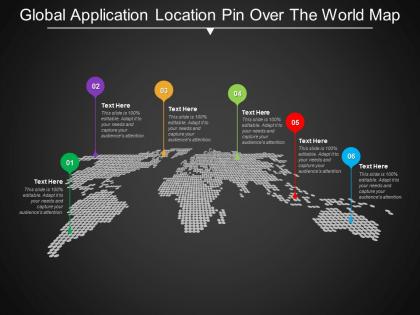
Global application location pin over the world map




Try Before you Buy Download Free Sample Product
 Impress Your
 Audience
 100%
100% Editable
 Save Hours
 of Time


Acquire that incisive edge with our Global Application Location Pin Over The World Map. It helps handle close competition.
People who downloaded this PowerPoint presentation also viewed the following :
Global application location pin over the world map with all 5 slides:
Address the dilemma with our Global Application Location Pin Over The World Map. Figure out the factors causing doubt.




FAQs for Global application location pin over
Geolocation is the process of identifying and tracking the real-world geographic location of devices using GPS satellites, cellular towers, Wi-Fi networks, and IP addresses. These technologies enable businesses to deliver location-based services, personalized marketing, and enhanced security measures, with retail, logistics, and financial services increasingly leveraging geolocation for improved customer experiences and operational efficiency.
Businesses can leverage geolocation data by delivering personalized location-based offers, optimizing delivery routes, providing proximity-based services, and enabling targeted marketing campaigns. Retail chains and restaurants increasingly use geofencing to send relevant promotions when customers are nearby, while logistics companies streamline operations and reduce costs, ultimately delivering faster services and more personalized customer experiences.
GPS relies on satellite signals for precise outdoor positioning, while other geolocation technologies include Wi-Fi triangulation, cellular tower positioning, Bluetooth beacons, and IP-based location services. These technologies work together by providing indoor accuracy where GPS fails, enabling seamless location services, and delivering comprehensive positioning solutions, with many retail and logistics companies finding that strategic combinations ultimately enhance customer experiences and operational efficiency.
Geolocation impacts privacy through unauthorized tracking, data collection without consent, location profiling for targeted advertising, and potential surveillance by third parties or governments. While these concerns present challenges, many organizations are implementing transparent data policies, user consent mechanisms, and privacy controls, ultimately enabling users to benefit from location services while maintaining greater control over their personal information.
Geolocation revolutionizes mobile marketing by enabling personalized campaigns, real-time promotions, behavioral tracking, and proximity-based targeting strategies. Retailers leverage location data to send targeted offers when customers near stores, while restaurants deliver time-sensitive promotions during peak hours, ultimately enhancing customer engagement and conversion rates while delivering measurable ROI improvements.
Geolocation serves as the foundational technology for location-based services by providing precise positioning data, enabling real-time tracking, facilitating proximity-based interactions, and supporting geographic content delivery. Through GPS and cellular triangulation, businesses streamline navigation services, targeted advertising, and asset management, with retail stores and ride-sharing platforms finding that location accuracy ultimately enhances customer experiences and operational efficiency.
Geolocation enables emergency responders to rapidly identify affected areas, track resource deployment, and coordinate rescue operations through real-time location data and mapping technologies. Emergency services leverage GPS tracking, mobile positioning, and satellite imagery to locate victims, optimize evacuation routes, and monitor field personnel, ultimately delivering faster response times and more effective disaster coordination across multiple agencies and jurisdictions.
Ethical considerations include user consent and transparency, data privacy protection, location accuracy limitations, potential surveillance concerns, and secure data storage practices. While geolocation enhances customer experiences and operational efficiency, organizations must balance these benefits with responsible data handling, with many companies finding that clear privacy policies and opt-in consent ultimately build greater customer trust.
Healthcare leverages geolocation for ambulance routing, patient tracking, and telemedicine services, while retail uses it for location-based marketing, inventory management, and customer analytics. These applications streamline operational efficiency by enabling targeted services, optimizing resource allocation, and enhancing customer experiences, with many organizations finding that strategic geolocation integration delivers competitive advantages and measurable cost reductions.
The next decade will bring enhanced GPS accuracy through satellite constellations, indoor positioning via Bluetooth beacons and WiFi, augmented reality navigation, and AI-powered predictive location services. These advancements will revolutionize retail personalization, autonomous vehicle navigation, and emergency response systems, ultimately delivering faster services and competitive advantages across industries.
Geolocation drives smart city growth by enabling intelligent traffic management, optimizing resource allocation, enhancing public safety through real-time monitoring, and improving citizen services delivery. Through GPS and location analytics, cities streamline emergency response times, reduce energy consumption, and deliver personalized services, ultimately creating more efficient urban environments that attract businesses and residents.
Developers face challenges including battery drain from continuous GPS usage, privacy compliance with location data regulations, accuracy variations between indoor and outdoor environments, cross-platform compatibility issues, and user permission management. These technical hurdles require strategic solutions like optimized location polling, robust privacy frameworks, and fallback positioning methods, with many development teams finding that investing in comprehensive geolocation architecture ultimately delivers superior user experiences and regulatory compliance.
Geolocation data enhances supply chain management by enabling real-time tracking, optimizing route planning, and improving delivery accuracy across global networks. Through GPS integration and IoT sensors, companies streamline inventory management, reduce transportation costs, and enhance customer transparency, with logistics providers and retailers finding that precise location intelligence ultimately delivers faster services and competitive operational advantages.
Legal implications of collecting geolocation data include privacy law compliance, user consent requirements, data protection regulations like GDPR and CCPA, cross-border transfer restrictions, and mandatory disclosure obligations. These regulations require organizations to implement transparent privacy policies, secure storage protocols, and user control mechanisms, with many companies finding that proactive compliance ultimately delivers customer trust and competitive advantage.
Geolocation enhances public transportation by enabling real-time vehicle tracking, optimized route planning, and dynamic scheduling adjustments based on traffic patterns and passenger demand. Through GPS integration and mobile applications, transit authorities streamline operations while passengers receive accurate arrival predictions and service updates, ultimately delivering improved efficiency, reduced wait times, and enhanced user experiences across urban transportation networks.
-
Excellent design and quick turnaround.
-
Designs have enough space to add content.