

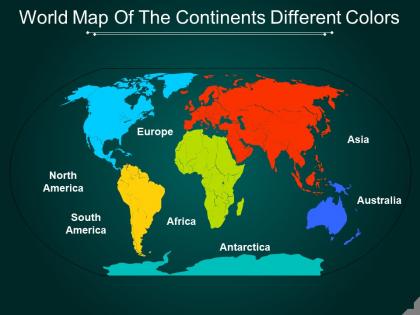
World map of the continents different colors




Try Before you Buy Download Free Sample Product
 Impress Your
 Audience
 100%
100% Editable
 Save Hours
 of Time


Showcase the geographical base of your industry with this World Map Of The Seven Continents. Depict the home as well as the host country of your business using this location PPT template. Take the advantage of this location PPT image to reveal the location of your business centers, manufacturing units, and branches. Describe the various paths or ways and select the right one according to the need of the hour in this business unit PPT graphic. Expound the economic viability of each of the prime factors and undertake various expansion missions using this geographical base PowerPoint layout. Utilize this direction PPT layout to showcase the factors that affect the location including raw materials, market, transport costs, etc. Further, you can represent the importance of certain factors such as political conditions, economic situations, etc. using this business map PPT slideshow. Download this world map PPT visual to prove your mettle across the globe.
People who downloaded this PowerPoint presentation also viewed the following :
World map of the continents different colors with all 5 slides:
Gift them good advice with our World Map Of The Continents Different Colors. Earn their gratitude for your generosity.



FAQs for World map of the
So basically, every continent has these dead giveaways that make them super recognizable. Africa's got the massive Sahara and that crazy Rift Valley. The Himalayas totally dominate Asia, plus all those huge river systems. Europe's all about peninsulas and mountain chains like the Alps. North America? Rocky Mountains and plains that go on forever - honestly, the Great Plains are kinda mind-blowing when you see them from a plane. South America's spine is the Andes, then there's the Amazon which is just insanely huge. Australia's mostly desert with some coastal mountains, Antarctica's all ice. These features are clutch for figuring out where you are on any map.
Continental climates are all over the place - Antarctica's freezing, Africa's deserts are brutal, Europe's pretty chill. Latitude matters most (how far from the equator you are). Ocean currents and altitude play huge roles too. Asia gets crazy temperature swings because it's so massive and far from oceans that could moderate things. I always forget how altitude affects temps until I'm somewhere mountainous and suddenly need a jacket! If you're traveling somewhere, just check how close it is to water and what latitude - those two things'll give you a decent idea of what you're walking into weather-wise.
So basically, continents are like giant isolated labs where evolution went crazy in different directions. Australia ended up with marsupials while Africa got big cats - totally different paths. All that separation over millions of years created the insane biodiversity we have today. Geography shapes everything too, from rainforests to deserts depending on the continent. It's actually pretty cool how continental barriers just let species do their own thing. Oh and that's why conservation groups organize by regions - makes way more sense that way.
Honestly, humans have pretty much messed with landscapes everywhere. You've got deforestation and mining happening across all continents. North America and Europe are covered in cities and industrial stuff. Asia's rivers are dammed up and polluted from all the factories. Africa's dealing with desertification because of overgrazing, plus tons of deforestation. The Amazon situation is just depressing - those satellite photos are brutal. Australia's got mining problems and all these invasive species destroying native animals. Even Antarctica has research stations now, which is kinda wild when you think about it. I'd pick one specific area to focus on rather than trying to tackle everything.
So every continent basically built civilizations that still matter today. China created crazy efficient bureaucracies, India developed deep philosophical traditions. Greek democracy and Roman law from Europe? That stuff literally runs our governments still. Egypt's pyramids and Mali's trade routes connected half the world back then. The Aztecs had this insane calendar system, and the Incas built engineering masterpieces - all without any contact with other continents, which is wild when you think about it. Australia's Aboriginal cultures have been passing down stories for 60,000+ years straight. Understanding this stuff will honestly help you connect better internationally, whether it's work or just travel.
So basically, tectonic plates are behind all the big stuff - earthquakes, volcanoes, you name it. Picture this: plates are constantly moving around, and when they crash into each other or pull apart, that's when things get crazy. Earthquakes happen when all that built-up pressure just... snaps. It's wild how much force we're talking about. Most volcanoes pop up where plates meet too, especially when ocean plates slide under land ones and melt into magma. The Pacific Ring of Fire is probably the best example - total chaos zone. USGS has live tracking if you want to see what's happening near you right now.
Africa's sitting on tons of minerals and rare earth stuff. Asia crushes it with manufacturing plus they've got huge workforces. North America? Energy powerhouse - oil, renewables, the works. South America's biodiversity is insane, plus all that lithium everyone wants now. Europe's killing it with tech innovation, and Australia's got mining and ag exports locked down. But honestly, the sustainability angle is messy. Some places are going hard on green tech while others are still just extracting everything they can get their hands on. If this is for work stuff, maybe check out the UN's development goals framework - most regions use that as their roadmap.
Continents are basically giant heat sponges that mess with air and ocean currents everywhere. Land heats up and cools down way faster than water, so you get these huge pressure systems. That's what drives monsoons in Asia or keeps Europe weirdly warm thanks to ocean currents. Plus the size and where continents sit totally changes wind patterns and blocks moisture. I always forget how much geography actually controls climate until I think about it. If you're checking climate data anywhere, definitely look at what's upwind and how the land affects those crazy seasonal temperature swings.
So Wegener had this continental drift idea back in 1912 - totally right about continents moving around, but he couldn't figure out the mechanism. That's why everyone thought he was crazy at first. Then we discovered seafloor spreading and realized oceanic plates were doing all the heavy lifting. Game changer. Now plate tectonics covers everything - continental drift, earthquakes, volcanoes, mountains, you name it. The magnetic striping stuff on ocean floors is pretty wild if you want to see the proof in action. It's like having a recording of the whole process.
Boundaries are weird - they mess up logical partnerships but also create structures that actually help countries cooperate. Like, trade disputes and immigration fights happen when national interests clash with what makes sense regionally. Border drama can totally derail economic deals that should be no-brainers. But then you have things like the EU and ASEAN that use those same boundaries as organizing principles for diplomacy. It's all about perspective, really. Are boundaries walls or just ways to structure cooperation? When you're looking at regional stuff, check out both the conflicts AND the formal frameworks. You'll see the whole picture that way.
Okay so the big ones you'll want to know: humans first spread out of Africa like 60,000+ years ago to basically everywhere. Then the Atlantic slave trade was massive - millions of Africans forced to the Americas. European colonization hit the Americas and Australia from the 1500s on. Oh and there's been huge rural-to-city migration globally (that one's still happening). More recent stuff includes economic migration from Latin America north, plus lots of movement within Europe. Honestly the slave trade part is pretty heavy to research but super important. What time period are you focusing on? That'll help narrow down which patterns matter most for your project.
Oh totally! You see it everywhere once you start looking. Like, all those place names around us? Most come from Indigenous languages. And quinoa, corn dishes - that's straight from Native American traditions. Africa's got hundreds of different ethnic groups, which is why their music and art feels so diverse (colonization couldn't kill that). Aboriginal dreamtime stories still influence Australian environmental policies today, which is pretty cool. Even Europe - those Celtic festivals and Germanic folklore didn't just disappear. It's wild how these deeper cultural layers stick around. Next time you're out, try spotting them.
Africa's getting hit hard with desertification and water shortages. Asia's air pollution is insane - you should see those satellite pics from China. Europe's losing biodiversity fast, mostly from intensive farming. North America can't figure out wildfires and habitat destruction. South America's Amazon situation is honestly terrifying at this point. Australia's coral reefs are dying from ocean warming. Even Antarctica's ice is melting way faster than scientists thought. The tricky part? You can't just copy-paste solutions between regions since each place has totally different root causes driving these problems.
So here's the deal - continents handle education and tech totally differently depending on their money situation and what they value culturally. Europe's big on standardized, government-funded stuff with gradual tech rollouts. Asia (especially East Asia) goes crazy for STEM and digital innovation - those kids are machines honestly. Africa's actually super smart about this - they're skipping right to mobile solutions since they don't have old infrastructure holding them back. North America obsesses over universities and Silicon Valley-type adoption. South America struggles more with uneven access and funding issues though. You'll definitely want to check each region's digital setup before launching anything there.
Honestly, it's pretty wild how differently tourism hits each continent. Europe's drowning in overtourism - like, those historic sites are getting wrecked. Africa's complicated though - safaris bring conservation money but mess with habitats too. Asia gets the worst Instagram treatment (those poor temples), but hey, locals do make bank. South America's Amazon is caught between eco-tourism cash and actual environmental damage. North America handles it okay with their park systems. Antarctica? That's just depressing with all those cruise ships. My advice? Research specific places since it varies SO much, even within the same continent. Look for sustainable tourism certifications when you're booking stuff.
-
Informative presentations that are easily editable.
-
Helpful product design for delivering presentation.