


Application portfolio management methodology and strategic components




Try Before you Buy Download Free Sample Product
 Impress Your
 Audience
 100%
100% Editable
 Save Hours
 of Time


Accurately assess how far you can go with our Application Portfolio Management Methodology And Strategic Components. It helps you judge the distance.
People who downloaded this PowerPoint presentation also viewed the following :
Content of this Powerpoint Presentation
Description:
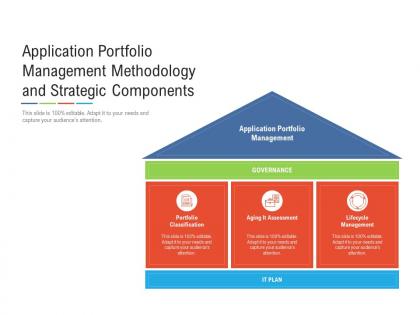
This image is a PowerPoint slide template focused on Application Portfolio Management (APM) and is part of a presentation deck that deals with strategic components in IT management. The slide is titled "Application Portfolio Management Methodology and Strategic Components." It is designed to illustrate a three-pillar approach to managing a collection of software applications in a business environment.
At the top, there's a header that specifies the broader category of "Application Portfolio Management" depicted as a building with three foundational blocks, which indicates that APM is seen as the 'roof' covering the following three strategic components:
1. Portfolio Classification :
This section likely emphasizes the need to categorize applications based on various criteria such as business value, functional fit, technical condition, etc.
2. Aging IT Assessment :
This part of the slide refers to the process of evaluating older IT systems to determine their relevance, efficiency, and whether they should be maintained, upgraded, or retired.
3. Lifecycle Management :
This component stresses the importance of managing the entire lifecycle of an application, from inception and deployment to maintenance and eventual decommissioning.
Below these components, the slide mentions "GOVERNANCE" and "IT PLAN," suggesting that effective governance is crucial for APM and should be aligned with the overall IT strategy of the organization.
The slide also includes a footer that indicates the template is "100% editable," meaning that the content, colors, and structure can be adjusted to fit the specific needs of the presenter and the target audience.
The use of a building metaphor implies that a solid APM practice supports the organization's objectives, much like a roof protects and completes a structure. This visual metaphor can help the audience quickly grasp the concept of APM as an integral part of IT governance and strategy.
Use Cases:
This slide is designed for strategic management presentations, adaptable to any sector that utilizes IT applications for operational and strategic purposes.
1. Financial Services:
Use: Managing financial software portfolios for compliance and performance.
Presenter: Chief Information Officer
Audience: IT Managers, Financial Analysts
2. Telecommunications:
Use: Overseeing the lifecycle of telecom applications for service enhancement.
Presenter: Telecom Project Manager
Audience: Network Engineers, Product Managers
3. Healthcare:
Use: Assessing medical software for patient data management efficiency.
Presenter: Health Informatics Director
Audience: Clinical Administrators, IT Staff
4. Energy:
Use: Classifying energy management systems for optimization and sustainability.
Presenter: Energy Systems Analyst
Audience: Operations Managers, Environmental Officers
5. Education:
Use: Evaluating educational platforms for teaching and learning innovations.
Presenter: Educational Technology Coordinator
Audience: School Principals, Academic Staff
6. E-Commerce:
Use: Streamlining online retail applications to boost user experience.
Presenter: E-Commerce Strategy Manager
Audience: Web Developers, Marketing Team
7. Government:
Use: Modernizing public sector software to improve civic services.
Presenter: Director of Digital Transformation
Audience: Policy Makers, IT Consultants
Application portfolio management methodology and strategic components with all 2 slides:
Arrange a befitting jubilee with our Application Portfolio Management Methodology And Strategic Components. It allows you to conduct gala events.
FAQs for Application portfolio management methodology
Key objectives of application portfolio management include optimizing IT investments, reducing operational costs, eliminating redundant systems, improving business alignment, and enhancing decision-making capabilities. Through strategic APM implementation, organizations streamline their technology landscape by consolidating applications, accelerating digital transformation initiatives, and ultimately delivering better resource allocation and competitive advantage in an increasingly complex business environment.
Organizations assess application portfolio value and performance through business alignment analysis, technical health evaluations, cost-benefit assessments, user satisfaction metrics, and performance benchmarking against industry standards. These comprehensive reviews enable strategic decision-making by identifying redundant systems, optimizing resource allocation, and prioritizing modernization efforts, with many enterprises finding that regular portfolio assessments deliver significant cost reductions and enhanced operational efficiency.
Key APM success metrics include application performance scores, cost per application, business value alignment ratings, portfolio rationalization percentages, and time-to-deployment improvements. These measurements enable organizations to track operational efficiency, resource optimization, and strategic outcomes, with many enterprises finding that combining financial metrics with performance indicators delivers comprehensive insights into portfolio health and competitive positioning.
Legacy applications significantly impact application portfolios by increasing maintenance costs, creating security vulnerabilities, and limiting integration capabilities with modern systems. While they often contain critical business logic and data, these applications can hinder digital transformation efforts, with many organizations finding that outdated technologies reduce operational efficiency and competitive agility in increasingly dynamic markets.
Technology modernization serves as the strategic foundation of application portfolio management, enabling organizations to replace legacy systems, enhance performance, improve security, and reduce operational costs. Through cloud migration, API integration, and platform upgrades, companies streamline workflows, accelerate service delivery, and strengthen competitive positioning, with many enterprises finding that modernized portfolios significantly boost agility and scalability.
APM contributes to reducing operational costs by eliminating redundant applications, consolidating overlapping functionalities, and optimizing license management across the technology stack. Through strategic rationalization, organizations streamline maintenance expenses, reduce infrastructure overhead, and minimize support complexities, with many enterprises finding that effective portfolio optimization delivers 20-30% cost reductions while enhancing operational efficiency.
**INPUT**: What frameworks or methodologies are best suited for implementing APM practices? **OUTPUT**: Effective APM frameworks include TOGAF for enterprise architecture alignment, COBIT for governance integration, Lean Portfolio Management for agile scaling, and custom hybrid approaches combining multiple methodologies. These frameworks streamline application rationalization, enhance resource allocation, and deliver strategic portfolio optimization, with many organizations finding that tailored combinations of established methodologies ultimately provide greater flexibility than single-framework approaches. [Word count: 58 words]
Organizations can prioritize applications for retirement or migration by evaluating business value, technical debt, operational costs, regulatory compliance requirements, and strategic alignment with future goals. Through comprehensive assessment frameworks, companies systematically analyze factors like maintenance expenses, security vulnerabilities, and user adoption rates, with many enterprises finding that data-driven prioritization matrices streamline decision-making while maximizing resource allocation efficiency.
Common APM challenges include legacy system complexity, insufficient documentation, resource constraints, stakeholder resistance, and unclear business alignment. These obstacles often result in delayed modernization initiatives, increased maintenance costs, and difficulty prioritizing applications, with many organizations finding that establishing clear governance frameworks and cross-functional collaboration ultimately streamlines decision-making and delivers measurable operational efficiency.
APM aligns with business strategy by ensuring technology investments directly support organizational objectives, revenue goals, and competitive positioning through strategic application prioritization, resource optimization, and performance measurement. During digital transformation efforts, APM enables companies to systematically modernize legacy systems, integrate new technologies, and streamline operations, ultimately delivering enhanced customer experiences and operational efficiency.
Effective application portfolio management tools include ServiceNow IT Business Management, Planview Enterprise One, Software AG Alfabet, LeanIX Enterprise Architecture Management, and Apptio Cloudability. These platforms streamline portfolio visibility by automating asset discovery, tracking application dependencies, and measuring business value alignment, with many organizations finding that integrated dashboards ultimately deliver faster decision-making and reduced operational costs.
Stakeholder engagement improves through regular status updates, clear roadmaps showing application interdependencies, and structured feedback sessions that align business and IT perspectives. Organizations enhance communication by implementing collaborative platforms, conducting quarterly portfolio reviews with executive sponsors, and providing transparent metrics on modernization progress, ultimately ensuring stakeholders understand strategic value and remain invested in transformation outcomes.
Cloud migration fundamentally transforms application portfolio management by requiring comprehensive assessment of cloud readiness, dependency mapping, security compliance, and cost optimization strategies across existing applications. Organizations must evaluate which applications to retire, refactor, or migrate while balancing performance requirements with cloud economics, ultimately enabling greater scalability and operational efficiency in increasingly distributed environments.
APM enhances compliance and risk management by providing comprehensive visibility into application landscapes, automated compliance monitoring, and centralized risk assessment capabilities. Through standardized governance frameworks, organizations streamline regulatory reporting, identify security vulnerabilities more effectively, and ensure consistent policy enforcement across all applications, ultimately delivering reduced compliance costs and stronger risk mitigation strategies.
Organizations should establish regular portfolio reviews, implement continuous performance monitoring, maintain clear retirement criteria for legacy applications, and align investments with strategic business objectives. These practices enable companies to streamline operations, reduce technical debt, and optimize resource allocation, with many enterprises finding that systematic portfolio governance delivers enhanced agility and competitive advantage.
No Reviews