


Architecture And Construction Services Firm Our Work And Projects




Try Before you Buy Download Free Sample Product
 Impress Your
 Audience
 100%
100% Editable
 Save Hours
 of Time


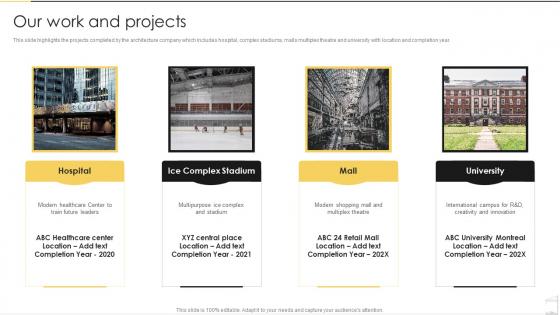
This slide highlights the projects completed by the architecture company which includes hospital, complex stadiums, malls multiplex theatre and university with location and completion year.
People who downloaded this PowerPoint presentation also viewed the following :
Architecture And Construction Services Firm Our Work And Projects with all 6 slides:
Use our Architecture And Construction Services Firm Our Work And Projects to effectively help you save your valuable time. They are readymade to fit into any presentation structure.





FAQs for Architecture And Construction Services Firm Our
Latest trends include green building materials, energy-efficient designs, renewable energy integration, water conservation systems, and circular construction practices. These approaches streamline environmental impact while enhancing operational efficiency, with many construction firms finding that sustainable practices deliver significant cost reductions, improved building performance, and competitive advantage in an increasingly eco-conscious market.
BIM technology enhances project efficiency by enabling 3D visualization, real-time collaboration, and precise resource planning throughout design and construction phases. Through integrated modeling platforms, architecture and construction teams streamline workflows, reduce material waste, and minimize costly errors, with many firms finding that BIM ultimately delivers faster project completion and improved cost control.
Architects ensure compliance by thoroughly researching local building codes, integrating regulatory requirements into design specifications, coordinating with municipal authorities throughout the approval process, and conducting regular reviews during construction phases. Through detailed code analysis and strategic planning, construction firms and developers streamline permitting processes, minimize costly revisions, and deliver projects that meet safety standards, ultimately reducing legal risks while accelerating project timelines.
Architectural styles significantly influence material selection through structural requirements, aesthetic considerations, and historical authenticity demands. Modern minimalist designs favor steel, glass, and concrete for clean lines, while traditional styles like Victorian or Colonial require specific woods, stones, and metals to maintain period accuracy, with many architects finding that material choices ultimately define both visual impact and structural integrity.
Commercial and residential design differ in factors including functionality requirements, traffic patterns, regulatory compliance, spatial efficiency, and operational needs. Commercial spaces prioritize workflow optimization, accessibility standards, and brand representation, while residential projects focus on comfort, privacy, and personal lifestyle preferences, with many architects finding that understanding these distinct priorities ultimately delivers more effective, purpose-driven environments.
Smart building technology revolutionizes construction planning and execution by enabling precise resource allocation, automated project monitoring, and enhanced collaboration through digital twin modeling and IoT sensors. Construction firms increasingly leverage these technologies to streamline workflows, minimize material waste, and accelerate project timelines, ultimately delivering cost-effective buildings with superior energy efficiency and operational performance.
Renovating historical buildings presents both preservation complexities and design innovation opportunities, requiring specialized expertise in heritage materials, structural assessments, regulatory compliance, and modern integration techniques. Through strategic restoration approaches, architecture firms deliver enhanced property values, cultural preservation outcomes, and sustainable adaptive reuse solutions, with many finding that historical projects ultimately provide competitive differentiation and premium positioning.
Project management principles streamline construction phases through clear scope definition, resource allocation, timeline management, risk assessment, and stakeholder communication protocols. These methodologies enable construction teams to minimize delays, control costs, and maintain quality standards, with many architectural firms finding that structured project management approaches ultimately deliver projects on schedule and within budget while enhancing client satisfaction.
Emerging sustainable materials include cross-laminated timber, recycled steel, bamboo composites, hempcrete, and mycelium-based insulation. These materials streamline environmental compliance, reduce carbon footprints, and enhance energy efficiency compared to traditional concrete and steel, with many construction firms finding that sustainable options deliver long-term cost savings, improved building performance, and competitive advantage in an increasingly eco-conscious market.
Collaboration between architects and engineers enhances construction outcomes by integrating design vision with structural feasibility, optimizing material usage, and identifying potential conflicts early in the planning phase. This strategic partnership streamlines project timelines, reduces costly revisions, and ensures seamless coordination between aesthetic goals and technical requirements, ultimately delivering superior buildings with enhanced functionality and reduced construction risks.
Climate change significantly impacts architectural design through extreme weather resilience requirements, sustainable material selection, energy-efficient building systems, and adaptive infrastructure planning. Construction practices are evolving with green building certifications, carbon-neutral materials, and climate-responsive designs, with many architects and developers finding that sustainable approaches ultimately deliver cost savings, regulatory compliance, and enhanced property values in an increasingly environmentally-conscious market.
3D printing revolutionizes construction through automated building processes, reduced material waste, complex geometric capabilities, faster project timelines, and cost-effective customization. Architecture firms and construction companies leverage this technology to create intricate facades, affordable housing components, and rapid prototyping solutions, ultimately delivering enhanced design flexibility and significantly lower labor costs.
Construction site safety strategies include comprehensive training programs, regular safety audits, personal protective equipment enforcement, hazard identification systems, and emergency response protocols. These approaches streamline risk management by establishing clear safety cultures, implementing real-time monitoring technologies, and ensuring regulatory compliance, with many construction companies finding that proactive safety investments ultimately deliver reduced insurance costs, fewer project delays, and enhanced worker productivity.
Architects create flexible spaces through modular design systems, movable partitions, convertible furniture, multi-purpose zones, and adaptable infrastructure that accommodates changing technology and workflow requirements. These design strategies enable buildings to evolve with user needs, ultimately reducing renovation costs and extending building lifecycles, with many commercial and educational facilities finding that adaptable spaces significantly enhance long-term operational efficiency and user satisfaction.
Urbanization demands sustainable construction practices, vertical development strategies, integrated infrastructure planning, and adaptive building technologies to accommodate population density. Growing cities like Mumbai and Lagos increasingly adopt modular construction, green building standards, and smart infrastructure systems, ultimately delivering cost-effective housing solutions and enhanced urban livability while addressing resource constraints.
-
Designs have enough space to add content.
-
The Designed Graphic are very professional and classic.