


Asset Digital Twin Powerpoint Presentation Slides




Try Before you Buy Download Free Sample Product
 Impress Your
 Audience
 100%
100% Editable
 Save Hours
 of Time


Unlock the potential of Digital Twin Technology, a leading industrial software firm that leverages industrial data to tackle the most complex challenges. Our expertly crafted Asset Digital Twin PowerPoint presentation delves into the world of Digital Twin Technology, elucidating its services, implementation methods, and compelling reasons to invest. Explore the symbiotic relationship between Digital Twin Technology and emerging technologies like Augmented Reality AR, Virtual Reality VR, and the Internet of Things IoT, and discover how they revolutionize industries. Delve into the applications of Twin Technology across diverse sectors, including manufacturing, healthcare, supply chain, and retail. Our Digital Twins PPT also provides valuable insights into procurement options, pricing considerations, and comprehensive training programs for mastering digital twin technology. Leverage our 30-60-90 days plan and roadmap to ensure the successful implementation of your digital twin model. Monitor and measure the effectiveness of your digital twin initiatives with our user-friendly dashboard. Take advantage of this powerful template to unlock the potential of Digital Twin Technology and revolutionize your industry. Gain access now and embark on a transformative journey toward breakthrough business outcomes.
People who downloaded this PowerPoint presentation also viewed the following :
Content of this Powerpoint Presentation
Slide 1: This slide introduces Asset Digital Twin. State your company name and begin.
Slide 2: This is an Agenda slide. State your agendas here.
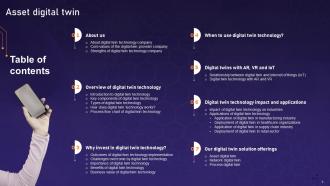
Slide 3: This slide shows Table of Content for the presentation.
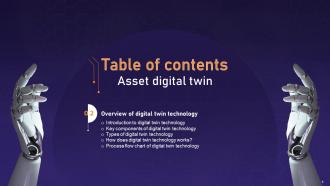
Slide 4: This slide also shows Table of Content for the presentation.
Slide 5: This slide shows title for topics that are to be covered next in the template.
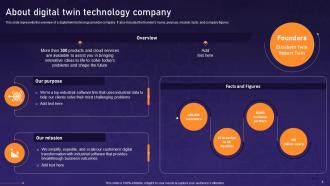
Slide 6: This slide presents the overview of a digital twin technology provider company.
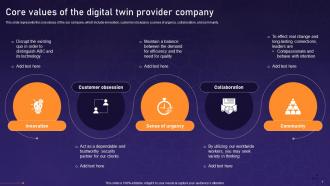
Slide 7: This slide describes the core values of the company.
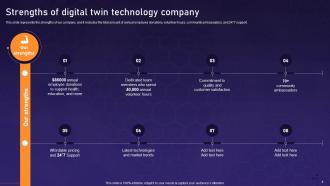
Slide 8: This slide presents the strengths of the company.
Slide 9: This slide shows title for topics that are to be covered next in the template.
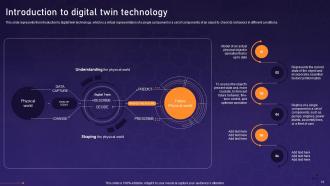
Slide 10: This slide presents the introduction to digital twin technology.
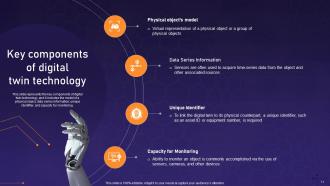
Slide 11: This slide describes the key components of digital twin technology.
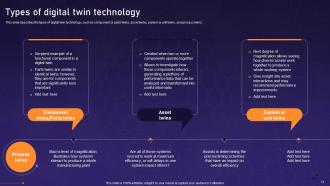
Slide 12: This slide illustrates the types of digital twin technology.
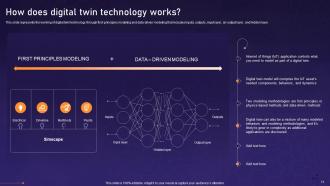
Slide 13: This slide presents the working of digital twin technology through first-principles modeling and data-driven modeling.
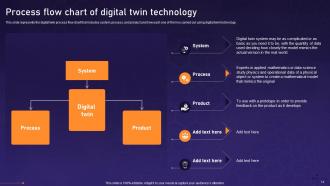
Slide 14: This slide describes the digital twin process flow chart.
Slide 15: This slide shows title for topics that are to be covered next in the template.
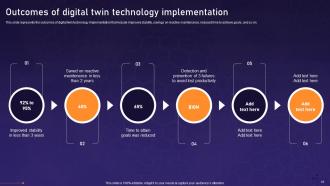
Slide 16: This slide presents the outcomes of digital twin technology implementation.
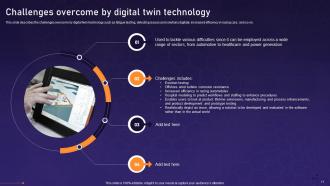
Slide 17: This slide describes the challenges overcome by digital twin technology.
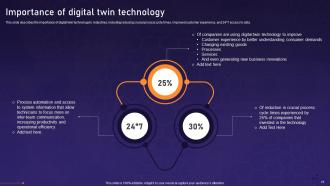
Slide 18: This slide displays the importance of digital twin technology to industries.
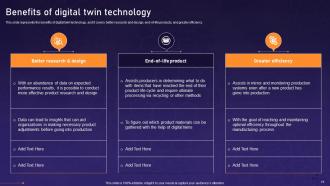
Slide 19: This slide represents the benefits of digital twin technology.
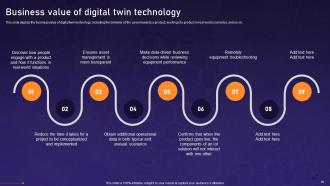
Slide 20: This slide depicts the business value of digital twin technology.
Slide 21: This slide shows title for topics that are to be covered next in the template.
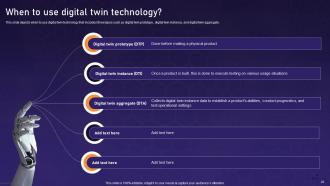
Slide 22: This slide depicts when to use digital twin technology that includes three types.
Slide 23: This slide shows title for topics that are to be covered next in the template.
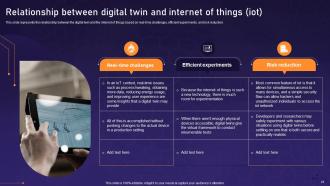
Slide 24: This slide represents the relationship between the digital twin and the internet of things based on real-time challenges.
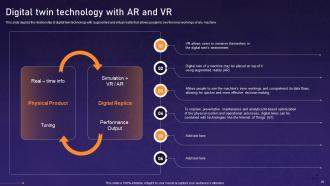
Slide 25: This slide depicts the relationship of digital twin technology with augmented and virtual reality.
Slide 26: This slide shows title for topics that are to be covered next in the template.
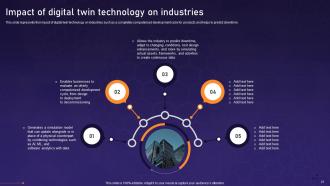
Slide 27: This slide represents the impact of digital twin technology on industries.
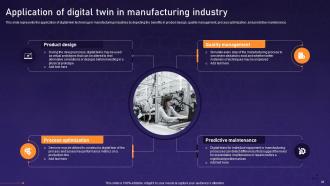
Slide 28: This slide presents application of digital twin technology in manufacturing industries.
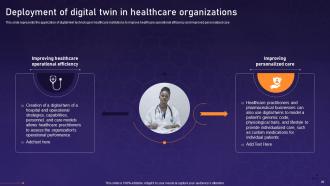
Slide 29: This slide showcases the application of digital twin technology in healthcare institutions.
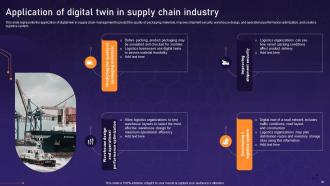
Slide 30: This slide represents the application of digital twin in supply chain management.
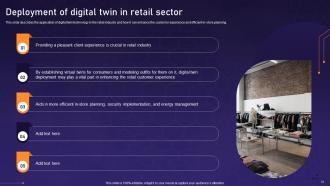
Slide 31: This slide describes the application of digital twin technology in the retail industry.
Slide 32: This slide shows title for topics that are to be covered next in the template.
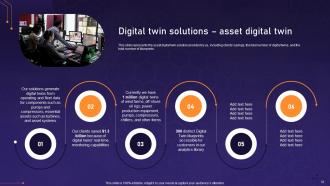
Slide 33: This slide represents the asset digital twin solution provided by company.
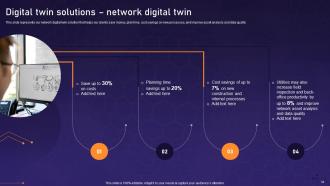
Slide 34: This slide describes company's network digital twin solution.
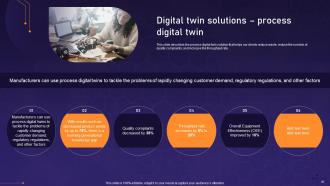
Slide 35: This slide illustrates the process of digital twin solution that helps clients.
Slide 36: This slide shows title for topics that are to be covered next in the template.
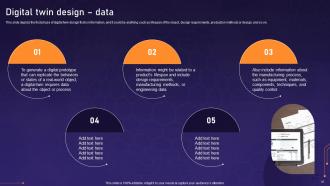
Slide 37: This slide depicts the first phase of digital twin design that is information.
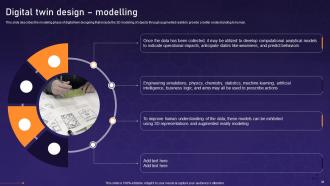
Slide 38: This slide describe the modeling phase of digital twin designing that include the 3D modeling of objects through augmented reality.
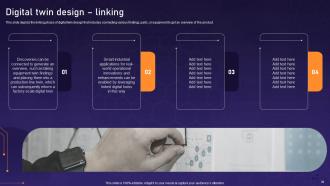
Slide 39: This slide depicts the linking phase of digital twin design that includes connecting various findings.
Slide 40: This slide shows title for topics that are to be covered next in the template.
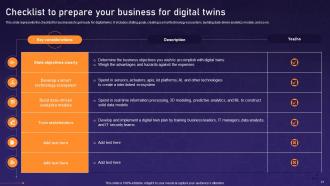
Slide 41: This slide presents the checklist for businesses to get ready for digital twins.
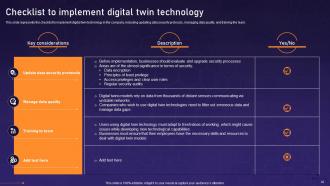
Slide 42: This slide represents the checklist to implement digital twin technology in the company.
Slide 43: This slide shows title for topics that are to be covered next in the template.
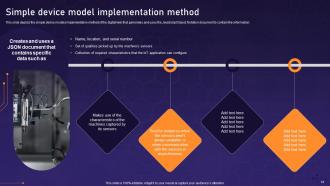
Slide 44: This slide depicts the simple device models implementation method of the digital twin.
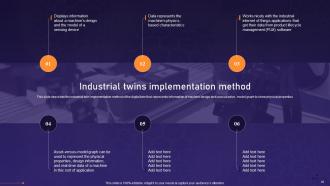
Slide 45: This slide describes the industrial twin implementation method of the digital twin.
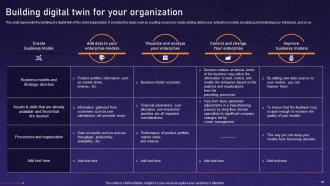
Slide 46: This slide presents the building of a digital twin of the client organization.
Slide 47: This slide shows title for topics that are to be covered next in the template.
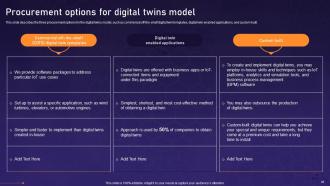
Slide 48: This slide describes the three procurement options for the digital twins model.
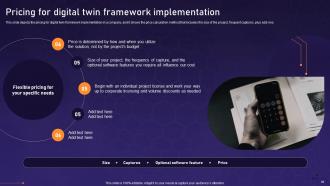
Slide 49: This slide depicts the pricing for digital twin framework implementation in a company.
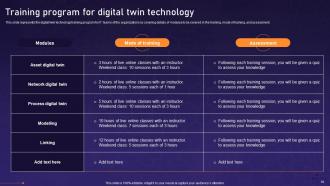
Slide 50: This slide presents the digital twin technology training program for IT teams of the organizations.
Slide 51: This slide shows title for topics that are to be covered next in the template.
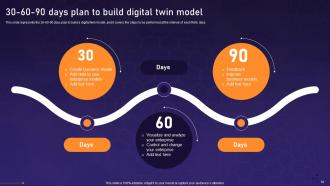
Slide 52: This slide represents the 30-60-90 days plan to build a digital twin model.
Slide 53: This slide shows title for topics that are to be covered next in the template.
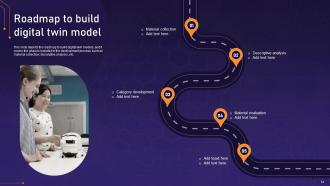
Slide 54: This slide depicts the roadmap to build digital twin models, and it covers the phases included in the development process.
Slide 55: This slide shows title for topics that are to be covered next in the template.
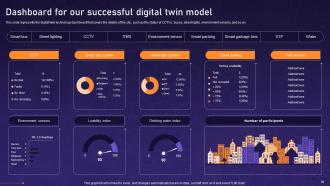
Slide 56: This slide presents the digital twin technology dashboard that covers the details of the city.
Slide 57: This slide shows all the icons included in the presentation.
Slide 58: This slide is titled as Additional Slides for moving forward.
Slide 59: This is About Us slide to show company specifications etc.
Slide 60: This is Our Vision, Mission & Goal slide.
Slide 61: This is a Timeline slide. Show data related to time intervals here.
Slide 62: This slide depicts Venn diagram with text boxes.
Slide 63: This slide shows Post It Notes for reminders and deadlines. Post your important notes here.
Slide 64: This is Our Goal slide. State your firm's goals here.
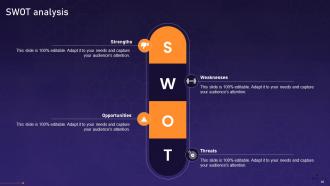
Slide 65: This slide shows SWOT analysis describing- Strength, Weakness, Opportunity, and Threat.
Slide 66: This is a Thank You slide with address, contact numbers and email address.
Asset Digital Twin Powerpoint Presentation Slides with all 71 slides:
Use our Asset Digital Twin Powerpoint Presentation Slides to effectively help you save your valuable time. They are readymade to fit into any presentation structure.








FAQs for Asset Digital Twin
So a digital twin is like having a live copy of your equipment that gets fed real-time data from sensors. Way different from the old spreadsheet approach where you'd just schedule inspections and hope for the best. You can actually see what's happening right now and spot problems before stuff breaks down. Pretty neat, honestly – beats scrambling around when everything goes wrong at once. The whole point is predicting failures instead of just reacting to them. I'd start small though. Pick your most important equipment and see what data you're already getting from it.
So basically, you're creating virtual copies of your equipment that watch everything in real-time - temperature, vibration, all that stuff. Pretty wild how they can spot patterns and predict failures before anything actually breaks. I'd honestly start with just your most expensive machines first, don't try to do everything at once. The whole point is switching from "oh crap it's broken" to actually planning maintenance when the data says you need to. ROI usually shows up pretty quick once you get rolling with it.
Think of IoT sensors as the eyes and ears for your digital twin. They grab real-time data - temperature, vibration, pressure, you name it - and pump it into your digital model. Otherwise you're stuck with just a fancy 3D rendering that doesn't tell you squat about what's actually happening. The streaming data keeps everything synced up, which is honestly where the magic happens. My advice? Figure out what metrics actually matter for your operations first. Then you can work backwards to pick the right sensors. Way easier than trying to collect everything and hoping something useful comes out of it.
So you'll basically connect everything through APIs and middleware platforms - stuff like your ERP, SCADA, maintenance tools, whatever you're already using. Data mapping between systems is honestly such a pain at first, but you get the hang of it. Most places I've seen just pick one critical asset to start with instead of going crazy trying to do everything at once. Your IT folks need solid data governance and security stuff sorted before jumping in though. Oh, and definitely run a pilot first to work out all the weird technical issues that always pop up.
Honestly, predictive maintenance is where you'll see the biggest impact - catching equipment problems before they wreck your whole operation. Manufacturing guys love digital twins because they can test changes virtually without messing with the actual production line. Pretty clever, right? Energy companies use them for turbine optimization and predicting failures at remote sites where sending repair crews costs a fortune. Plus you get continuous performance tracking for better asset management. My advice? Start with whatever piece of equipment would hurt most if it died unexpectedly - that's your best shot at proving ROI.
Honestly, digital twins are pretty cool for this stuff. Start with your biggest energy hogs or equipment that breaks down constantly - you'll see results faster. They show you what's actually happening with your assets in real-time, so you catch problems early instead of dealing with expensive failures later. The predictive maintenance alone saves tons of waste. You can run scenarios digitally too, which beats learning from costly mistakes. Plus the data helps you figure out if something's worth fixing or if you should just replace it. Way better than guessing.
Look, data integration is gonna be your worst enemy - plus getting decent real-time sensor feeds is harder than it sounds. Most places don't realize how much of a mess their current systems actually are. Oh, and people will push back thinking you're just burning money on shiny gadgets. Start with just one critical piece of equipment instead of trying to do everything at once. Quick wins with predictive maintenance that actually save cash will shut up the doubters. Get someone upstairs in your corner and assign a real champion to the project. But seriously - fix your data mess first or you'll just build problems on top of problems.
Digital twins basically give you x-ray vision into what's actually happening with your equipment right now. No more guessing games. You can run "what if" scenarios before spending money, catch failures before they wreck your day, and time replacements based on real data instead of some generic manual. Way better than the old "wait until it breaks" approach, honestly. The predictive stuff is pretty cool too - helps you plan ahead instead of scrambling. I'd start with your most critical equipment first. You'll notice the difference in your maintenance calls pretty quickly.
Honestly, data viz is what makes your Asset Digital Twin actually usable instead of just another spreadsheet nightmare. You'll get real-time dashboards and 3D models that show what's happening instantly. Way better than scrolling through endless sensor data rows. It's like seeing your car's dashboard while driving vs just reading the manual later – makes sense immediately. Patterns and weird stuff jump out at you. I'd start with whatever metrics your team cares about most and build dashboards around those. Heat maps are pretty cool too.
Honestly, start with encrypting everything - data sitting around and data moving between systems. IoT sensors are usually where hackers get in first, so those need extra attention. Set up role-based access controls so people only see what they actually need. I'd isolate the whole digital twin network if I were you. The audit trail thing is annoying but super important - you'll be shocked how quickly permissions get out of hand when your team grows. Map out where all your data flows first, then tackle your most valuable assets. Network monitoring should be running 24/7 too.
So basically, Asset Digital Twins are like having a flight simulator for your equipment. You can mess around with "what if" scenarios without breaking anything real. Test how your stuff handles crazy weather, equipment failures, different loads - whatever. The twin pulls from actual data and physics models, so the predictions are legit. Honestly, it's pretty neat being able to spot problems before they wreck your day. You'll find weak spots, figure out better maintenance timing, all that good stuff. I'd start with your worst-case failure scenarios first - those are usually the ones that'll bite you anyway.
Honestly, your digital twin is basically worthless if you're feeding it bad data. Garbage sensor readings or outdated maintenance records? You'll get misleading predictions about when stuff might break down. I've seen this mess up entire maintenance schedules - false alarms everywhere, missed repair windows, the whole nine yards. Real-time data streams are non-negotiable here. You need those validation processes running regularly too, otherwise nobody's gonna trust the system when it actually matters for making decisions.
Track your hard savings first - maintenance costs, downtime incidents, asset lifecycles. Energy efficiency usually gives the biggest surprises honestly. Don't forget the softer stuff like faster decisions and safety improvements either. Most places I've seen hit 15-25% maintenance savings in year one, which isn't bad. Baseline everything before you start, then check monthly progress. Oh and definitely begin with your most critical assets - quick wins help sell everyone on the whole thing. The ROI tracking gets way easier once you have that initial data.
Manufacturing and aerospace companies are crushing it with digital twins right now - the ROI on predictive maintenance is insane. Oil & gas is huge too because when you're losing millions per hour on downtime, you'll throw money at anything that actually works. Automotive uses them for production lines and vehicle development. Energy companies are all over wind turbines and power grids with this stuff. Oh, and if you want real examples - GE and Siemens publish a ton about their implementations. They're surprisingly transparent about what's working for them.
So AI and ML are basically making those digital twins actually useful instead of just cool-looking models. Now you get real-time alerts when something's off, plus the system learns from your sensor data to predict failures before they happen. Pretty crazy how good the predictions are getting these days. Your maintenance switches from "fix it when it breaks" to catching problems early - saves tons of money. The algorithms keep getting smarter by analyzing performance patterns. I'd start with whatever assets would hurt most if they went down and look into AI platforms for those first.
-
Informative presentations that are easily editable.
-
You can rely on SlideTeam whenever you run out of designs for your presentation. Thank you so much SlideTeam!