

Asset lifecycle management process powerpoint presentation slides





Try Before you Buy Download Free Sample Product
 Impress Your
Audience
 100%
Editable
 Save Hours
of Time


Optimize the profits generated by your firm’s assets throughout their lifecycle with our Asset Lifecycle Management Process PowerPoint Presentation Slides. The predictive analysis PPT presentation provides multiple objectives of the asset management process like predictive analysis, low-cost procurement, and visual asset management; improving OEE and asset optimization. Using the optimizing lifecycle PPT display the tabular presentation of the company assets to be optimized along with location, cost of procurement, and annual maintenance cost. With this categorisation PowerPoint slideshow, you can calculate the replacement cost and use our lifecycle management process including steps like a requirement, procurement, maintenance, and deployment. Use the nine-step process for maintaining assets and mention the key performance indicators in our PowerPoint templates. The equipment lifecycle PPT presentation also includes multiple steps like retirement and proposal process and current disposal plan, gap analysis to calculate challenges, procurement process, and new equipment maintenance software to achieve the end goal. In the end, use the asset life PPT layout to measure the long-term performance of your company’s assets.
People who downloaded this PowerPoint presentation also viewed the following :
Content of this Powerpoint Presentation
Slide 1: This title slide introduces the Asset Lifecycle Management Process. Add the name of your company here.
Slide 2: This slide contains the Table of Content. It includes: Objectives of Asset lifecycle Management, Asset Categorization, Our Asset lifecycle Management Process, Gap Analysis, Optimizing Asset Lifecycle, End Goal to be Achieved through Asset Lifecycle Management, and Measuring Asset Performance.
Slide 3: This is a table of content slide showing the Objectives of Asset lifecycle Management.
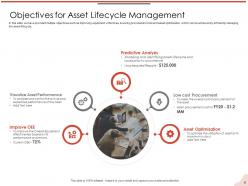
Slide 4: This slide presents the Objectives of Asset lifecycle Management. This includes: Improve OEE, Visualize Asset Performance, Predictive Analysis, Low-cost Procurement, and Asset Optimization.
Slide 5: This is a table of content slide showing Asset Categorization. This includes: Our Major Assets that Need to be Optimized and How Much Will it Cost to Replace the Asset?
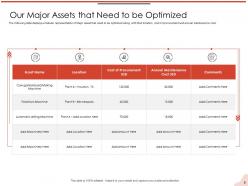
Slide 6: This slide presents Our Major Assets that Need to be Optimized. It displays a tabular representation of Major assets that need to be optimized along with their location, cost of procurement, and annual maintenance cost.
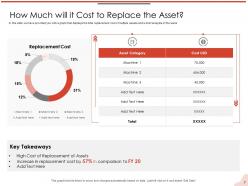
Slide 7: This slide presents How Much Will it Cost to Replace the Asset? It provides you with a graph that displays the total replacement cost of multiple assets and brief analysis of the same
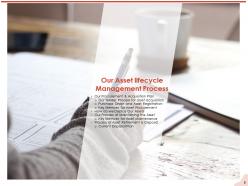
Slide 8: This is a table of content slide showing Our Asset lifecycle Management Process. This includes: Our Procurement & Acquisition Plan, How do we Deploy Our Assets, Our Process of Maintaining the Asset, and Process of Asset Retirement & Disposal.
Slide 9: This slide presents Our Asset Lifecycle Management Process. It provides you with the complete process of an organization's asset lifecycle, starting from asset procurement, its deployment, the maintenance of assets, and its retirement plan.
Slide 10: This slide presents Our Procurement & Acquisition Plan. It shows the process of how the organization plans and procures its assets beginning from asset procurement planning to its registration.
Slide 11: This slide presents Our Tender Process for Asset Acquisition. It analyzes and explains multiple phases of the company's tender process. From initial tender offering to final selection the slide describes each stage and analyses the time consumed.
Slide 12: This slide presents the Purchase Order and Asset Registration. It analyzes and explains multiple phases of the company's tender process. From initial tender offering to final selection the slide describes each stage and analyses the time consumed.
Slide 13: This slide presents the Key Metrics for Asset Procurement. It shows various KPIs like procurement cost, administrative cost, purchase order lifecycle, and lead time for measuring the effectiveness of your procurement process for the years 2019 and 2020.
Slide 14: This slide presents How do we Deploy our Assets. It shows the organization process of asset deployment and highlights major steps involved in it along with a Map that displays the location in which assets are deployed.
Slide 15: This slide presents Our Process for Maintaining the Asset. It provides you with multiple steps that the organization takes to Maintain their respective asset beginning with Preventive maintenance planning and ending at Asset Health check.
Slide 16: This slide presents the Key Metrics for Asset Maintenance. It shows the various KPIs like downtime, inventory maintenance budget, response time, and maintenance cost for measuring the effectiveness of the companies maintenance and support program of assets for the years 2019 and 2020
Slide 17: This slide presents the Process for Asset Retirement & Disposal. It shows the Multiple steps of asset retirement plan starting from planning, decommissioning, reinspection, and disposal are provided in the following slide.
Slide 18: This slide presents the Current Disposal Plan. It provides the disposal plan for the multiple assets, the provided table highlights the reason for asset disposal along with its procurement and sales cost.
Slide 19: This is a table of content slide showing the Gap Analysis which includes Challenges in asset Management.
Slide 20: This slide presents the Challenges in Asset Lifecycle Management. It highlights Multiple Challenges that the organization came across while managing the lifecycle of its assets
Slide 21: This is a table of content slide showing the Optimizing Asset Lifecycle. This includes: Optimizing Our Procurement Process, Our New Equipment Maintenance Plan, Asset Life Cycle Management Software, and Advantages of Asset Management Software.
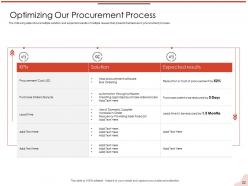
Slide 22: This slide presents Optimizing Our Procurement Process. It shows multiple solutions and expected results of multiple issues that present themselves in the procurement process.
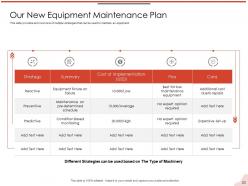
Slide 23: This slide presents Our New Equipment Maintenance Plan. It provides an overview of multiple strategies that can be used to maintain equipment.
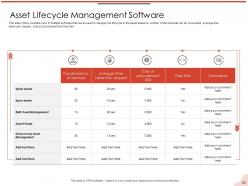
Slide 24: This slide presents the Asset Lifecycle Management Software. It offers a complete view of multiple software that can be used to manage the lifecycle of the asset based on the number of devices that can be connected, the average time is taken per request, cost of procurement, and free trial.
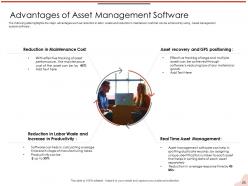
Slide 25: This slide presents the Advantages of Asset Management Software. It highlights the major advantages such as reduction in labor waste and reduction in maintained cost that can be achieved by using Asset management system software.
Slide 26: This is a table of content slide showing the End Goal to be Achieved through Asset Lifecycle Management.
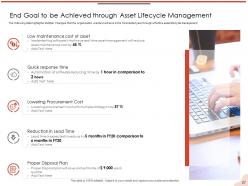
Slide 27: This slide presents the End Goal to be Achieved through Asset Lifecycle Management. It highlights Multiple Changes that the organization wants to achieve in the forecasted year through effective asset lifecycle management.
Slide 28: This is a table of content slide showing the Measuring Asset Performance.
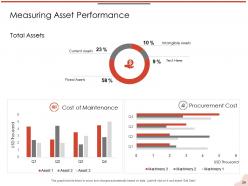
Slide 29: This slide presents the Measuring Asset Performance. It shows concepts like the cost of maintenance, procurement cost, and total assets.
Slide 30: This slide contains the Asset Lifecycle Management Process Icons for you to choose from.
Slide 31: This slide introduces the Additional Slides.
Slide 32: This is a table of content slide showing Managing Change in Asset Lifecycle Management
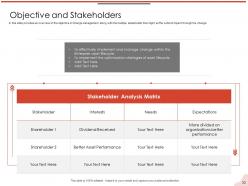
Slide 33: This slide presents the Objectives and Stakeholders. It provides an overview of the objective of change management along with the multiple stakeholders that might suffer a direct impact through the change.
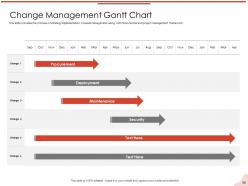
Slide 34: This slide presents the Change Management Gantt Chart. It provides the process of strategy implementation of asset management along with financial risk and project management framework.
Slide 35: This slide presents the Key Initiatives for Operational Excellence. It shows the key initiatives that an organization takes to achieve operational excellence.
Slide 36: This slide presents the How do We Plan our Finances? It shows the financial planning required for managing the operational plan in an efficient way.
Slide 37: This slide presents the Planning our Human Resource. It shows the Capacity planning required for managing the operational activity in the Asset lifecycle.
Slide 38: This slide shows a Column - Chart that compares 2 products’ data over a timeline of financial quarters for one year.
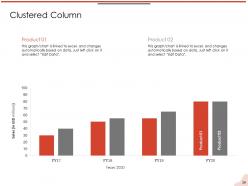
Slide 39: Clustered Column This slide shows a bar graph that compares 2 products’ sales over a timeline of financial years.
Slide 40: This slide presents a Circular Diagram to showcase the elements of a concept or project.
Slide 41: This slide presents a MAGNIFYING GLASS to give more details about the individual steps in a project.
Slide 42: This slide presents Idea Generation to heklp in brainstorming sessions.
Slide 43: This slide provides a Venn diagram that can be used to show interconnectedness and overlap between various departments, projects, etc.
Slide 44: This slide is a Timeline template to showcase the progress of the steps of a project with time.
Slide 45: This slide contains Important Notes that can be used to express any brief thoughts or ideas.
Slide 46: This is a Thank You slide where details such as the address, contact number, email address are added.
Asset lifecycle management process powerpoint presentation slides with all 46 slides:
Use our Asset Lifecycle Management Process Powerpoint Presentation Slides to effectively help you save your valuable time. They are readymade to fit into any presentation structure.
-
Asset Lifecycle Management Process
-
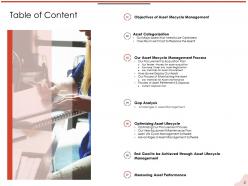
Table of Content
-
Objectives of Asset Lifecycle Management
-
Objectives for Asset Lifecycle Management
-
Asset Categorization
-
Our Major Assets that Need to be Optimized
-
How Much will it Cost to Replace the Asset
-
Our Asset Lifecycle Management Process
-
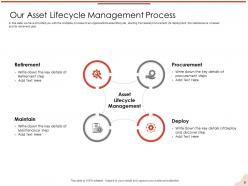
Our Asset Lifecycle Management Process
-
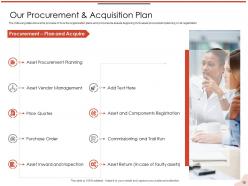
Our Procurement Acquisition Plan
-
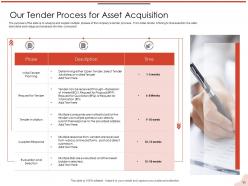
Our Tender Process for Asset Acquisition
-
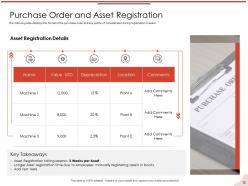
Purchase Order and Asset Registration
-
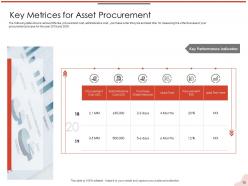
Key Metrics for Asset Procurement
-
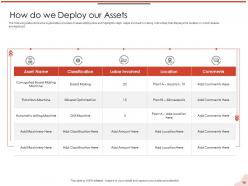
How do we Deploy our Assets
-
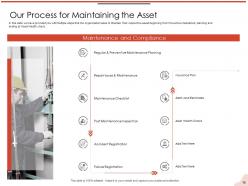
Our Process for Maintaining the Asset
-
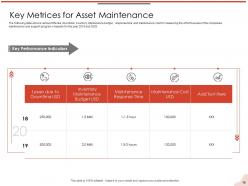
Key Metrics for Asset Maintenance
-
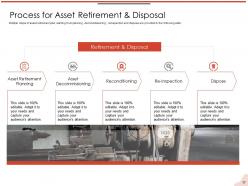
Process for Asset Retirement Disposal
-
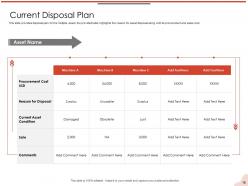
Current Disposal Plan
-

Gap Analysis Challenges in asset Management
-
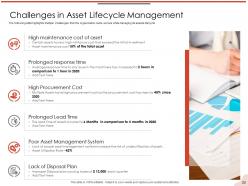
Challenges in Asset Lifecycle Management
-
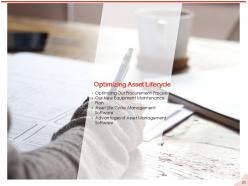
Optimizing Asset Lifecycle
-
Optimizing Our Procurement Process
-
Our New Equipment Maintenance Plan
-
Asset Lifecycle Management Software
-
Advantages of Asset Management Software
-
End Goal to be Achieved through Asset Lifecycle Management
-
End Goal to be Achieved through Asset Lifecycle Management
-
Measuring Asset Performance
-
Measuring Asset Performance
-
Asset Lifecycle Management Process Icons Slide
-

Additional Slides
-
Managing Change in Asset Lifecycle Management
-
Objective and Stakeholders
-
Change Management Gantt Chart
-
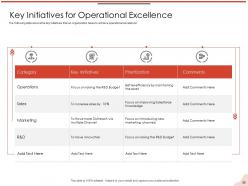
Key Initiatives for Operational Excellence
-
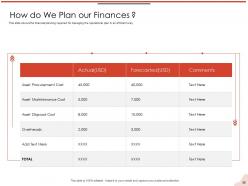
How do We Plan our Finances
-
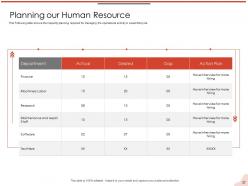
Planning our Human Resource
-
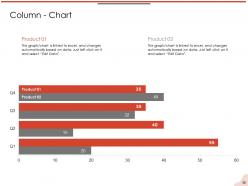
Column Chart
-
Clustered Column
-
Circular Diagram
-
Magnifying Glass
-
Idea Generation
-
Venn
-
Timeline
-
Important Notes
-
Thank You for Watching
FAQs for Asset lifecycle management process
So basically there's five main stages - planning, getting the stuff, setting it up, running/maintaining it, then getting rid of it when it's done. Planning is figuring out what you actually need. Then you buy it, deploy it, and maintain it during operations (which honestly is like 80% of the whole lifecycle). That's where you're getting your money's worth. Eventually things get too expensive to keep fixing or just become obsolete, so you retire them. The trick is tracking costs and performance the whole time so you know when to pull the plug. I'd start by figuring out where your current stuff sits in this cycle.
Start with RFID tags or IoT sensors to track when stuff's actually being used vs just sitting there collecting dust. Most companies get a reality check when they see their real utilization numbers - it's usually way lower than they think. Build dashboards showing trends over weeks/months, not just daily snapshots. Track both how long equipment runs AND how well it performs, since something running 24/7 but badly isn't really helping you. Focus on your priciest assets first to get baseline data. Once you see the payback, you can roll it out everywhere else.
So basically, modern asset management runs on tech now. IoT sensors give you real-time updates on everything, plus predictive analytics warn you before equipment craps out - which honestly feels like magic sometimes. Mobile apps keep your field crews in the loop, and digital twins let you test scenarios without blowing your budget. The whole point is shifting from "wait till it breaks" to actually preventing failures. Oh, and automated workflows handle all the boring scheduling stuff so you don't have to. Trust me, it saves serious money long-term.
Honestly, good asset management is a total game changer for your budget. Track your critical stuff first - when you know what you actually own, you make way better buying decisions. Proper maintenance schedules will save your ass from those 3am emergency repair calls (been there, it sucks). You can actually predict when things need replacing instead of playing equipment roulette. Downtime kills productivity, so preventing breakdowns keeps everyone happy. Oh, and you'll get better resale value when you finally dump old equipment. Start documenting maintenance on your most expensive assets. The data shows you exactly where money's disappearing.
Oh man, data silos are gonna be your worst nightmare. Maintenance uses spreadsheets while finance has their own system - total chaos honestly. Manual processes slow everything to a crawl. Real-time asset status? Good luck with that when half your data's outdated or just wrong. Nobody knows who actually owns what assets either, which drives me crazy. Integration between systems is basically nonexistent at most places. Start by figuring out where info gets lost in your current mess of processes. That's step one before you fix anything else.
Track these four things: total cost of ownership (are you actually saving money long-term?), asset utilization rates, maintenance costs as percentage of asset value, and uptime percentages. Honestly, utilization rates always shock people - equipment just sits there way more than you'd think. The goal is seeing these improve year-over-year while your operational costs don't go up. Sometimes they even drop, which is awesome. Get your baselines set this quarter so you'll have something to compare against later.
So ALM and sustainability actually work really well together - you're already tracking everything about your assets anyway. Monitor how they perform over their whole lifecycle and you'll spot ways to cut energy use and make equipment last longer. Honestly, the data you collect makes those dreaded sustainability reports so much easier to put together. I'd start with whatever assets are your biggest resource hogs first. Smart replacement planning helps too. The whole point is using that ALM data to reduce environmental impact without screwing up your operations. Makes sense, right?
So basically, IoT sensors let you see what's actually happening with your equipment in real-time - temperature, vibration, all that stuff. No more guessing when things might break or doing maintenance "just because." You'll get alerts before failures happen, which honestly saves so much headache and money. My buddy's company started with just their most expensive machines and saw results pretty quick. The cool part is you can base maintenance on actual wear instead of arbitrary schedules. Makes deciding whether to fix or replace way easier too. I'd say start small though - don't go crazy trying to monitor everything at once.
Skip the calendar-based stuff and track maintenance based on actual usage instead. Sensors and regular inspections are your best bet - predictive monitoring seriously changed everything for us once we figured it out. Train your team properly and document procedures for each type of equipment. Record everything because you'll start seeing patterns that help you nail the timing and spot problems before they blow up. Oh, and don't try to do everything at once. Start with your most critical assets then work your way through the rest of your equipment.
Compliance controls your entire asset lifecycle - acquisition through disposal. Healthcare and finance get hit hardest with stuff like FDA validation or SOX requirements. Spreadsheets won't cut it anymore (learned that the hard way). Your system has to automatically track everything: usage data, maintenance schedules, inspection dates. Audit trails become crucial when regulators show up. Build this tracking into your processes right from the start. Trust me, scrambling during an audit is the worst. Some industries are pickier than others, but detailed records keep everyone happy.
So basically, you can predict when your equipment's gonna break before it actually does - pretty neat trick. Historical data and sensor readings help you spot patterns and figure out optimal maintenance timing. No more emergency repairs at 2am! Start with your most critical stuff and get some condition monitoring sensors on there. The data feeds into predictive models that'll show you performance trends before they tank your budget. It's like having a heads up on everything instead of playing whack-a-mole with broken assets. Honestly beats the hell out of reactive maintenance.
Honestly, your team's knowledge makes or breaks your equipment. When people actually know what they're doing, stuff breaks less and lasts way longer. Pretty obvious when you think about it. Engaged workers will spot problems early instead of pretending everything's fine until something explodes. They'll stick to maintenance schedules too. ROI goes through the roof when you're not constantly replacing things or dealing with emergency repairs. Figure out where your team's weakest first - maybe it's troubleshooting, maybe basic operation. Then build some real hands-on training that shows how daily tasks connect to keeping assets healthy long-term.
Start auditing your stuff way early - like 6-12 months out. Figure out what you can actually sell, donate for tax writeoffs, or needs special disposal. Electronics are a pain so definitely use certified e-waste vendors (learned this the hard way). Check if anything can get refurbished or moved to other departments first. Planning ahead beats scrambling when everything's about to expire. Oh, and make a simple decision tree so your team isn't constantly asking what to do with random equipment. It's basically about getting max value while avoiding compliance nightmares.
So it really comes down to what each industry cares about most. Manufacturing obsesses over avoiding downtime and keeping production running smoothly. Healthcare? Completely different world - they're dealing with FDA rules and patient safety stuff that's super strict. Energy companies put safety and environmental regulations first, while IT folks are more worried about software updates and security patches. Oh, and end-of-life planning too. The basic ideas don't change much between industries, but your priorities and what regulations you're stuck with will totally shape how you actually do ALM. I'd start by figuring out what rules and operational stuff matter most in your space.
Honestly, predictive maintenance using AI is where I'd start - you'll see results fast there. IoT sensors are everywhere now for real-time monitoring, which is pretty cool. Digital twins basically create virtual copies of your actual equipment so you can test stuff without breaking anything. Cloud platforms have replaced those awful on-premise systems (thank god). Everyone's obsessing over sustainability tracking since companies need to report carbon footprints and all that. The best part? People are finally using data analytics to understand what's actually happening instead of just hoarding random data. Start with predictive maintenance though - that's your quickest win.
-
Best Representation of topics, really appreciable.
-
Really like the color and design of the presentation.
-
Innovative and Colorful designs.
-
Use of icon with content is very relateable, informative and appealing.
-
Excellent template with unique design.
-
Unique research projects to present in meeting.
-
Use of different colors is good. It's simple and attractive.