

Agile product lifecycle management system powerpoint presentation slides





Try Before you Buy Download Free Sample Product
 Impress Your
Audience
 100%
Editable
 Save Hours
of Time


Agile product lifecycle management incorporates all product aspects from conception to disposal throughout the process. The primary purpose of this deck is to optimize the product lifecycle process. Here is an efficiently designed template on Agile Product Lifecycle Management System that showcases the challenges faced by product leaders and compares product metrics with key competitors. It also covers the estimated market share of product lifecycle management and talks about innovative technologies. This deck provides information about the ways to manage the product lifecycle process. It includes steps, product management roles, and essential strategies for assessing agile lifecycle management software comparative assessment. The deck presents a strategic timeline to reduce cost, capabilities required for the software development lifecycle process, etc. It provides a glimpse of metrics to measure product success and management priorities. It also shows the costs involved in managing agile product lifecycle stages and the impact of initiatives on overall product performance. At last, this deck incorporates a dashboard and metrics that depict KPIs to measure agile product performance. Get access to this insightful template now.
People who downloaded this PowerPoint presentation also viewed the following :
Content of this Powerpoint Presentation
Slide 1: This slide displays title i.e. 'Agile Product Lifecycle Management System' and your Company Name.
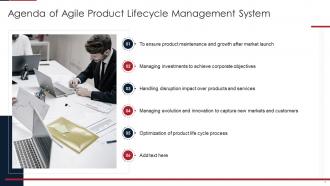
Slide 2: This slide presents agenda.
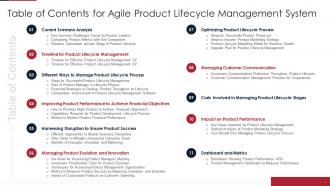
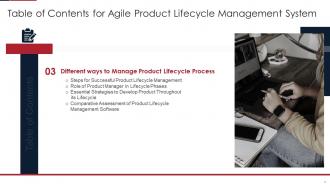
Slide 3: This slide exhibits table of contents.
Slide 4: This slide depicts title for three topics that are to be covered next in the template.
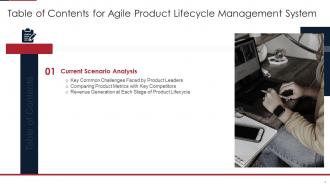
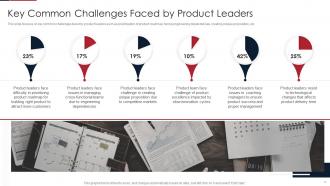
Slide 5: This slide focuses on key common challenges faced by product leaders such as prioritization of product roadmap, etc.
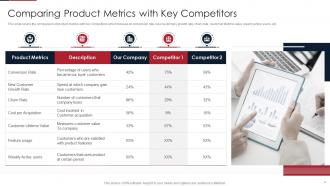
Slide 6: This slide covers the comparison of product metrics with key competitors which focuses on conversion rate, new customers growth rate, etc.
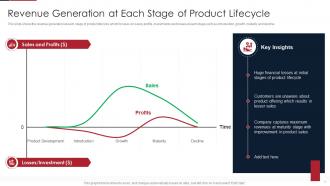
Slide 7: This slide shows the revenue generation at each stage of product lifecycle which focuses on sales, profits, etc.
Slide 8: This slide depicts title for two topics that are to be covered next in the template.
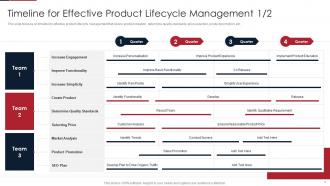
Slide 9: This slide focuses on timeline for effective product lifecycle management that covers product creation, determine quality standards, etc.
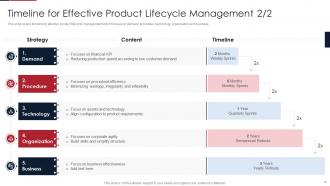
Slide 10: This slide covers timeline for effective product lifecycle management which focuses on demand, procedure, technology, organization and business.
Slide 11: This slide depicts title for four topics that are to be covered next in the template.
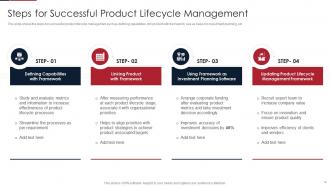
Slide 12: This slide shows the steps for successful product lifecycle management such as defining capabilities, link product with framework, etc.
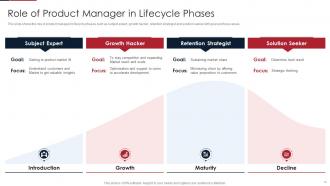
Slide 13: This slide shows the role of product manager in lifecycle phases such as subject expert, growth hacker, etc.
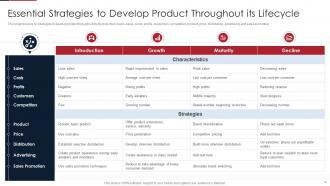
Slide 14: This slide focuses on strategies to develop product throughout its lifecycle that covers sales, costs, profits, customers, competitors, etc.
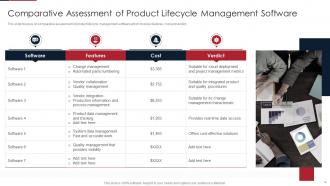
Slide 15: This slide focuses on comparative assessment of product lifecycle management software which involves features, cost and verdict.
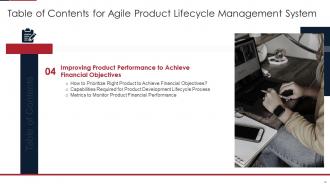
Slide 16: This slide depicts title for three topics that are to be covered next in the template.
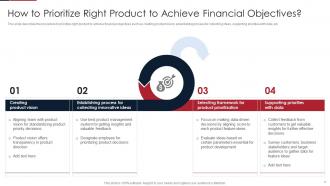
Slide 17: This slide describes the procedure to prioritize right product to achieve financial objectives such as creating product vision, etc.
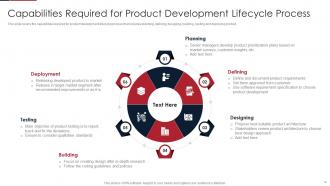
Slide 18: This slide covers the capabilities required for product development lifecycle process that includes planning, defining, designing, etc.
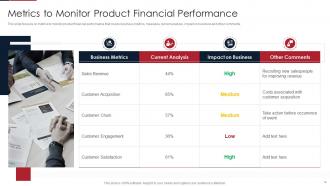
Slide 19: This slide focuses on metrics to monitor product financial performance that covers business metrics, measures, current analysis, etc.
Slide 20: This slide depicts title for three topics that are to be covered next in the template.
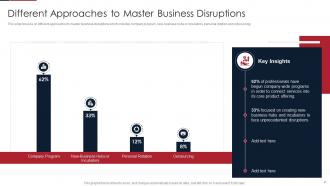
Slide 21: This slide focuses on different approaches to master business disruptions which includes company program, new-business hubs or incubators, etc.
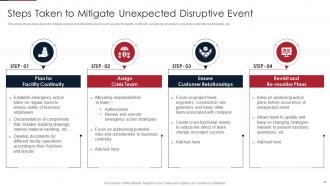
Slide 22: This slide shows steps taken to mitigate unexpected disruptive event such as plan for facility continuity, assigning crisis team, etc.
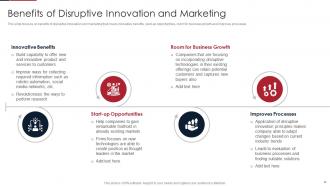
Slide 23: This slide focuses on benefits of disruptive innovation and marketing that covers innovative benefits, start-up opportunities, etc.
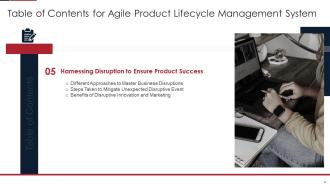
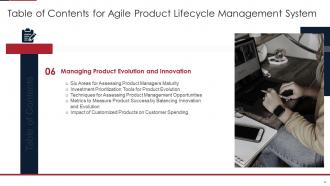
Slide 24: This slide depicts title for five topics that are to be covered next in the template.
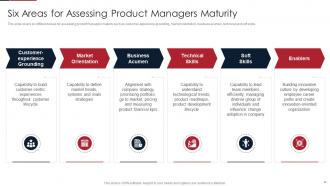
Slide 25: This slide covers six different areas for assessing product managers maturity such as customer-experience grounding, market orientation, etc.
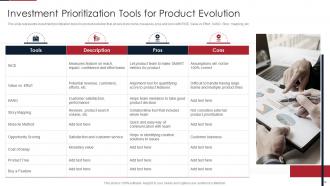
Slide 26: This slide represents investment prioritization tools for product evolution that shows tools name, measures, pros and cons with RICE, etc.
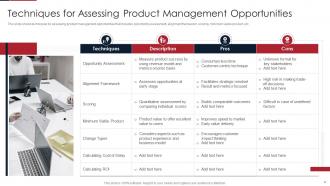
Slide 27: This slide shows techniques for assessing product management opportunities that includes opportunity assessment, alignment framework, etc.
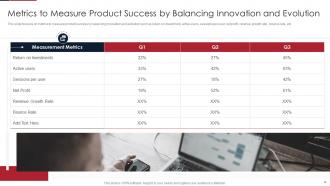
Slide 28: This slide focuses on metrics to measure product success by balancing innovation and evolution such as return on investment, active users, etc.
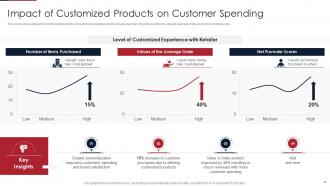
Slide 29: This slide shows impact of customized products on customer spending which includes number of purchased items, etc.
Slide 30: This slide depicts title for four topics that are to be covered next in the template.
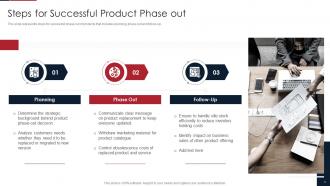
Slide 31: This slide represents steps for successful phase out of products that includes planning, phase out and follow-up.
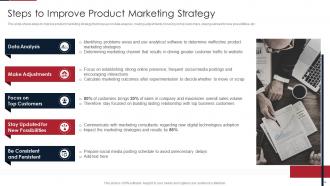
Slide 32: This slide shows steps to improve product marketing strategy that focuses on data analysis, making adjustments, focusing on top customers, etc.
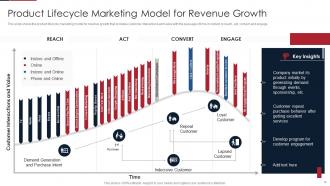
Slide 33: This slide shows the product lifecycle marketing model for revenue growth that includes customer interactions and value.
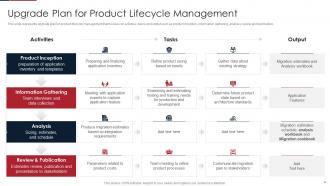
Slide 34: This slide represents upgrade plan for product lifecycle management that focuses on activities, tasks and output such as product inception, etc.
Slide 35: This slide depicts title for two topics that are to be covered next in the template.
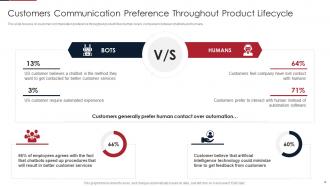
Slide 36: This slide focuses on customer communication preference throughout product lifecycle that covers comparison between chatbots and humans.
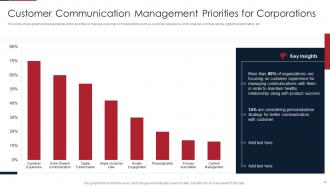
Slide 37: This slide shows graphical representation of firm priorities to manage customer communications such as customer experience, etc.
Slide 38: This slide depicts title for one topic that is to be covered next in the template.
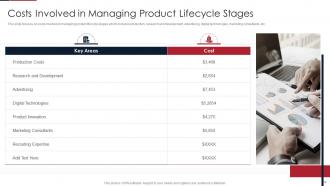
Slide 39: This slide focuses on costs involved in managing product lifecycle stages which includes production, research and development, etc.
Slide 40: This slide depicts title for three topics that are to be covered next in the template.
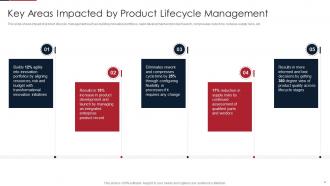
Slide 41: This slide shows impact of product lifecycle management such as building innovative portfolios, rapid development and product launch, etc.
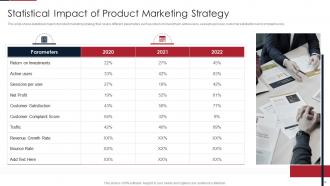
Slide 42: This slide shows statistical impact of product marketing strategy that covers different parameters such as return on investment, etc.
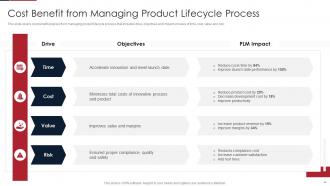
Slide 43: This slide covers cost benefit analysis from managing product lifecycle process that includes drive, objectives and impact on basis of time, etc.
Slide 44: This slide depicts title for two topics that are to be covered next in the template.
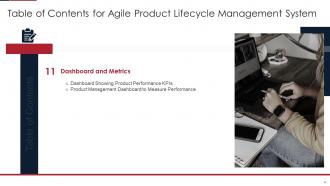
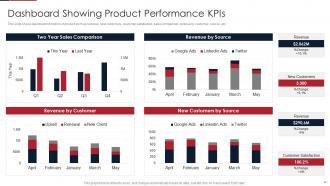
Slide 45: This slide shows dashboard of metrics of product such as revenue, new customers, customer satisfaction, sales comparison, etc.
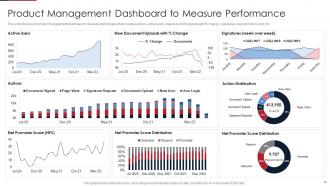
Slide 46: This slide focuses on product management dashboard to measure performance that includes actions, active users, etc.
Slide 47: This is the icons slide.
Slide 48: This slide presents title for additional slides.
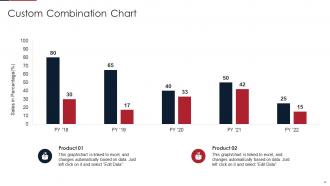
Slide 49: This slide exhibits yearly sales custom combination chart for different products. The charts are linked to Excel.
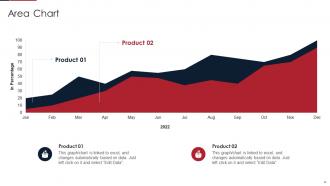
Slide 50: This slide displays monthly area charts for different products. The charts are linked to Excel.
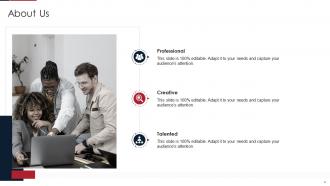
Slide 51: This slide shows about your company, target audience and its client's values.
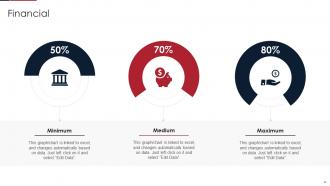
Slide 52: This slide showcases financials.
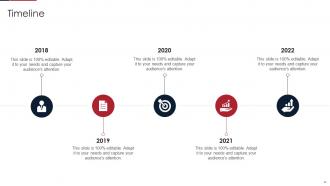
Slide 53: This slide exhibits yearly timeline.
Slide 54: This slide depicts 30-60-90 days plan for projects.
Slide 55: This slide shows roadmap.
Slide 56: This slide exhibits magnifying glass.
Slide 57: This slide depicts posts for past experiences of clients.
Slide 58: This is thank you slide & contains contact details of company like office address, phone no., etc.
Agile product lifecycle management system powerpoint presentation slides with all 66 slides:
Use our Agile Product Lifecycle Management System Powerpoint Presentation Slides to effectively help you save your valuable time. They are readymade to fit into any presentation structure.









FAQs for Agile product lifecycle management system
So basically it's all about iterating fast, working closely with customers, and being flexible instead of planning every tiny detail upfront. Waterfall methods make you commit to everything from day one - which honestly feels safer but usually bombs because you're just guessing what people want. With Agile PLM you can actually pivot when you realize you're wrong (and you will be wrong sometimes, we all are). The whole point is getting feedback constantly and adjusting. Way less risky than crossing your fingers and hoping your initial plan was genius. Start by shortening those feedback cycles and talk to customers more than feels comfortable.
Honestly, Agile forces people to actually communicate instead of hiding in their departments. Daily standups make everyone share what's blocking them. Sprint planning gets different teams on the same page about priorities. Those short cycles are key - you can't just dump work on someone and ghost for three months like before. Everyone has to stay looped in the whole time. Retrospectives help teams figure out where they're stepping on each other's toes. Having one shared backlog means marketing, engineering, design, and sales are all looking at the same info. If you're not ready for full Agile yet, just try weekly cross-team check-ins first.
So your product backlog is like this master list of everything you want to build - features, bug fixes, improvements, all ranked by what matters most to the business. Sprint planning grabs pieces from that list and chunks them into 1-4 week sprints. Honestly, I think of it like meal prep but for development work. Your backlog keeps the big picture strategy on track while sprints make sure you're actually shipping stuff regularly. When priorities change (and trust me, they always will), you can pivot without losing momentum. Keep that backlog prioritized ruthlessly and don't let sprint planning meetings drag on forever.
Honestly, forget about story points - they're pretty much useless for measuring real success. Focus on cycle times and how fast you're getting stuff to customers instead. Customer satisfaction scores are where it's at. Track your deployment frequency and lead times from idea to actual delivery. Team health matters too though - are people feeling good about the work? Regular retros will tell you that. Oh, and defect rates obviously. Pick maybe 3-4 metrics that actually matter for your business goals and stick with them sprint after sprint. Don't overthink it.
Honestly, the main headache is that PLM systems love their waterfall gates and approvals - totally opposite of what Agile wants. Documentation becomes a nightmare because compliance folks need everything documented while Agile prefers working code over endless docs. Traditional milestone budgets don't mesh well when teams need to pivot fast. Most legacy PLM tools can't even handle constant updates running in parallel, which is basically Agile's whole thing. My advice? Figure out which PLM gates actually matter versus the ones that are just bureaucratic BS from years ago. Start fixing those critical ones first and work your way down.
Honestly, feedback is everything in Agile - it tells you what to build and when to pivot. I collect it through user tests, surveys, quick chats with customers. Then prioritize my backlog based on what I'm hearing. Way better than waterfall where you'd build for months before knowing if anyone wanted it (learned that the hard way). Each sprint the feedback loop gets tighter. You're adjusting features based on real user needs instead of just guessing. If you're not already doing it, start adding feedback checkpoints to every sprint. Game changer.
So basically agile flips the whole risk thing on its head. Rather than doing massive upfront planning (which honestly never works out anyway), you're just dealing with problems as they pop up each sprint. Way better approach IMO. Testing happens constantly, you get user feedback quickly, and those retrospectives catch stuff early. When the market shifts or you hit technical roadblocks, pivoting becomes way easier. Problems stay bite-sized instead of snowballing for months. Pro tip: treat every retro like a mini risk check-in. You'll spot issues before they blow up.
Honestly, I'd go with Jira for tracking stories and sprints - it's kind of the standard for a reason. ProductPlan or Roadmunk work great for roadmapping stuff. GitLab's solid if you want that whole code-to-deployment pipeline in one place, though Azure DevOps is decent too. The tool landscape is such a mess right now, there's like a million options. But here's the thing - whatever you pick needs to actually talk to each other. Nothing worse than having your product team in one tool and devs in another with zero integration. Start small with one main platform, then add pieces as you figure out what your team actually needs day-to-day.
Honestly, Agile is a game-changer for getting stuff to market faster. You break everything into short sprints and actually talk to customers early instead of hiding in a cave for months building something nobody wants. Real feedback beats guessing every time. Problems get caught way sooner, and your team won't waste time on features that sound cool but don't matter. Plus you can pivot quickly when needed - which trust me, you will. Start with your MVP features and do 2-week sprints around those core things first. Way better than the old "build it and pray" method.
Honestly, you've gotta get leadership on board first - without that, you're dead in the water. Break down those silos between dev, marketing, ops, all of them. Regular retrospectives are clutch for helping teams actually improve instead of just going through the motions. Training is huge too because most people think they get Agile but really just do standups and call it a day. Create that psychological safety so people aren't scared to mess up and learn fast. Oh, and celebrate the small wins! Keep iterating based on what customers actually tell you rather than stubbornly sticking to your original plan.
Yeah totally doable, just need more structure upfront. Build compliance checks right into your sprints instead of saving them for later. I'd make templates for all the required docs so your team isn't reinventing the wheel every time. Treat regulatory stuff like any other user story - non-negotiable but still gets prioritized with features. People think agile means chaos but that's insane for pharma/aerospace obviously. Short iterations actually help catch compliance problems early. Oh and during backlog grooming, flag which regulations hit each feature. Trust me, you'll thank yourself later when you're not scrambling.
Yeah, Agile PLM is actually perfect for this stuff. You're testing eco-friendly designs way faster instead of realizing at the end that you used too much plastic or whatever. Each sprint lets you evaluate environmental impact as you go - no more nasty surprises. Rapid prototyping means you can mess around with sustainable materials without committing huge money upfront (which honestly saves cash anyway). You'll get real user feedback on green features people actually want, not just checkbox nonsense. Oh, and definitely add environmental criteria to your definition of done for each sprint - that's where the magic happens.
Dude, CI/CD is seriously where it's at for agile teams. Instead of those massive, terrifying releases, you're shipping stuff constantly - like multiple times per day if you want. Users give you feedback right away, so you can actually pivot when needed. The whole automated pipeline handles testing and deployment, which means way less tedious manual work. Honestly, my old team was skeptical at first but now we can't imagine going back. Start with something simple though - don't try to automate everything at once or you'll hate your life. Pick one basic feature and build from there.
Oh man, you're about to hit some major headaches. Teams will constantly step on each other, dependencies pile up like crazy, and your sprints end up waiting on everyone else. The flexibility that makes Agile great? Yeah, that clashes hard with enterprise governance needs. Communication becomes a nightmare between product lines. You'll probably need something like SAFe or LeSS to keep things organized - honestly those frameworks can feel heavy but they work. Get your executives on board first (trust me on this), then start with a pilot program. Focus on breaking down those silos between teams before anything else.
Honestly, Agile PLM is where it's at for staying competitive. Launch early versions instead of waiting forever for something "perfect" - then just iterate based on real user feedback. Markets change so fast these days, you can't afford to wait months. Set up cross-functional teams that actually talk to each other and can pivot quickly. If a product isn't working? Kill it before you waste more money. The whole rapid prototyping thing sounds fancy but it's really just about testing stuff fast and often. Way better than guessing what people want.
-
Great designs, Easily Editable.
-
Unique research projects to present in meeting.
-
Nice and innovative design.