

Authority matrix with responsibilities scope and change approval





Try Before you Buy Download Free Sample Product
 Impress Your
 Audience
 100%
100% Editable
 Save Hours
 of Time


Give them a glimpse of the glory ahead with our Authority Matrix With Responsibilities Scope And Change Approval. They help heighten anticipation.
People who downloaded this PowerPoint presentation also viewed the following :
Content of this Powerpoint Presentation
Description:
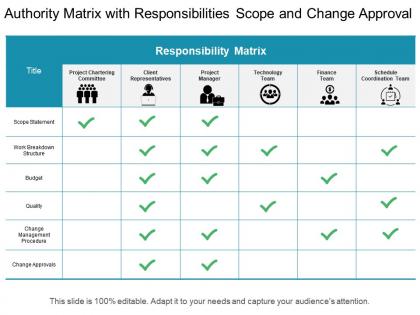
The image is of a PowerPoint slide titled "Authority Matrix with Responsibilities Scope and Change Approval." This slide presents a responsibility matrix, also known as a RACI (Responsible, Accountable, Consulted, and Informed) matrix, which is a tool used to assign roles and responsibilities within a project team.
The matrix is structured as a table with the following columns, each representing a different role within the project team:
1. Project Chartering Committee
2. Client Representatives
3. Project Manager
4. Technology Team
5. Finance Team
6. Schedule Coordination Team
The rows of the matrix represent different aspects or work streams of a project:
1. Scope Statement
2. Work Breakdown Structure
3. Budget
4. Quality
5. Change Management Procedure
6. Change Approvals
Green check marks indicate which roles are responsible for which aspects. For example, the Project Chartering Committee is responsible for the Scope Statement, Change Management Procedure, and Change Approvals, as indicated by the check marks in their respective rows.
The matrix clearly assigns which team or role is responsible for various project elements, ensuring clarity in the delegation of tasks. This is critical for project governance and for maintaining clear lines of communication and accountability.
Use Cases:
Authority matrices clarify roles, enhance workflow efficiency, and ensure accountability, making them vital across various sectors for project management and operational clarity.
1. Construction:
Use: Outlining project roles for building projects
Presenter: Construction Project Manager
Audience: Building Team, Contractors
2. Information Technology:
Use: Assigning responsibilities in software development projects
Presenter: IT Project Lead
Audience: Developers, QA Analysts
3. Healthcare:
Use: Defining roles in hospital administration projects
Presenter: Healthcare Administrator
Audience: Department Heads, Administrative Staff
4. Education:
Use: Allocating tasks in educational program development
Presenter: Academic Program Coordinator
Audience: Faculty, Institutional Planners
5. Finance:
Use: Clarifying duties in financial system implementations
Presenter: Finance Systems Manager
Audience: Accountants, Financial Analysts
6. Manufacturing:
Use: Managing responsibilities in manufacturing process improvements
Presenter: Operations Manager
Audience: Process Engineers, Production Staff
7. Marketing:
Use: Delegating tasks in marketing campaign projects
Presenter: Marketing Director
Audience: Marketing Team, Creative Staff
Authority matrix with responsibilities scope and change approval with all 5 slides:
Catch the fancy of consumers with our Authority Matrix With Responsibilities Scope And Change Approval. They are designed to capture their attention.




FAQs for Authority matrix with responsibilities scope
So an Authority Matrix is just a chart showing who can approve what decisions and how much money they can spend. Different roles get mapped to different types of choices - hiring, contracts, budgets, whatever. Pretty straightforward stuff. The whole point is people know their limits without constantly asking "hey, can I do this?" Honestly saves everyone's sanity. You'll want spending thresholds clearly laid out, plus who handles strategic decisions. Just make sure it's actually easy to find when people need it, or they'll still bother you anyway.
Dude, seriously try making an Authority Matrix for your next project. It's basically just mapping out who decides what and who needs to be looped in. No more of those painful email threads where everyone's like "idk, ask Sarah... actually maybe check with Tom first?" When people know exactly who calls the shots on budgets vs daily stuff, meetings get so much shorter. I'm talking actual decisions happening instead of just... more meetings to discuss the meeting. Trust me on this one - the time you spend setting it up front will save you hours of that awkward "well who's supposed to approve this?" dance later.
Look, you need four main things: decision types, approval levels, dollar limits, and who's responsible for what. Map out everything - hiring, contracts, budget stuff. Then set clear dollar thresholds like "team lead handles up to $5K, director gets $25K" or whatever makes sense. Most of these things crash and burn because they're way too vague. People just start ignoring them after a week. Actually tell your team what the limits are - don't just email some chart nobody reads. Oh, and update it when people leave or get promoted, which happens more than you'd think.
So Authority Matrix is all about who can spend what money - like "you're good for $5K but need your boss for anything bigger." RACI charts are different, they map out the whole workflow thing - who does what, who signs off, who needs to be in the loop. Honestly? I've worked places where RACI charts just sit in some SharePoint folder nobody looks at. Authority Matrix actually gets used daily since people need to know spending limits for real decisions. If you're building this stuff from scratch, I'd start with Authority Matrix first. Way more practical and you'll reference it constantly.
You definitely need one for messy projects with tons of stakeholders who keep butting heads. Multi-department stuff, product launches, anything where everyone's confused about who actually gets to decide what. Seriously saves your sanity when leadership keeps getting dragged into every little choice. Also super helpful during org changes - people get weird about authority when things are shifting. Oh, and vendor relationships too since those can get political fast. New team members love having it spelled out so they're not accidentally stepping on toes. Just set it up early, not when everything's already falling apart.
So basically an Authority Matrix shows who gets to decide what on your project. Map out decisions by dollar amounts, risk levels, whatever makes sense. Your team won't waste time asking "um, can I approve this?" for every little thing. Smaller stuff gets handled fast, bigger decisions go up the chain. Honestly, it's a lifesaver during crunch time. Just list out your typical project calls and assign authority levels to each one. Trust me, you'll dodge so many unnecessary email chains and meetings later. Takes like an hour to set up but saves weeks of confusion.
Honestly, the biggest pain will be people not wanting to give up their little kingdoms of power. Get leadership on board first - that's crucial. Start with just one department instead of going big right away. The thing that trips most people up is overlapping roles where nobody knows who's actually in charge. Also, you'll have weird edge cases that don't fit anywhere on your matrix. Keep it updated too, because these things get stale fast if you ignore them. Oh, and don't expect perfect compliance right away - some folks will "forget" the new system when it's convenient for them.
Look at your org chart first and figure out who actually makes decisions (not just who's supposed to). Then set up your approval levels and dollar limits to match reality. Honestly, most startups only need like 2-3 levels max. Bigger companies? Maybe 5 or more depending on how bureaucratic you want to get. Don't forget about compliance stuff if you're in a regulated industry - that'll add extra hoops. Here's what I'd do: pick a few real examples from your workflow and test the matrix against those. See what breaks or feels clunky, then adjust. Way better than guessing what might work.
Think of the Authority Matrix as your company's spending guardrails. Someone might approve a $10K contract but need their boss for $50K+ decisions. Pretty straightforward stuff. It stops people from making choices that could seriously mess up the business - and honestly, I've seen too many companies learn this the hard way. Plus you get a clear paper trail when things go sideways, so you know exactly who signed off on what. Just make sure your team actually knows what they can and can't approve without asking up the chain.
Look, once a year is the absolute minimum for reviewing your Authority Matrix. Big changes though? New leadership, restructuring, major process shifts - update it right away. Don't be like those companies I've seen where outdated approval chains killed urgent decisions. Honestly, quarterly check-ins work way better than annual ones. Keep it as a living doc, not something buried in a folder somewhere. And for the love of all that's holy, make sure people can actually find the current version when they need it. Nothing worse than hunting for approval info during crunch time.
Yeah, definitely get one set up. Auditors go crazy for that paper trail showing who signed off on what and when. It'll save you from those nightmare scenarios where someone without authority makes a huge decision - trust me, I've seen it blow up companies. The matrix basically maps out decision-making levels so everything follows your policies and regulatory stuff. Honestly though, don't wait until you're scrambling during an audit. Way smarter to have it ready beforehand. Takes like five minutes to set up but saves you months of headaches later.
Ugh, the two big ones I always see? First - people make them ridiculously overcomplicated. Like I'm talking full-blown Excel monstrosities that nobody wants to touch. Second mistake is just assuming everyone will magically start using it once you're done. Get buy-in early or you're screwed. Actually explain what each authority level means in real life, not just on paper. Oh, and definitely test it out with some actual scenarios before rolling it out company-wide. I've seen too many of these things just collect dust because nobody bothered to make sure they actually work in practice.
Dude, forget those static spreadsheets – workflow software is where it's at. It'll automatically send decisions to the right people based on dollar amounts or whatever criteria you set. Plus you get notifications when stuff gets stuck (no more awkward follow-up emails, thank god). The tracking is pretty sweet too – you can see who approved what and how long everything took. Oh, and digital audit trails are clutch for covering your ass later. Honestly, just start with something simple and digitize your current setup. You'll be amazed how much smoother approvals get.
Honestly, skip showing them the actual matrix at first. Role-play scenarios instead - like, situations they'll actually run into day-to-day. Way more effective. I've watched teams completely bomb this because they just handed out approval charts and called it training lol. Practice the real stuff: when do you escalate vs. make the call yourself? Don't forget those weird edge cases that always pop up later. Managers should bring it up in meetings for the first couple weeks too, otherwise people forget about it pretty fast. Trust me on this one.
Look, Authority Matrices actually work pretty well for fixing messy workplace dynamics. Once everyone knows who decides what, you won't get those annoying "not my department" runarounds anymore. Trust me, it cuts down on office politics fast. People feel way more confident when they understand their actual authority - no more tiptoeing around or waiting for someone else to step up. The transparency thing really builds trust between departments too. I'd start by just sketching out how decisions currently happen at your place. You'll probably notice some obvious problem spots right away that are creating tension.
-
Very unique and reliable designs.
-
Great experience, I would definitely use your services further.