

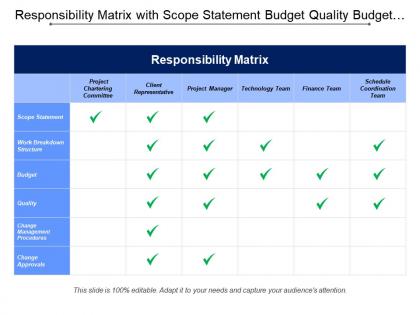
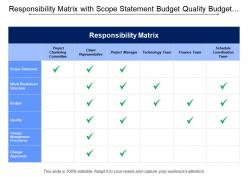
Responsibility matrix with scope statement budget quality budget




Try Before you Buy Download Free Sample Product
 Impress Your
 Audience
 100%
100% Editable
 Save Hours
 of Time


Earn greater appreciation with our Responsibility Matrix With Scope Statement Budget Quality Budget. You will benefit hands over fist.
People who downloaded this PowerPoint presentation also viewed the following :
Responsibility matrix with scope statement budget quality budget with all 5 slides:
Our Responsibility Matrix With Scope Statement Budget Quality Budget are like a gatepost. Your ideas will swing open on them.

FAQs for Responsibility matrix with scope statement
Okay so RACI matrices are basically your "who's doing what" spreadsheet - maps out who's responsible, accountable, consulted, and informed for each task. Super helpful for avoiding those awkward "wait, I thought YOU were handling that" moments. Set it up early because honestly, people are terrible at assuming responsibility without clear boundaries. It stops duplicate work and catches things before they slip through cracks. The trick is actually getting buy-in from everyone upfront - don't just send it in an email and hope people read it. You need real agreement on roles or it's just another useless document floating around.
Dude, you need a responsibility matrix. Seriously cuts through all that "wait, whose job is this?" chaos that tanks projects. Basically you map out who's responsible for what, who approves stuff, who gets consulted - the whole deal. No more of those cringe moments where everyone's staring at each other assuming someone else handled it. RACI model works great for this. Once people know their lane and what everyone else is doing, communication gets so much cleaner. You'll stop drowning in pointless emails and things won't slip through cracks anymore. Trust me on this one.
So basically you'll want four components: tasks listed down the left, team members across the top, then drop RACI codes into each box (Responsible, Accountable, Consulted, Informed). Don't overthink it with fancy extra codes - trust me, I've seen people get way too complicated with this stuff. Task descriptions need to be crystal clear so nobody's confused about what they're actually doing. Be specific about who's doing what. Start by writing out all your deliverables first. Then go through each one and figure out who should be assigned to what. Pretty straightforward once you get the hang of it.
So the responsibility matrix is basically about *who* does what, while your project schedule covers *when* stuff happens. Your schedule has all the dates and deadlines, but the matrix breaks down roles - like who's actually responsible, who you need to check with first, who just gets a heads up. I swear, half the projects I've worked on fall apart because people think someone else is handling the important stuff! That's where the matrix saves you. You can totally use both together - your schedule says what's due Friday, the matrix tells you exactly who's supposed to deliver it. Makes sense?
Dude, responsibility matrices are game changers. No more "wait, I thought Sarah was doing that" disasters. Everyone knows their exact role upfront, which honestly saves so much drama later. You can spot if someone's drowning in tasks while others are twiddling thumbs. Plus it stops scope creep dead in its tracks - people can't randomly dump new stuff on you since everything's already mapped out. Oh, and it prevents those cringe moments where half the team shows up for the same task. Definitely make one at your next kickoff meeting, trust me on this.
Yeah, definitely! Start with basic RACI but then mess around with it to fit your team. Maybe add a "Support" role or break down "Consulted" into more specific types. Honestly, color-coding makes everything look less terrible than plain text. Map it to how decisions actually happen with your people - not some textbook version. I'd say try something simple first though. Get your team's thoughts on it, then adjust based on what clicks for them. The whole point is just making sure everyone knows their job without having to guess or send awkward Slack messages asking "wait, who's handling this?"
Honestly, the hardest part is just getting people to agree on who's doing what. Sounds basic, right? But it gets crazy messy because everyone has different ideas about their role. Some folks will push back on certain tasks or feel like you're breathing down their neck. Then you've got all these random tasks that don't fit anywhere neat and tidy. Oh, and if your team changes a lot - which mine does constantly - updating the thing becomes such a headache. I'd say draft something up first, brace yourself for complaints, and plan on redoing it at least twice before people stop grumbling.
Yeah, totally! Just don't go crazy and make some huge RACI chart for your whole project - that's the opposite of agile. What works better is making smaller ones for specific features or maybe an epic you're working on. Your team will actually know who's doing what without all the corporate overhead nonsense. Keep them simple and update as things change (which they will). Honestly, I'd just try it with your current sprint first and see if it actually helps or just creates more work.
Honestly, just get everyone in the same room - Zoom counts. List out all the roles first, then go through each task asking "who's doing this?" and "who do we need to loop in?" Don't try tackling this alone because it'll be a disaster (learned that one the hard way lol). The best part is watching people actually clarify what they want right there in the moment. Oh, and definitely capture everything while you're talking - send it around after for people to nitpick before you make it official.
Honestly, most teams I know just use Excel or Google Sheets - they're dead simple and everyone already knows how to use them. Monday.com and Asana have those nice RACI templates if you want something that looks more professional. Miro's good too, especially if your team likes visual stuff. For bigger companies, Microsoft Project or Smartsheet have all the fancy tracking features, but they can be overkill. The real trick is finding something everyone will actually keep updated instead of making it once and never touching it again. I've seen too many beautiful matrices that just collect digital dust.
Check your responsibility matrix at major milestones - usually monthly, but always after scope changes or team shifts. I made this mistake once and it was a disaster. Three people ended up doing identical work while important stuff got completely missed. Quick pulse checks help too whenever you add team members or change deliverables. Honestly, most teams treat these like set-it-and-forget-it documents, which is why projects get messy. Keep it updated and actually use it. Oh, and set those calendar reminders now because you'll definitely forget otherwise.
Biggest thing? Don't make roles super vague or they'll overlap everywhere. Then you get the whole "I thought YOU were handling that" mess. Only put one person as "Responsible" per task - multiple owners means no one actually owns it. Keep it basic with RACI, don't get all fancy with extra categories. Oh, and definitely run it by your actual team first. I've seen so many people just create these matrices in isolation, then wonder why nobody follows them. You want something that actually matches how work gets done, not just a document that looks good in meetings but sits unused.
Honestly, responsibility matrices are lifesavers for avoiding those "wait, who's supposed to do this?" disasters. Each person knows exactly what they're responsible for, accountable for, or just need to be kept in the loop about. No more awkward blame games when something falls through the cracks. I've seen teams waste so much time on duplicated work or missed handoffs - this fixes that. The RACI framework works pretty well, though the "consulted vs informed" thing can get confusing at first. Map out your main deliverables and assign roles to everyone involved. Trust me, you'll wonder why you didn't do this sooner.
So basically, a responsibility matrix stops risks from getting dropped because everyone thinks someone else is handling them. You assign specific people to watch different risks - who spots them, tracks them, responds to them. Game changer for avoiding those awkward "wait, wasn't that your job?" conversations during meetings. Plus when you're doing risk reviews, you can spot if someone's drowning in responsibilities or if something's not covered at all. Set it up when your project starts and tweak it whenever people's roles shift around.
Definitely go with hands-on workshops - that's what actually works. Get teams building a RACI matrix for something they're already working on. Role-playing sounds cheesy but honestly people grasp it way better when they act out different perspectives. I'd focus on spotting overlaps and gaps since that's where everything falls apart usually. Skip the slide presentations and give them a real template to mess around with. The RACI thing is pretty straightforward - Responsible, Accountable, Consulted, Informed. Just make sure they're applying it to current projects right away, not some theoretical example.
-
Innovative and Colorful designs.
-
Informative design.