


Automation benefits showing multiple gears with 6 benefit options





Try Before you Buy Download Free Sample Product
 Impress Your
 Audience
 100%
100% Editable
 Save Hours
 of Time


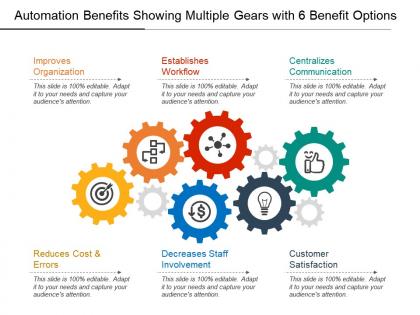
Finding difficulty in creating a PPT professional on automation advantage? Do not worry! SlideTeam has come up with predesigned automation benefits showing multiple gears with six benefit options PowerPoint template slide designed using creative and an impactful icon of the target board, workflow, communication, dollar sign, idea bulb, an upward thumb. Graphics of six gears has been used for crafting this editable automation advantages PPT template. Stages represented in this template slide are improved organization, establishes workflow, centralizes communication, reduce cost and errors, decrease staff involvement, and customer satisfaction. You can add your valuable information in the template as enough space is available in the template design. The best part about this template is that it is self-descriptive. You will be easily able to explain the benefits of automation with the help of impressive icons. The concept of topics like automation management, automation advantages, quality improvement, quality enhancement, business process automation, quality assurance, and business improvement can be explained using this template slide. Hurry up and download this automation benefits showing multiple gears with six benefit options PPT template. Acquire all the aces with our Automation Benefits Showing Multiple Gears With 6 Benefit Options. You will have the best cards in your hand.
People who downloaded this PowerPoint presentation also viewed the following :
Content of this Powerpoint Presentation
Description:
The image displays a PowerPoint slide titled 'Automation Benefits Showing Multiple Gears with 6 Benefit Options.' It visually represents six interlocking gears, each accompanied by a key benefit of automation. These benefits, highlighted in caps, are as follows:
1. Improves Organization:
A benefit is that automation can enhance the structure and order within processes or systems. This could relate to document management, task allocation, or workflow optimization.
2. Establishes Workflow:
Refers to the development of systematic processes that dictate the pattern of work from initiation to completion, ensuring efficiency and consistency.
3. Centralizes Communication:
Implies that automation can help in bringing all communication channels together, providing a single source of truth that facilitates better information sharing.
4. Reduces Cost & Errors:
Indicates that automation can save on operational costs and minimize the likelihood of human error, improving overall accuracy and quality.
5. Decreases Staff Involvement:
Suggests that tasks that were previously manual can now be handled automatically, reducing the need for staff intervention and allowing them to focus on more strategic activities.
6. Customer Satisfaction:
Points out that automation can lead to quicker response times, personalized service, and a more reliable customer experience, thus increasing the satisfaction of the clientele.
Each gear is marked with an icon that symbolically represents the respective benefit. At the bottom of each benefit section, there is a note stating, "This slide is 100% editable. Adapt it to your needs and capture your audience's attention." This indicates the customizable nature of the slide for various use cases.
Use Cases:
This slide can be effectively utilized in different industries where automation can play a key role:
1. Information Technology:
Use: To illustrate the benefits of software automation in IT projects.
Presenter: IT Project Manager or Systems Architect.
Audience: Technical Team Members, Stakeholders.
2. Manufacturing:
Use: To describe the advantages of implementing automated production lines.
Presenter: Operations Manager or Process Engineer.
Audience: Factory Personnel, Management Team.
3. Healthcare:
Use: To show how automation can streamline patient care and administrative tasks.
Presenter: Healthcare Administrator or IT Specialist.
Audience: Hospital Staff, Health Professionals.
4. Banking and Finance:
Use: To demonstrate how automation can enhance financial operations and customer service.
Presenter: Financial Analyst or Banking Executive.
Audience: Bank Employees, Finance Department.
5. Retail:
Use: To discuss how automated systems improve inventory management and customer engagement.
Presenter: Retail Manager or Supply Chain Coordinator.
Audience: Retail Staff, Store Managers.
6. Telecommunications:
Use: To highlight the role of automation in network management and customer support.
Presenter: Network Operations Center Manager or Customer Service Director.
Audience: Telecommunications Staff, Customer Support Teams.
7. Education:
Use: To exhibit ways in which automation can assist in student services and administrative efficiency.
Presenter: Educational Administrator or IT Coordinator.
Audience: Teachers, Administrative Personnel.
Automation benefits showing multiple gears with 6 benefit options with all 5 slides:
Initiate the debate with our Automation Benefits Showing Multiple Gears With 6 Benefit Options. Give a balanced account of every angle.

FAQs for Automation benefits showing multiple gears with
Dude, automating repetitive stuff is a game changer. You stop making those stupid little mistakes that happen when you're brain-dead from doing the same thing 50 times. Plus you get your time back for actual thinking work instead of mindless data entry. Machines work way faster than us too - no bathroom breaks or getting distracted by Instagram. I'd start with whatever eats up like 30+ minutes of your day regularly. Even something small makes a difference. Your whole team ends up happier when they can do creative stuff instead of boring admin tasks.
Honestly, automation's a game-changer when you do it smart. Your team gets way more productive since they're not grinding through boring repetitive stuff all day. People actually like their jobs more because they can work on creative problem-solving and strategy instead. The trick is getting everyone involved from day one - like, don't just spring it on them. When they help build the process, they see it as their tool rather than some threat. I mean, who actually enjoys data entry anyway? Short answer: happier employees who get more meaningful work done.
So automation saves you money in a few ways. Labor costs drop big time since machines can handle all that repetitive stuff without needing breaks or overtime. Error rates go way down too, which honestly saves more money than people realize - fixing mistakes gets expensive fast. Your training budget shrinks because you're not constantly hiring people for the boring tasks. Oh, and automated systems work 24/7 without complaining, which is pretty nice. I'd start with whatever process eats up most of your team's time and automate that first.
Dude, automation tools are seriously worth it for project management. They handle all the boring stuff - status updates, reminders, tracking progress. I used to waste hours on that crap every week. Your team actually knows what's happening without you constantly bugging them about updates. The early warning alerts are clutch too, like when deadlines start looking sketchy. Way fewer scheduling screwups since it's not just me trying to juggle everything in my head. Honestly? Just pick whatever task annoys you most and automate that first. Build from there.
You know how you always mess up when you're rushing through spreadsheets? Automation fixes that - does the same thing every time without the random typos. It catches mistakes right away instead of you finding them later during some awful audit. Honestly, I wish I'd started automating sooner because those copy-paste fails were killing me. The system just follows whatever rules you set up for formatting and calculations. My advice? Start with the boring, repetitive stuff first. That's where you'll actually notice the difference in accuracy.
So basically, automation jumps on all those repetitive customer questions right away - chatbots handling FAQs, tickets getting routed to the right people automatically, confirmation emails firing off instantly. Response times go from hours down to like seconds for the standard stuff. Honestly, your support team will thank you because nobody enjoys explaining how to reset passwords all day long. It frees them up for the actually tricky problems that need human problem-solving. Just make sure you've got solid escalation rules set up so real issues still reach real people when needed.
Look, automation frees up your team from all that boring repetitive stuff - data entry, status updates, whatever. Those people can work on projects that actually matter instead. The systems run all day and night too, which is pretty sweet when you think about it. You'll get better accuracy since humans make weird mistakes when they're tired or distracted. Turnaround times get faster. My advice? Start with whatever manual process eats up the most time. That's usually where you'll see the biggest impact right away.
Yeah, it's rough at first - dropped some serious cash on our setup and questioned everything for months. But compound savings are real. Most places break even around 18-24 months, then you're looking at 20-40% cost cuts in whatever you automate. Way fewer mistakes, higher throughput, and your people can actually do interesting work instead of mind-numbing repetitive stuff. Labor costs just keep going up while your bots work for free basically. Oh, and calculate what you're spending on manual processing now - that number usually makes the decision pretty obvious. Gets better every year too.
Honestly, just pick one annoying thing you do every day and automate that first. I'd probably start with social media scheduling - Buffer literally saves me like 5 hours a week, no joke. Mailchimp's free for email stuff, and Zapier can connect whatever apps you're already using. Don't go crazy trying to automate everything at once though. Most customer service chatbots and basic CRM tools have cheap starter plans under $20. Even automated invoicing helps a ton. The key is focusing on your biggest time-waster first, then building from there once you see how much time you get back.
Honestly, manufacturing and healthcare are killing it with automation right now. Smart factories can actually predict when machines will break before it happens - pretty wild stuff. Surgery's gotten crazy precise with robotic assistance too. Amazon's warehouse bots are everywhere now, and finance companies use AI to catch fraud way faster than before. Even farmers are using drones to monitor crops, though that still feels futuristic to me. If you're thinking about automating stuff at work, just look at whatever tasks eat up most of your time doing the same thing over and over. Those are usually your best bet.
Honestly, automation is like swapping your old clunky car for something that actually responds when you hit the gas. When markets go crazy, you can pivot fast instead of being stuck with manual processes that take forever. Your team gets to focus on the actual strategy stuff rather than boring repetitive tasks. Plus you can test new ideas without burning through your budget - which is huge. I'd start with whatever's eating up the most time in your routine processes first. Then you can tackle the more complex workflows once you've got the hang of it. Way better response times across the board.
Honestly, automation saved my butt with compliance stuff. Manual checks are such a pain - you always miss something or do it differently each time. With automation, everything gets documented the same way and you get real-time alerts if something's off. The audit trail happens automatically too, which is huge. When auditors show up (and they will), you've got all your reports ready instead of frantically digging through files. Just make sure you set it up right from the start so it captures what you actually need. Trust me, it's worth the upfront work.
Dude, automation is honestly a game changer for team stuff. No more work sitting in people's inboxes forever - that alone is worth it. Teams can actually focus on the interesting problems instead of constantly asking "where are we on this?" Every few hours lol. Real-time updates mean way less Slack spam too. The trick is getting everyone involved when you set it up. They'll catch workflow issues you'd totally miss. I learned that the hard way on my last project. Short version: it cuts out all the annoying handoff delays so people can do actual work.
So automated systems are actually pretty great for cutting down your environmental impact. Machines optimize power way better than we do - no more leaving lights on or running equipment when you don't need it. The waste reduction is huge too since everything gets measured precisely. I've seen some crazy stats on how much material waste drops just from consistent processes. Oh, and you can track resource usage in real time, which makes spotting problems so much easier. Honestly, most people see these systems pay for themselves within a year just from the energy and waste savings alone.
So basically you wanna measure two things - money saved and money made from automation. Track how many hours your team used to waste on boring manual stuff vs now. Then figure out your labor savings, fewer mistakes, all that good stuff. The before/after thing is honestly your best friend here - leadership loves seeing those clear numbers. Oh and don't forget to subtract what you actually spent setting it up (learned that one the hard way). I'd check in on these metrics monthly so you've got solid proof when budget season rolls around.
-
Nice and innovative design.
-
Innovative and Colorful designs.