


Retirement benefits powerpoint presentation slides





Try Before you Buy Download Free Sample Product
 Impress Your
 Audience
 100%
100% Editable
 Save Hours
 of Time


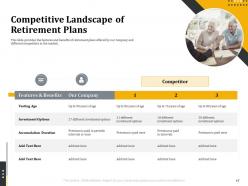
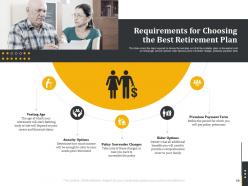
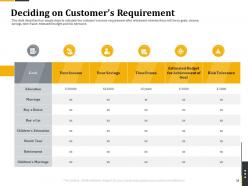
Get this visually appealing Retirement Benefits PowerPoint Presentation Slides to showcase a long-term comprehensive financial plan for retirement. The features and benefits of the retirement plan offered by your company can be easily depicted using the professionally designed pension plan PPT slideshow. You can also use the modern-designed PPT graphics to demonstrate the steps to calculate customer’s income requirements like goals, income savings, time frame, estimated budget, and risk tolerance. Utilize our visually appealing pension planning PowerPoint complete deck to talk about the requirements for choosing the best retirement plan, such as vesting age, annuity options, policy surrender charges, and rider options. Our ready-to-use retirement planning PowerPoint templates allow you to discuss the plans offered by your company with maximum and minimum entry. Thus, download our eye-catching and professionally designed retirement planning PowerPoint presentation to attract the attention of your viewers.
People who downloaded this PowerPoint presentation also viewed the following :
Retirement benefits powerpoint presentation slides with all 57 slides:
Use our Retirement Benefits Powerpoint Presentation Slides to effectively help you save your valuable time. They are readymade to fit into any presentation structure.








FAQs for Retirement benefits
So retirement packages - the good ones have 401k matching (grab every penny of that free money), health coverage that doesn't disappear when you retire, and sometimes a pension if you hit the jackpot. Life and disability insurance get overlooked but they're honestly pretty clutch. Oh, and HSAs are amazing for healthcare costs later - those bills get crazy. Some companies do phased retirement or financial planning help too. Main thing is don't leave employer matching on the table, that's just throwing away cash. My dad did that for years and still kicks himself about it.
Okay so basically employer plans like 401(k)s let you contribute way more - $23,000 vs only $7,000 for IRAs. Your company sets everything up and often matches contributions, which honestly you'd be crazy not to take. That's literally free money. IRAs give you way more control though - you pick your own investments and provider instead of being stuck with whatever funds your company chose. My advice? Max out that employer match first since it's guaranteed return, then open an IRA if you want more options. The contribution limits alone make employer plans pretty sweet if you're trying to save serious money.
So it really comes down to what type of account you're pulling from. Traditional 401k/IRA withdrawals get hit with regular income tax rates - pull out 50k and it's like you earned an extra 50k that year, tax-wise. Roth accounts though? Those are sweet since you already paid taxes upfront, so qualified withdrawals don't get taxed again. Brokerage accounts are kinda in the middle - you'll owe capital gains on any profits, but those rates are usually better than income tax rates. Oh, and if you're under 59½, there's that brutal 10% early withdrawal penalty on retirement accounts too.
Dude, definitely contribute enough to get your full company match first - that's literally free money just sitting there! Check your benefits thing to see what yours is, like maybe they'll match 50% of your first 6% or whatever. I swear, so many people I know don't even bother with this and it drives me crazy. Money tight? I get it, but try to at least hit that match amount before you stress about IRAs and all that other stuff. You're basically getting instant money back on what you put in, which is pretty hard to beat anywhere else.
So you can tap into Social Security at 62, but honestly? You'll get way less money. Full benefits don't kick in until 65-67 (depends on your birth year). With 401ks and IRAs, 59½ is the magic number - that's when you can withdraw without penalties. Medicare starts at 65 for most people. Here's the thing though - if you can wait until 70 to claim Social Security, you'll get even more each month. I'd definitely look up your birth year on their website to see your exact full retirement age. Planning this stuff out early makes a huge difference.
Honestly, it's all over the map depending on where you end up. Government and union jobs usually have the sweet pension deals and early retirement stuff. Tech companies throw crazy money at 401k matching to get good people. Retail though? Yeah, you're probably getting the bare minimum - maybe a basic 401k if you're lucky. Executive positions obviously crush entry-level even at the same place, which isn't shocking. My advice? Actually dig into the benefits paperwork when you're job hunting. I know it's boring as hell, but those details matter way more than you think they will.
Ugh, the worst mistake is waiting too long to start - seriously kicks you in the ass later. People always think they'll need way less money than they actually will, but then healthcare costs hit and it's brutal. Don't just dump everything into your 401k either, you need to spread it around. Oh and when you switch jobs? Roll over that account instead of cashing out, even though I know it's tempting when you're broke. Inflation's gonna mess with you over 30 years too. Just automate the contributions so you don't talk yourself out of it every month.
Start planning like 6-12 months out - gives you time to figure out the 401k stuff and when you can touch it without getting hit with penalties. Healthcare is honestly the biggest headache though. COBRA's expensive as hell but might be your best bet until Medicare starts. Oh, and see if your company does that gradual retirement thing where you go part-time first - way less jarring. I'd definitely sit down with HR sooner than later to map everything out. They'll have all the forms you need anyway, plus they know when your current coverage actually ends.
Since you don't have a company 401k, you're gonna have to handle retirement yourself. Look into a SEP-IRA or Solo 401k - way higher contribution limits than regular IRAs. Solo 401k is honestly my favorite because you contribute as both employee AND employer. Pretty cool setup. Your income's gonna be all over the place some years, so plan for that when deciding how much to save. Without employer matching, you'll need to save more aggressively. I'd start by figuring out what percentage you can realistically put away each month.
Ugh, healthcare costs are brutal in retirement - definitely plan for them early. Medicare starts at 65 but doesn't cover everything, so you're looking at $200-400+ monthly for supplemental insurance. Retire before 65? You'll need COBRA or marketplace plans, which honestly can be insanely expensive. Some companies still offer retiree benefits but they're pretty rare these days. I'd start looking into Medicare options about a year before you turn 65. Oh, and don't forget long-term care costs - those can destroy your savings if you're not prepared.
Look, early retirement sounds amazing - more freedom, better health to actually enjoy it. But honestly? It's expensive as hell. You'll get hit with like 25-30% less Social Security since you're claiming early. Plus no more employer health insurance until you hit 65 for Medicare, and those premiums are no joke. You're also missing out on years of salary and 401k contributions, which adds up fast. My advice? Do the math first - figure out your monthly income versus what you'll actually spend. The numbers might surprise you. Healthcare costs alone could be a dealbreaker depending on your situation.
Honestly, learning basic finance stuff will change how you handle retirement - no joke. People who get the fundamentals start contributing way earlier and actually know what they're doing with investments. Your 401k becomes way less confusing once you understand compound interest and employer matching (seriously, free money). The stats are pretty wild - educated employees contribute like 40% more than people just winging it. Even those boring company workshops can add literal years to when you'll be able to retire. I know it sounds dry, but it's worth sitting through if your work offers anything.
Ugh, economic changes totally screw with retirement benefits. Inflation eats away at your pension payments since they're usually fixed. Market crashes? Your 401(k) gets destroyed - honestly still recovering from 2022's mess. Companies might freeze benefits when times get tough, which sucks. Interest rates going crazy means employers have to contribute more or less to pension plans. Social Security does bump up with cost-of-living adjustments, but they're always behind real inflation rates. Best thing you can do is spread your money across different account types and actually check on everything when the economy goes sideways.
Look, Social Security only covers about 40% of what you made before retiring - definitely not enough to live on. You'll need your 401k and other savings to make up the difference. Think of it as your safety net, not your whole plan. Together, you want everything to replace like 70-80% of your old income. You can start claiming at 62 but you get way less money. Wait until 70 and you'll max out your benefits - honestly wish more people knew that. Check SSA.gov to see your projected numbers, then figure out how much you need to save to hit your target.
Honestly, I'd focus on getting 70-80% of what you're making now for retirement income. Check if they do contribution matching - that's basically free cash you don't want to miss. The investment options matter too, so look for diverse stuff with low fees that actually makes sense. Vesting schedules can be tricky depending on how long you plan to stick around. Oh, and if you're someone who switches jobs a lot, make sure the plan travels with you. Some companies throw in financial planning help which is pretty nice. Bottom line: will this plus Social Security cover your lifestyle later? Worth doing the math real quick.
-
I discovered this website through a google search, the services matched my needs perfectly and the pricing was very reasonable. I was thrilled with the product and the customer service. I will definitely use their slides again for my presentations and recommend them to other colleagues.
-
Excellent design and quick turnaround.
-
Nice and innovative design.
-
Very unique, user-friendly presentation interface.
-
Use of different colors is good. It's simple and attractive.