

Retirement plan powerpoint presentation slides





Try Before you Buy Download Free Sample Product
 Impress Your
 Audience
 100%
100% Editable
 Save Hours
 of Time


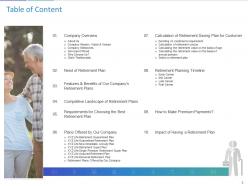
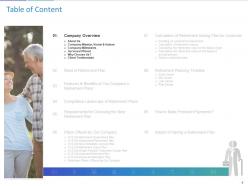
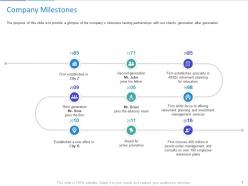
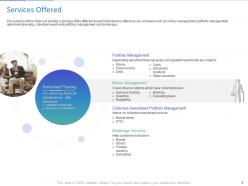
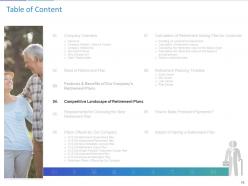
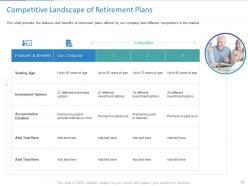
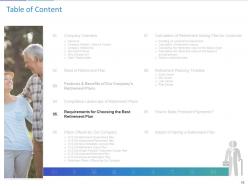
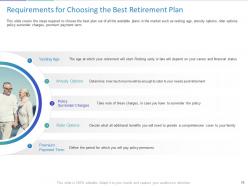
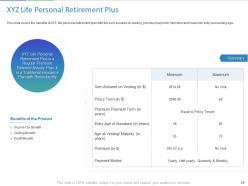
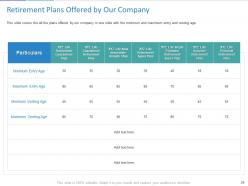
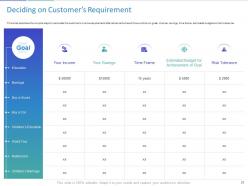
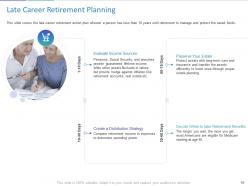
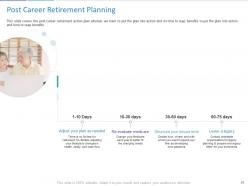
Showcase a long-term comprehensive financial plan for retirement years with the aid of this content ready Retirement Plan PowerPoint Presentation Slides. Demonstrate the features and benefits of the retirement plan offered by your company and different companies in the market by using the professionally designed pension plan PPT slideshow. Take the assistance of this visually appealing pension planning PowerPoint complete deck to talk about the requirements for choosing the best retirement plan such as vesting age, annuity options, policy surrender charges, and rider options, etc. Utilize the ready to use retirement planning PowerPoint templates to discuss the plans offered by your company with maximum and minimum entry and versing age. You can also use the topic-specific pension plan PPT graphics to describe the steps to calculate customer’s income requirements like goals, income savings, time frame, estimated budget, and risk tolerance, etc. Thus download our informative and interesting retirement planning PowerPoint presentation to attract the attention of your viewers. Our Retirement Plan Powerpoint Presentation Slides ensure focused attention to your thoughts. They get exclusive handling.
People who downloaded this PowerPoint presentation also viewed the following :
Retirement plan powerpoint presentation slides with all 57 slides:
Use our Retirement Plan Powerpoint Presentation Slides to effectively help you save your valuable time. They are readymade to fit into any presentation structure.




FAQs for Retirement plan
Honestly, just focus on four things: figure out when you want to retire and how much you'll need, pick investments that won't keep you up at night (index funds are solid if you're not into research), automate your contributions so you don't have to think about it, and check in on everything once a year. Max out those 401k and IRA accounts first - the tax breaks are legit. I know everyone says this, but starting early makes such a huge difference. Even throwing in like $50 a month beats waiting until you're 40 and panicking about it.
Okay so first figure out how much you've saved vs what you'll actually need in retirement. The whole "save 10-12x your annual salary" thing is solid advice but honestly feels impossible when you first hear it. Don't panic though. Use one of those online retirement calculators - they're actually pretty helpful. Factor in Social Security and any pensions you might have. Check if your current savings rate will get you there, and if not, bump up your contributions. I usually tell people to review this stuff once a year so you don't fall behind.
Dude, definitely max out that employer match first - it's literally free money. 401(k)s are honestly where most people build their retirement savings because the contribution limits are so much higher than IRAs. Plus you get those sweet tax breaks. The automatic payroll thing is clutch too since you won't even miss the money (trust me, if it hits your checking account first, it's gone). I always tell people to bump up their contribution every time they get a raise. Like, you're already used to living on less anyway, right?
Okay so the 4% rule is your starting point - withdraw 4% of your savings each year and you shouldn't run out. Need $60k annually? That's roughly $1.5 million saved (ugh, I know). But here's the thing - aim for about 70-80% of what you're making now since some expenses disappear in retirement. Track your current spending first, then mess around with those online calculators. Healthcare costs are gonna be brutal though, and inflation will chip away at everything over time. Honestly the numbers always seem impossible until you actually start breaking them down scenario by scenario.
Honestly, wait until 70 if you can manage it financially - you get like 8% more for every year past your full retirement age. Worth it if you ask me. You'll want at least 35 years of earnings since they calculate based on your highest 35 (the math gets annoying but whatever). If you're married, don't claim without talking to your spouse first - there's spousal benefit stuff that might work better together. Oh, and check your statement every year! They screw up earnings records more than you'd think, so catch that early.
Dude, inflation and taxes are gonna wreck your retirement if you're not careful. That $100 grocery bill today? It'll be like $180 in 20 years - crazy right? Then taxes come for whatever's left. Your 401k gets hit when you withdraw, but Roth accounts are tax-free later (honestly the best deal ever). You'll need way more saved than you think just to live the same way. Max out those tax-advantaged accounts now. Oh, and mix traditional and Roth contributions - don't put all your eggs in one basket.
So diversification is just spreading your money across different investments instead of dumping everything in one place. Like, imagine if you only bought tech stocks and then the whole sector crashed - yikes. Mix it up with stocks, bonds, maybe some real estate or international stuff. When one investment sucks, hopefully others are doing better to balance things out. Honestly, I learned this the hard way watching my coworker lose half his retirement when his company stock tanked. Check your 401k - if it's loaded with just one thing, time to rebalance.
Honestly, just grab your 401k match first - it's literally free money. After that, max out a Roth IRA if you can swing it since you get way more investment choices (your 401k probably has like 12 boring mutual funds). The limits are different too - $23k for 401ks vs only $7k for IRAs. Traditional accounts save you taxes now but you'll get hit later. Roth is the opposite - pay upfront, withdraw tax-free in retirement. I'd probably go 401k match → Roth IRA → then back to maxing the 401k if you've got money left over.
Look, once a year minimum but honestly? Big life stuff is what really counts. New job, marriage, divorce, kids - that's when you gotta dig into the numbers. I usually do mine around tax time because I'm already drowning in financial paperwork anyway. Market goes crazy or you get a bonus? Perfect time to check if you're still on track. Your investment mix should change as you get older too. Just set a phone reminder and don't stress about making it perfect - even a quick review beats ignoring it completely.
Start with your 401k provider's free stuff - webinars, calculators, maybe even one-on-one sessions. Department of Labor has good info but honestly reads like watching paint dry sometimes. Morningstar and Fidelity's learning centers are way more user-friendly. YouTube's surprisingly decent for retirement basics too. Oh, and libraries often do free financial workshops if you're into that. I'd honestly just call your 401k people first since they know your actual plan details. Way easier than trying to figure out generic advice that might not even apply to you.
Hey! So healthcare usually runs about 15-20% of retirement expenses. Medicare premiums are the obvious part, but you've also got supplemental insurance plus dental/vision stuff Medicare barely touches. The long-term care thing is what really scares me though - those costs can absolutely wreck your budget. Medical inflation runs around 6-7% yearly, which is brutal. Definitely look into HSAs if you can swing it now, since that money rolls over and becomes gold in retirement. Oh, and check what Medicare actually costs in your area first - it varies more than people think.
Dude, the worst thing you can do is wait too long to start - like I did in my twenties, ugh. Also don't just dump money into your 401k randomly without thinking it through. Diversify your investments or you're screwed if one sector tanks. Inflation's sneaky too, so factor that in. Never touch those retirement accounts early no matter how tempting - the penalties are brutal. Start by figuring out what you'll actually need when you retire, then calculate backwards. Honestly, even saving an extra $50 a month makes a massive difference over decades.
Okay so first grab any employer match - literally free money you can't pass up. High-interest debt comes next, then emergency fund stuff. After that? Max out retirement contributions. I know everyone says 10-15% but honestly starting with like 3-5% beats doing nothing at all. Once you've got the basics down, you can juggle other goals - house fund, vacation money, whatever. Oh and definitely automate your retirement contributions or you'll find excuses to skip them when random expenses come up. Trust me on that one.
Honestly, you really want to crush as much debt as possible before retiring. Credit card interest will destroy your budget when you're living on less income. Your mortgage too - those payments hit different when you can't just work more hours, you know? While you're still pulling in your full paycheck, go hard on the high-interest stuff first. Then chip away at the mortgage. Trust me, the last thing you want is stressing about bills when you should be chilling and actually enjoying retirement. Way better to tackle it now while you've got the earning power.
Apps like Personal Capital or Mint are total game-changers for retirement tracking - way better than those old spreadsheets I used to torture myself with. Just connect all your accounts and boom, everything's in one place. Your 401k, IRA, savings, whatever. They'll automatically tell you if you're hitting your goals and bug you when you're not (which honestly can be annoying but helpful). Most will even show projections based on what you're putting in now. Pick one app, link everything up, then check monthly. I learned the hard way that checking daily just makes you crazy.
-
Helpful product design for delivering presentation.
-
Excellent products for quick understanding.
-
Design layout is very impressive.
-
Great experience, I would definitely use your services further.
-
Top Quality presentations that are easily editable.