


Bant Lead Qualification Framework Utilizing The Meddic Model For Lead Qualification




Try Before you Buy Download Free Sample Product
 Impress Your
 Audience
 100%
100% Editable
 Save Hours
 of Time


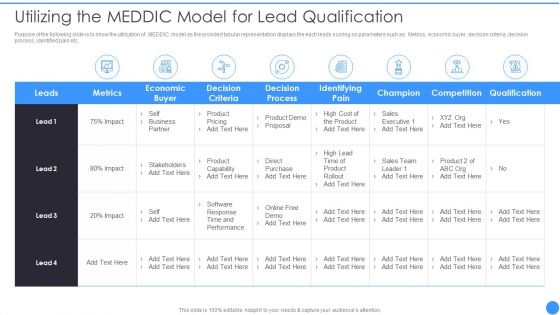
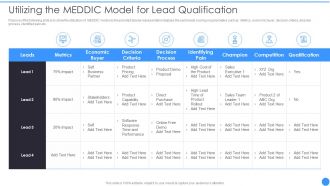
Purpose of the following slide is to show the utilization of MEDDIC model as the provided tabular representation displays the each leads scoring on parameters such as Metrics, economic buyer, decision criteria, decision process, identified pain etc.
People who downloaded this PowerPoint presentation also viewed the following :
Bant Lead Qualification Framework Utilizing The Meddic Model For Lead Qualification with all 6 slides:
Use our Bant Lead Qualification Framework Utilizing The Meddic Model For Lead Qualification to effectively help you save your valuable time. They are readymade to fit into any presentation structure.





FAQs for Bant Lead Qualification Framework Utilizing The Meddic Model
The key components of BANT lead qualification framework are Budget, Authority, Need, and Timeline. These criteria help sales teams streamline lead evaluation by assessing financial capacity, decision-making power, business requirements, and purchase timing, with many organizations finding that systematic BANT implementation significantly enhances conversion rates and optimizes resource allocation across sales processes.
BANT focuses on Budget, Authority, Need, and Timeline, while CHAMP emphasizes Challenges, Authority, Money, and Prioritization, and MEDDIC covers Metrics, Economic buyer, Decision criteria, Decision process, Identify pain, and Champion. BANT streamlines qualification through straightforward financial and timing assessments, while CHAMP and MEDDIC dive deeper into organizational dynamics and decision-making processes, ultimately delivering faster qualification cycles versus more comprehensive stakeholder analysis.
The BANT framework delivers improved lead prioritization, shorter sales cycles, higher conversion rates, better resource allocation, and enhanced forecasting accuracy for sales teams. This strategic qualification method enables sales professionals to focus on prospects with confirmed budgets and decision-making authority, ultimately streamlining the sales process and maximizing revenue potential across organizations.
Sales professionals can effectively assess a prospect's budget by asking direct questions about allocated funds, understanding their current spending on similar solutions, and exploring their cost-benefit expectations for potential investments. Through strategic conversations about financial priorities, budget approval processes, and timeline constraints, salespeople can gauge spending capacity while positioning their offerings within realistic financial parameters, ultimately ensuring qualified prospects align with their solution's value proposition.
Determining prospect authority involves analyzing organizational hierarchy through LinkedIn research, asking direct questions about decision-making processes, and identifying stakeholders involved in similar purchases. Effective strategies include requesting introductions to other team members, observing meeting attendance patterns, and understanding budget approval workflows, with successful sales teams finding that mapping the complete decision-making structure early significantly accelerates deal closure and reduces unexpected obstacles.
Understanding a prospect's Need within BANT enables sales teams to tailor their approach by identifying specific pain points, aligning product features with business challenges, and prioritizing solutions that address critical operational gaps. This insight allows salespeople to craft personalized value propositions, accelerate decision-making timelines, and position offerings as strategic investments rather than mere purchases, ultimately delivering higher conversion rates.
Timelines can be established by asking specific questions about decision deadlines, budget approval cycles, implementation requirements, and competitive pressures driving urgency. Sales teams gauge prospect Timeline through discovery calls, stakeholder mapping, and understanding seasonal business factors, with many organizations finding that qualified prospects with clear timelines convert significantly faster than those without defined purchase schedules.
CRM software centralizes BANT qualification by tracking budget discussions, authority identification, need assessments, and timeline documentation across all prospect interactions, while automating lead scoring and progression through sales stages. Through integrated workflows, sales teams streamline qualification processes, enhance data accuracy, and accelerate decision-making, with many organizations finding that CRM-enabled BANT implementation delivers improved conversion rates and strategic resource allocation.
Sales teams can adapt BANT for SaaS models by redefining Budget to include recurring costs and implementation expenses, Authority to encompass technical decision-makers alongside financial approvers, Need to focus on scalability and integration requirements, and Timeline to reflect subscription cycles and onboarding phases. This strategic adaptation enables organizations to better qualify prospects in subscription environments, ultimately improving conversion rates and reducing churn while delivering more targeted sales approaches.
Complex sales processes using BANT frameworks often encounter challenges with lengthy decision timelines, multiple stakeholders with varying budgets and authorities, and evolving needs throughout extended sales cycles. These complexities require adaptive qualification approaches, with many organizations finding that supplementing BANT with relationship mapping and progressive discovery ultimately delivers more accurate pipeline forecasting and improved conversion rates.
The BANT framework facilitates alignment by establishing shared qualification criteria that both teams understand, creating consistent lead scoring processes, and enabling seamless handoffs through standardized assessment protocols. This strategic approach streamlines communication between departments, reduces friction over lead quality disputes, and ultimately delivers higher conversion rates, with many organizations finding that unified BANT implementation significantly improves pipeline efficiency and revenue outcomes.
Common pitfalls when interpreting BANT qualification results include treating it as a binary pass/fail system, overemphasizing budget without understanding decision-making authority, and neglecting to reassess qualifications throughout lengthy sales cycles. Sales teams should recognize that BANT elements evolve dynamically, with prospects' needs, budgets, and timelines shifting based on market conditions, making continuous qualification essential for maintaining accurate prospect prioritization and ultimately improving conversion rates.
Lead scoring integration with BANT enhances qualification accuracy by assigning numerical values to each BANT criterion, creating weighted scores based on budget size, authority level, need urgency, and timeline proximity. This strategic combination enables sales teams to prioritize prospects more effectively, automate initial qualification processes, and focus resources on highest-converting opportunities, ultimately delivering faster conversions and improved sales efficiency.
**INPUT**: What training resources or materials are recommended for teams looking to implement BANT successfully? **OUTPUT**: Recommended BANT training resources include CRM platform tutorials, sales methodology workshops, qualification framework guides, role-playing scenarios, and industry-specific case studies. These materials enhance team capabilities by standardizing qualification processes, improving discovery techniques, and building confidence in budget discussions, with many sales organizations finding that structured training programs deliver faster lead conversion and more accurate pipeline forecasting. **Word count: 58 words**
Feedback from the BANT framework enables continuous improvement by identifying patterns in qualified versus unqualified leads, revealing gaps in targeting criteria, and highlighting areas where prospects consistently lack budget, authority, need, or timeline alignment. Sales teams can refine their prospecting strategies, adjust qualification thresholds, and enhance training programs based on these insights, ultimately streamlining lead conversion rates and focusing resources on higher-probability opportunities.
-
The PPT layout is great and it has an effective design that helps in presenting corporate presentations. It's easy to edit and the stunning visuals make it an absolute steal!
-
A library of engaging, customizable and content-ready templates.