

 0 Comment
 Customer Reviews

Ever walked into a room and totally forgotten why you went there?
Yup, us too. Welcome to the weird, wonderful world of memory and learning—the OG power couple of your brain.
Whether you're in a hurry for an exam or simply trying to learn how to bake banana bread without burning the house down, memory and learning give you a hand-most of the time.
After all, we live in an age of continuous information bombardment. Too much information can be daunting. However, understanding what to do for memory enhancement and learning does not seem so clear. There are several instances when memory fails us, especially in today's knowledge-driven world.
The Brain Mechanics
Whether you are preparing your mind for the test or simply trying to internalize new concepts, it can feel like an overwhelming challenge. When your brain is overloaded, it doesn't know how to store all that stuff After all, memory and learning are not one-dimensional. Rather, they involve quite complex processes, structures, and functions.
The brain’s morphology, too, is one of mind-boggling creation, especially the parts concerned with learning and memory. These processes involve the hippocampus, prefrontal cortex, and neural networks that encode, store, and retrieve information.
Understanding how these work can help optimize memory retention and learning efficiency, even amidst the overwhelming influx of information we face daily. However, it's often intimidating to explain things like the functioning of the hippocampus and the nature of the different types of memory to audiences that are not scientifically oriented.
Now, here’s the good news—SlideTeam’s Memory and Learning PPT Templates are the effective solutions to these problems; they make the concepts of memory and learning easier to understand and more engaging.
These presentation templates are designed with dynamic visuals components—pie charts, barometers, and flow diagrams— to elucidate memory processes. This combination of visuals with the underlying ideas increases engagement and interactivity in learning to help retain information.
Take your presentation to the next higher level using these must-have deep learning PPT Templates.
Template 1: Exploring The Hippocampal Network For Memory And Learning PPT Slides
This is a 35-slide presentation deck that covers in-depth learning with regard to the hippocampus and its effects on memory and learning capabilities. Featured topics include therapeutic interventions, education methods, neurofeedback training, cognitive rehabilitation, and many other perspectives and insights.
The leading advantage of this deck is the way it correlates scientific data with intuitive illustrations.
It lays out an all-inclusive framework to explore the functions of the hippocampus in cognition, problem-solving, reasoning, and others. You'd also learn how the brain retains and recalls information, which is aligned with long-term memory.
Download it now.
[product_image id=1390514]
Template 2: Exploring The Dentate Gyrus's Role In Memory And Learning PPT Example
Leverage this presentation theme to explain how the dentate gyrus, part of the hippocampus, is crucial for learning and memory.
The core focus of this PPT Slide is to brief how this region deals with the actual cultivation of memory. It relates especially to the acquisition of new information and to removing the confusion between closely associated memories. It also shows how the memories are stored in larger neural networks.
Memory retrieval is another crucial aspect discussed in this PowerPoint Presentation. It explains how the brain retrieves stored memories when needed, such as during daily tasks. Get it now.
[product_image id=1398133]
Template 3: Exploring Learning And Memory Related Receptors PPT Sample
This PPT Slide describes how certain receptors within the brain help us learn and remember things. These receptors are specialized parts of the brain nerve cells that send and receive signals and are important for memory formation and learning. They help explain important brain activities in terms of signaling, communication between neurons, and memory storage. This amalgamation of simple language and infographics helps in explaining the complex concepts in an easy way.
[product_image id=1399604]
Template 4: Interleaving Techniques Enhance Learning And Memory PPT Template
This Presentation Template contains different Slides showing how interleaving promotes better learning through real examples, research findings, and graphics. Interleaving, a unique form of study, can also fortify memory and promote better understanding. It's helpful specifically for subjects such as math, science, or language where practice and problem-solving are needed. This is a great resource for professionals, researchers, or anyone interested in learning how to study smarter and not just harder. Download it now.
[product_image id=1381401]
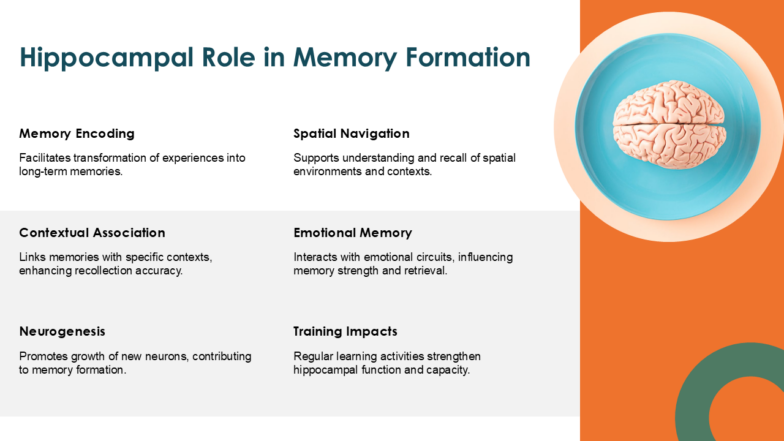
Template 5: Hippocampal Role in Memory Formation
This PPT Slide describes the physiological transformation process that the information takes from short-term to long-term memory, alongside the importance of the hippocampus in that process. The Presentation Theme simplifies the three most critical terms of memory regarding storage, retrieval, and encoding using clear imagery, tone, and real-world examples. Get it now.
Template 6: Types of Memory and the Hippocampus PPT
Download this Presentation Template to explore how our brain stores different kinds of memories. The template covers four main types of memory:
- Declarative memory—events we can describe (like remembering a science formula).
- Procedural memory —refers to skills that we learn and perform automatically, such as riding a bike.
- Ephemeral memory—a type of memory that may last for very short periods of time (like remembering some random thought)
- Spatial memory—long-term memory, which serves to direct and locate the directions.
All the information is well organized in tabular form, showing definitions, functions, real-life examples, the duration of each memory type, and its considerations in day-to-day life.

Template 7: Memory Retrieval Process in the Hippocampus PPT
The retrieval of memory, as this presentation asserts, is more than just a process of "remembering." This involves a complex chain of processes involving searching through possibly relevant stored memories, matching the right ones, and finally retrieving them into our realm of awareness.
These steps, such as encoding, consolidation, storage, retrieval, recognition, recollection, reconsolidation, and integration, are formulated in circular graphic form, which helps in visualizing how memory runs as a continuous and dynamic process. Download it now.

Template 8: Hippocampal Circuitry and Connectivity
This Presentation Template revolves around how the hippocampus functions at different levels. Four main components of connectivity highlighted are-anatomical, molecular, functional, and behavioral. Combining these four components provides a whole picture of the hippocampus, which simplifies highly complex processes into easy-understand concepts with visuals, real examples, and sophisticated scientific explanation.
Overall, this PPT Slide is great for neuroscience researchers to understand how the hippocampus supports rather abstract mental functions with real-world actions.

Template 9: Impact of Stress on Hippocampal Function
This Presentation Preset serves as a guide to elucidate the effect of stress on the brain, specifically on the hippocampus. It is organized into two main sections—pros and cons—to facilitate an easy grasp of the whole picture. For example, it demonstrates how cortisol, a significant stress hormone, can interrupt memory recall and lead to inexpediency in the formation of new memories. In contrast, a little bit of activation of the determinate stress response may also prompt the effective neural networks regarding speedy decision-making.

Template 10: Emerging Technologies in Hippocampal Research PPT
This Presentation Theme explores the innovative tools and techniques such as reinforcement learning used to study the hippocampus in more advanced and exciting ways. The well-structured and visually engaging layout is perfect for researchers interested in how science is unlocking the secrets of the brain.
It also highlights a pie chart that shows the current focus areas in hippocampal research and which ones are getting more attention. Another highlight is a barometer chart, which rates the impact of each emerging technology so that the audience can see which has made a difference in the field. Get it now.

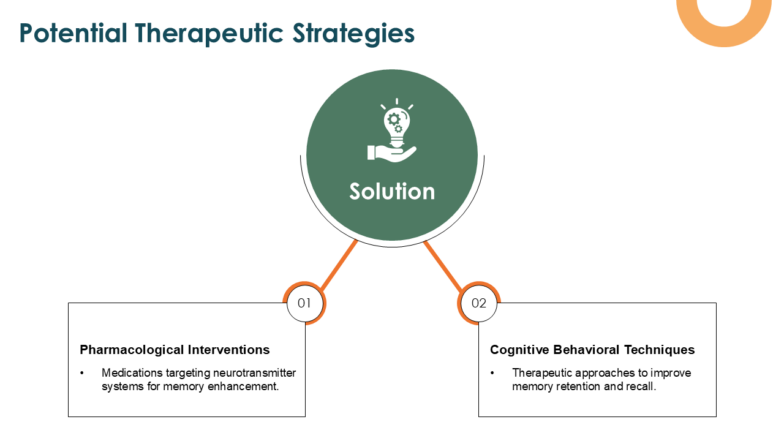
Template 11: Potential Therapeutic Strategies PPT
This Presentation Template surveys alternative methods in enhancing hippocampal function in individuals who suffer from memory deficits, stress-related disorders, or cognitive decline. This presentation design describes two major approaches: pharmacological interventions and cognitive-behavioral therapy (CBT). It illustrates how both strategies work, either on their own or together, with the use of flowcharts, case examples, and comparison tables.
Template 12: Hippocampus and Aging: Implications for Memory PPT
This presentation discusses the important aspects of brain change with aging. The PPT Slide has a pyramid diagram showing layers of cognitive decline, with each stage representations, which represents memory functions as well as other cognitive functions. The main factors are hippocampal shrinkage, neurogenesis drainage , and memory encoding and retrieval.
It also has statistical visuals to show the increasing impact of age on the hippocampus and overall mental performance.

Template 13: Learning Techniques and the Hippocampal Network PPT
In this PPT Slide, a few highly effective learning strategies are highlighted as boosters to memory and brain functioning. The focus is on four brain-friendly cognitive techniques backed by science closely related to how the hippocampal network operates: active recall, chunking, story-formed techniques for embedding information, mind mapping, and visualization techniques.

Wrapping Up: Learn Smarter, Present Better
Memory and learning are not supposed to be mysterious or hard to understand. Using SlideTeam's Memory and Learning PPT Templates, complex concepts such as cognitive processes theory, working memory, and memory consolidation can easily be translated into lessons that learners will find digestible, awakening, and unforgettable.
Ranging from corporate trainers, educators, and students to healthcare professionals, these memory and learning PPT Templates are excellent for simplification of learning techniques, memory retention improvement, and giving each of your presentations an edge over the rest.
Why grapple with all that heavy content and boring presentations when you can simplify memory retention and learning with fun and effective tools offered by SlideTeam?
FAQs on Neuroplasticity & Cognitive Processes
Q1. What is the relationship between memory and learning?
Ans: The brain mechanisms of memory and learning are intimately interrelated. Learning is actually the process by which new information comes into one's mental storage, while memory is the buildup through which one stores and recalls that information later. Whenever something is learned, a connection or pathway is created in our brains. If, however, we don't review and use that information, then our memory becomes weak and goes unpracticed.
Q2. What is the process of memory and learning?
Ans: Memory and learning are deeply interlinked processes within the brain. Learning is an act of acquiring knowledge or experience, while memory concerns the ability to store and retrieve that information. First, we receive information through our senses, which then transfers to short-term memory. If we concentrate on this information or practice it, the brain transfers this information to long-term memory. Through repeated exposure, the brain strengthens the connections between neurons, effectively aiding in memory retention and formation processes such as synaptic plasticity. This entire process enhances our understanding.
Q3. How do you understand learning and memory?
Ans: Learning is an acquisition of knowledge and skills with the help of study, experience, or teaching. Memory is the ability to store, retain, and, later on, retrieve that information when needed. Learning and memory go hand in hand; what is learned is stored in memory, whereas the memory source acts as reinforcement for the application of the learned knowledge.