


Knowledge management powerpoint templates




Try Before you Buy Download Free Sample Product
 Impress Your
 Audience
 100%
100% Editable
 Save Hours
 of Time


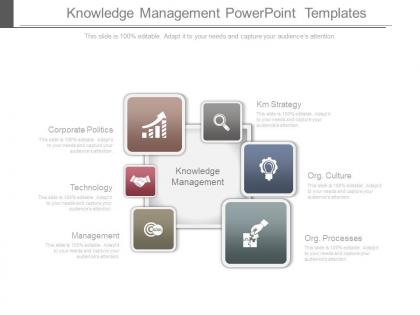
Highlight the importance of management in the organization with our knowledge management PowerPoint template design. Managing every task effectively in the business firm is important as it decide the fate of it. Our presentation slide highlights some key aspects that need to be shared with your audience such as corporate politics, technology, management, knowledge management, km strategy, org culture, org processes. The PPT slide enables you to demonstrate the knowledge management aspect in the professional manner. If you have knowledge about managing the things wisely in the corporate firm then you can easily accomplish your objectives. When you work towards the target you have to ensure that you have solutions for all the obstacles that will come in your way. This Presentation design enables you to do so as it has been professionally designed just to let you convey your message to your audience in the perfect manner. Look at other PPT slides as well as if you are in search of the impeccable design for your next business presentation.Establish your authority with our Knowledge Management Powerpoint Templates. Display ability to control.
People who downloaded this PowerPoint presentation also viewed the following :
Knowledge management powerpoint templates with all 7 slides:
You have repeatedly displayed your professional acumen. Now put a stamp of authority with our Knowledge Management Powerpoint Templates.



FAQs for Knowledge
Honestly, you need four main things to make knowledge management actually work. First, figure out how you'll capture and organize everything - sounds boring but it's crucial. Then pick tech that people will genuinely use (not just the fanciest option). Building a sharing culture is probably the toughest part though. People hoard info naturally. You also need someone keeping things updated so it doesn't turn into digital clutter. Oh, and find your natural sharers - every team has them. Before buying anything expensive, just map out what knowledge you have versus what you're missing. That alone might surprise you.
Honestly, you've gotta make it feel worth their time. People want recognition when they share stuff - like actually calling them out in meetings when they help others. Set up simple things like team wikis or those "what we learned this week" chats. Your managers need to do it first though, because if they're secretive about everything, everyone else will be too. The trick is showing real benefits. Once people realize shared knowledge makes their day easier (not harder), they'll start doing it naturally. Maybe try one small test run first and see what happens?
Honestly, tech is what makes knowledge management actually doable when you've got a big team. Tools like Confluence or Notion let you dump everything in one place instead of having info spread across a million random docs. AI search is clutch too - saves you from spending forever hunting through folders (been there). Real-time collaboration means everyone can jump in and update stuff as needed. My advice? Pick something your team will actually stick with rather than the shiniest new platform. I've seen too many companies go fancy then watch nobody use it.
Check your usage stats first - who's actually hitting the knowledge base and how often. Time-to-resolution is huge too, especially for common issues. I'd definitely run employee surveys because honestly, people will tell you straight up if they can't find what they need. New hire training time is another good one to watch. Oh, and count those "hey does anyone know..." emails - fewer of those means people are finding answers on their own. Don't try to track everything though. Pick maybe 2-3 metrics that actually matter for your team's day-to-day stuff.
Oh man, the user adoption thing will kill you if you're not careful. People hate changing how they work, especially when they can just walk over to Dave and get their answer in 30 seconds. Keeping everything updated is brutal too - I've seen so many systems turn into digital junkyards because nobody maintains them. Finding stuff becomes impossible when your search returns 47 different versions of the same process doc. Start with just one team though. Prove it works there first, then expand. Way less painful that way.
So basically, knowledge management stops you from making the same mistakes twice. Instead of starting from scratch every time, you can actually learn from what's already happened - past projects, wins, failures, whatever. Think of it like your team having a photographic memory. The tricky part is organizing everything so people can find it later (not just dumping files everywhere like my desktop, lol). Start small though - figure out what decisions you're constantly making and build around those first. Way better than just winging it based on hunches.
Dude, most companies totally suck at this until someone retires and walks out with 20 years of knowledge. You need to get your experienced people talking NOW. Set up regular sessions where they can dump what's in their heads. Exit interviews should go deep - not just "how was your experience here?" garbage. Storytelling works way better than boring documentation. Record those random hallway conversations where the real insights happen. Oh, and create wikis with actual examples people can search later. Mentoring relationships are gold for this stuff too. Seriously though, start with whoever's been there longest.
Basically, knowledge management turns your team's collective smarts into innovation fuel. Document what you've learned from past projects - the wins, fails, all of it. Then make it easy for people to actually find and use that stuff (seriously, nobody wants to dig through buried folders). Cross-pollination is where the magic happens though. Marketing might stumble on how engineering tackled something similar and boom - new ideas. Instead of everyone starting from scratch every time, they're building on what already works. Set up some shared spaces where teams can dump insights and browse what others discovered.
Oh man, this stuff really works. People stick around way longer when they can actually find answers instead of banging their heads against problems someone already solved. I've seen it happen - your best developer leaves and takes all their tribal knowledge with them, then everyone's scrambling. Good knowledge sharing makes people feel confident and helps them grow faster too. Honestly, just start small by writing down answers to the same five questions everyone always asks. You don't need some fancy system right away. Once people see how much time it saves, they'll actually start contributing to it themselves.
So it really depends on what matters most to your business. Tech companies obsess over code repos and docs because everything changes so fast. Healthcare? They're paranoid about compliance - can't blame them with patient data on the line. Manufacturing cares more about safety stuff and how to fix machines when they break. Financial companies are super focused on risk and regulations, obviously. Honestly, every industry thinks they're special snowflakes, but there's way more overlap than people realize. I'd just figure out what knowledge would totally screw you if it disappeared tomorrow and start there.
Oh man, consent and privacy are your biggest headaches here. People need to actually want to share their knowledge, not feel pressured into it. Then there's the whole intellectual property nightmare - like, who owns what ideas and gets the credit? Data privacy gets messy too, especially with sensitive stuff. Honestly, proprietary knowledge makes everything way more complicated because of competitive advantages and all that. Being upfront about how you'll use people's knowledge helps. Just make sure everyone benefits from sharing, not just the company - that seems only fair, right?
Honestly, start with smart search - way better than the keyword stuff that never finds what you need. AI can auto-tag and sort your content too, which is a lifesaver. Chatbots are solid for quick answers when people have random questions. The coolest part? It'll actually spot knowledge gaps by tracking what people search for but come up empty on. That's pretty brilliant if you think about it. I'd just pick one thing first though - maybe the search feature - then add more once everyone's convinced it's not just fancy tech for tech's sake.
Honestly, leadership makes or breaks knowledge management - I've seen this play out so many times. Without their buy-in, you're basically pushing a boulder uphill. Find one influential leader who'll champion your cause first. That person can knock down barriers you'd never get past alone. Leaders need to actually walk the walk on sharing knowledge, not just talk about it in meetings. They've got to budget time for these activities instead of cutting them when things get crazy (which, let's be real, is always). Plus they need to reward people who share stuff - otherwise why would anyone bother? The culture piece is huge too. People won't open up if they think they'll get burned for admitting gaps.
Honestly, just start with whatever you've got - Google Docs, shared folders, even a basic wiki works. The whole point is making it dead simple for people to dump their knowledge and actually find stuff later. Go after that "tribal knowledge" first though. You know, all the random processes living in people's heads? I've watched companies completely fall apart when key people left and took everything with them. Not fun. Set up basic templates for your common stuff and get people doing quick brain dumps after projects wrap up. Even if everyone just spends 15 minutes a week on it, you'll build up real knowledge over time. Don't get fancy with systems until you know what actually works.
Honestly, AI-powered knowledge discovery is where things are headed - systems that actually learn from how people use them. Real-time collaboration platforms are huge too. Companies are ditching those old static databases for dynamic stuff that adapts. There's also this whole movement toward letting everyone contribute knowledge, not just the "designated experts" (which makes sense tbh). The workflow integration is getting crazy tight - like, info just pops up when you need it instead of having to search separately. I'd start looking at AI-enhanced platforms now and think about connecting those knowledge silos you probably have.
-
Easily Editable.
-
Nice and innovative design.