


Merchandise Management Powerpoint Presentation Slides





Try Before you Buy Download Free Sample Product
 Impress Your
 Audience
 100%
100% Editable
 Save Hours
 of Time


Address any dichotomy with our Merchandise Management Powerpoint Presentation Slides. Decide on how to end the impasse.
People who downloaded this PowerPoint presentation also viewed the following :
Content of this Powerpoint Presentation
Slide 1: This slide introduces Merchandise Management. State the name of your company and get started.
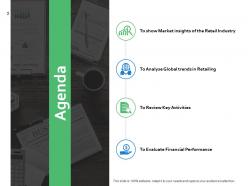
Slide 2: This is an Agenda slide with the following specifications- To show Market insights of the Retail Industry, To Analyse Global trends in Retailing, To Review Key Activities, To Evaluate Financial Performance.
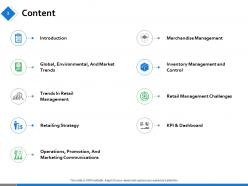
Slide 3: This slide shows Content. Its constituents are- Introduction, Global, Environmental, And Market Trends, Trends In Retail Management, Retailing Strategy, Operations, Promotion, And Marketing Communications, Merchandise Management, Inventory Management and Control, Retail Management Challenges, KPI & Dashboard.
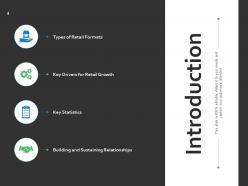
Slide 4: This slide provides a brief Introduction with- Types of Retail Formats, Key Drivers for Retail Growth, Key Statistics, Building and Sustaining Relationships.
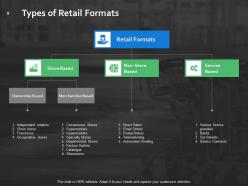
Slide 5: This slide shows the different Types of Retail Formats which are majorly divided into three types- Store Based, Non-Store Based, Service Based.
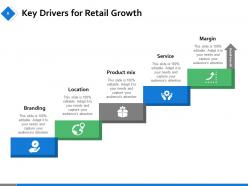
Slide 6: This slide showcases Key Drivers for Retail Growth which are as follows- Branding, Location, Product mix, Service, Margin.
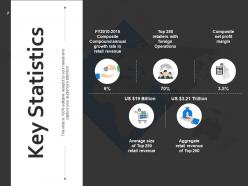
Slide 7: This slide shows Key Statistics with US $19 Billion, US $3.21 Trillion, FY2010-2015- Composite Compound annual growth rate in retail revenue, Top 250 retailers with foreign Operations etc. as examples. You can alter these statistics according to your own business need and requirement.
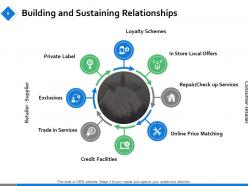
Slide 8: This is Building and Sustaining Relationships slide with the following components- Loyalty Schemes, In Store Local Offers, Repair/Check up Services, Online Price Matching, Credit Facilities, Private Label, Exclusives, Trade in Services, Retailer -Supplier, Consumer-retailer.
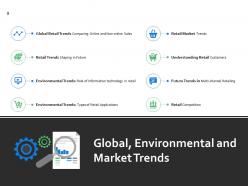
Slide 9: This slide shows Global, Environmental and Market Trends.
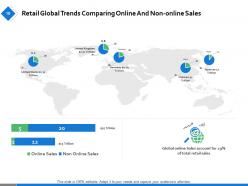
Slide 10: This slide shows Retail Global Trends Comparing Online And Non-online Sales using a world map imagery wherein you can present the stats of different countries.
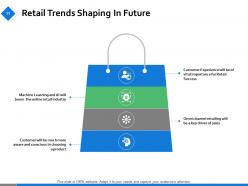
Slide 11: This slide shows the Retail Trends Shaping In Future which involve the following four points- Customer Experience will be of vital importance for Retail Success, Machine Learning and AI will boom the online retail industry, Customer will be much more aware and conscious in choosing a product, Omni channel retailing will be a key driver of sales.
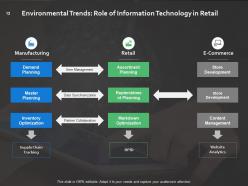
Slide 12: This slide shows Environmental Trends: Role of Information Technology in Retail which is majorly divided into the following three categories- Manufacturing, Retail, E-Commerce.
Slide 13: This slide is 100% editable. Adapt it to your needs and capture your audience's attention. This slide shows Environmental Trends: Types of Retail Applications which involve- POS, Inventory Management, Workforce management, Store-level demand, Perishables Management, Enterprise Retail Systems, Store Operation Systems, Supply Chain Systems.
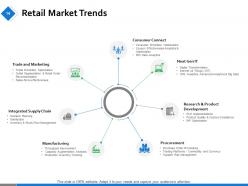
Slide 14: This slide shows Retail Market Trends. These are- Consumer Connect, Research & Product Development, Procurement, Integrated Supply Chain, Trade and Marketing, Next Gen IT, Manufacturing.
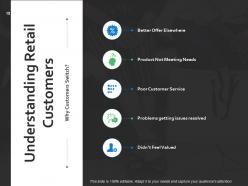
Slide 15: This slide helps in Understanding Retail Customers with the following points- Better Offer Elsewhere, Product Not Meeting Needs, Problems getting issues resolved, Didn’t Feel Valued, Poor Customer Service.
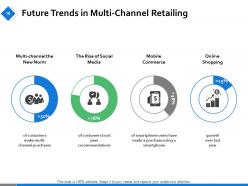
Slide 16: This slide shows Future Trends in Multi-Channel Retailing which involve the following four points- Multi-channel the New Norm, The Rise of Social Media, Mobile Commerce, Online Shopping.
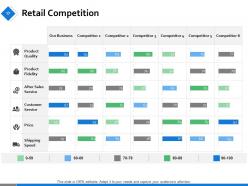
Slide 17: This slide shows Retail Competition analysis.
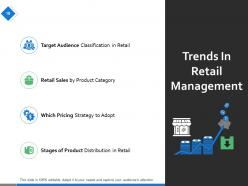
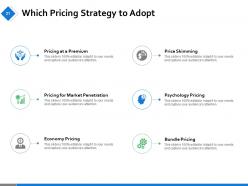
Slide 18: This slide shows Trends In Retail Management which are- Target Audience Classification in Retail, Retail Sales by Product Category, Which Pricing Strategy to Adopt, Stages of Product Distribution in Retail.
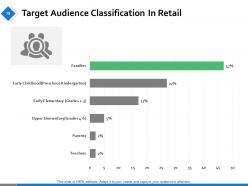
Slide 19: This slide presents Target Audience Classification In Retail in a bar graph/ chart form.
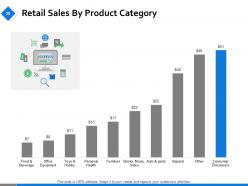
Slide 20: This slide shows Retail Sales By Product Category graphically.
Slide 21: This slide shows Which Pricing Strategy to Adopt. We have mentioned few of its parameters from which you can choose as per your business need.
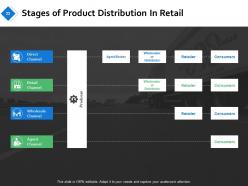
Slide 22: This slide shows Stages of Product Distribution In Retail. It also shows four different channels in retail and their corresponding stages.
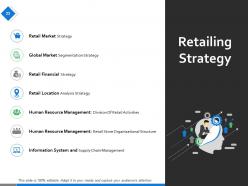
Slide 23: This slide shows Retailing Strategy.
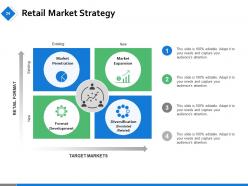
Slide 24: This is shosw Retail Market Strategy matrix slide showing- Market Penetration, Market Expansion, Format Development, Diversification (Unrelated /Related), RETAIL FORMAT, TARGET MARKETS.
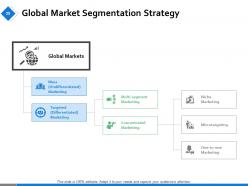
Slide 25: This slide shows Global Market Segmentation Strategy in a flowchart form with points and subpoints.
Slide 26: This slide shows Retail Location Analysis Strategy with Real Estate Planning divided into- Market Research, Performance Measurement, Site Selection.
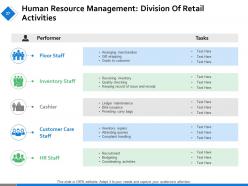
Slide 27: This slide shows Human Resource Management: Division Of Retail Activities with two main subheadings- PERFORMER: Floor Staff, Inventory Staff, Cashier, Customer Care Staff, HR Staff. and TASKS.
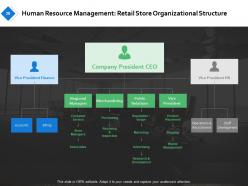
Slide 28: This slide shows Human Resource Management: Retail Store Organizational Structure flow chart with the following subheadings- Company President CEO, Vice President HR, Vice President Finance. We have also mentioned its subpoints which you can use as per your need.
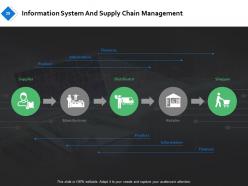
Slide 29: This slide shows Information System And Supply Chain Management.
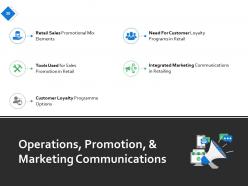
Slide 30: This slide shows Operations, Promotion, & Marketing Communications which include- Customer Loyalty Programme Options, Retail Sales Promotional Mix Elements, Need For Customer Loyalty Programs in Retail, Tools Used for Sales Promotion in Retail, Integrated Marketing Communications in Retailing.
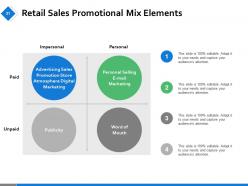
Slide 31: This slide shows Retail Sales Promotional Mix Elements divided into four categories- Paid, Unpaid, Impersonal, Personal.
Slide 32: This slide shows Tools Used for Sales Promotion in Retail- Demos, Samples, 2 for the price of 1, Referral Gifts, Coupons, Contests, Frequent Shopper, Prizes, POP/ POS.
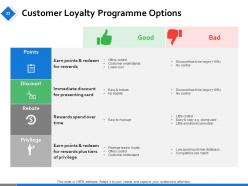
Slide 33: This slide shows Customer Loyalty Programme Options with the following sub headings- Points, Discount, Rebate, Privilege. It also shows Good and Bad parameters denoted by thumbs up and thumbs down imagery.
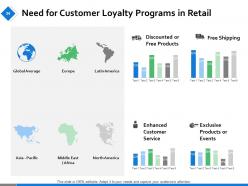
Slide 34: This slide shows Need for Customer Loyalty Programs in Retail with map imagery and charts and graphs.
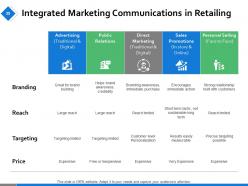
Slide 35: This slide shows Integrated Marketing Communications in Retailing with the following sub headings- Advertising (Traditional & Digital), Public Relations, Direct Marketing (Traditional & Digital), Sales Promotions (In store & Online).
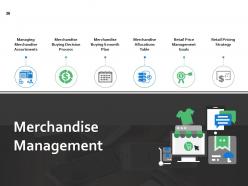
Slide 36: This slide shows Merchandise Management which consists of- Retail Price Management Goals, Merchandise Buying 6 month Plan, Managing Merchandise Assortments, Merchandise Buying Decision Process, Merchandise Allocations Table,
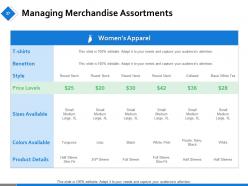
Slide 37: This is Managing Merchandise Assortments slide showing Women’s Apparel.
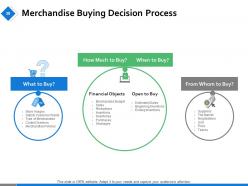
Slide 38: This slide shows Merchandise Buying Decision Process with the following criterias to be stated- How Much to Buy? When to Buy? What to Buy? From Whom to Buy?
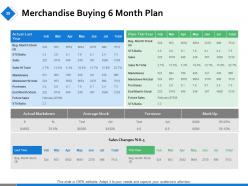
Slide 39: This slide shows Merchandise Buying 6 Month Plan.
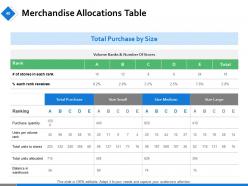
Slide 40: This slide presents Merchandise Allocations Table which shows the Total Purchase by Size.
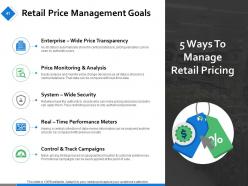
Slide 41: This is Retail Price Management Goals slide mentinoning five ways to manage retail pricing- Price Monitoring & Analysis, System – Wide Security, Real – Time Performance Meters, Control & Track Campaigns, Enterprise – Wide Price Transparency.
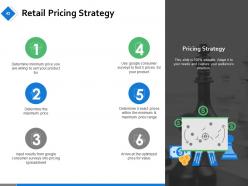
Slide 42: This slide shows Retail Pricing Strategy with the following six points- Determine minimum price you are willing to sell your product for, Determine the maximum price, Input results from google consumer surveys into pricing spreadsheet, Use google consumer surveys to test 5 prices for your product, Determine 5 exact prices within the minimum & maximum price range, Arrive at the optimized price for value.
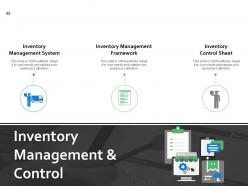
Slide 43: This is Inventory Management & Control slide with- Inventory Management System, Inventory Control Sheet, Inventory Management Framework.
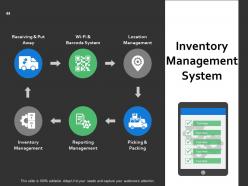
Slide 44: This slide shows Inventory Management System which includes the following steps- Receiving & Put Away, Wi-Fi & Barcode System, Location Management, Picking & Packing, Reporting Management, Inventory Management.
Slide 45: This slide shows Inventory Management Framework with the following sub headings- Inventory Operations, Outbound Operations, Quality Assurance, Inbound Operations.
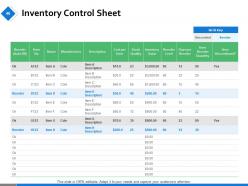
Slide 46: This slide shows Inventory Control Sheet. Use it to add data as per your inventory.
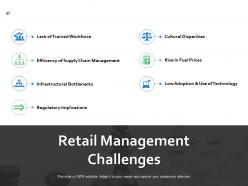
Slide 47: This slide shows Retail Management Challenges listed as- Regulatory Implications, Lack of Trained Workforce, Efficiency of Supply Chain Management, Infrastructural Bottlenecks, Cultural Disparities, Rise In Fuel Prices, Low Adoption & Use of Technology, Retail Management Challenges.
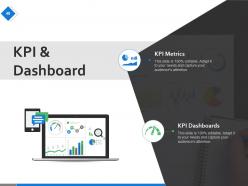
Slide 48: This slide shows KPI & Dashboard consisting of the following two attributes- KPI Metrics, KPI Dashboards.
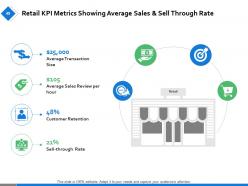
Slide 49: This is Retail KPI Metrics Showing Average Sales & Sell Through Rate slide which consists of information redarding- Retail, Average Transaction Size, Average Sales Review per hour, Customer Retention, Sell-through Rate.
Slide 50: This slide also shows Retail KPI Metrics Showing Average Purchase Value & Online Sales.
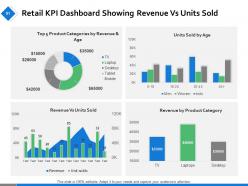
Slide 51: This is another slide showing Retail KPI Dashboard Showing Revenue Vs Units Sold.
Slide 52: This slide also shows Retail KPI Dashboard Showing Total Sales Per Labor Hour Sales By Unit.
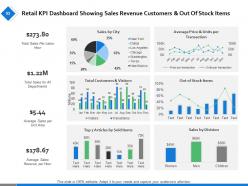
Slide 53: This slide shows another variation of Retail KPI Dashboard Showing Sales Revenue Customers & Out Of Stock.
Slide 54: This is Merchandise Management Icons Slide. Alter the icons as per your requirement.
Slide 55: This slide is titled Additional Slides to move forward. You can change the slide content as per need.
Slide 56: This is a Coffee Break slide to halt. You may change it as per requirement.
Slide 57: This is Our Vision & Mission slide with text boxes to state.
Slide 58: This is Our Team slide. Mention name, designation etc. of your team members here.
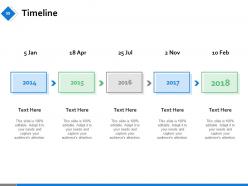
Slide 59: This is a Timeline slide to present important dates, journey, evolution, milestones etc.
Slide 60: This is a Post It slide to mark events, important information etc.
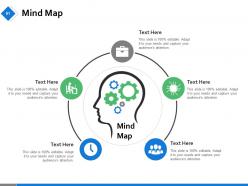
Slide 61: This slide shows a Mind map for representing entities.
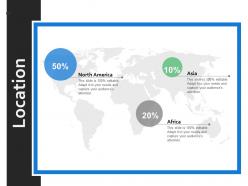
Slide 62: This is a Location slide to show global growth, presence etc. on a world map image.
Slide 63: This is a Quotes slide to convey company/ organization message, beliefs etc. You may change the slide content as per need.
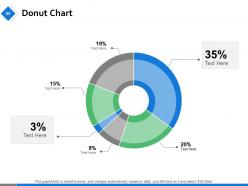
Slide 64: This is a Donut Chart slide to present product/ entity comparison, specifications etc.
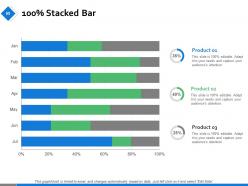
Slide 65: This is a 100% Stacked Bar slide to present product/ entity comparison, specifications etc.
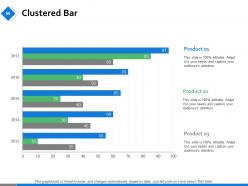
Slide 66: This slide shows a Clustered Bar for product/ entity comparison.
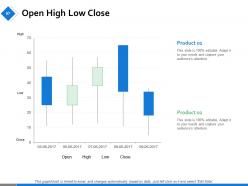
Slide 67: This slide presents Open-High-Low-Close-Chart. You can add the information.
Slide 68: This is a Thank You slide with Address# street number, city, state, Contact Numbers, Email Address.
Merchandise Management Powerpoint Presentation Slides with all 68 slides:
Ensure disputes don't emerge with our Merchandise Management Powerpoint Presentation Slides. It helps forge agreement.









FAQs for Merchandise Management
So basically you need four main things: inventory planning, demand forecasting, supplier relationships, and performance analytics. Understanding what customers actually want is crucial - not what you think they want (trust me on this one). Stock levels need constant optimization, plus you've got to manage vendor partnerships well. Track your sell-through rates and margin performance religiously. Pricing strategy is honestly make-or-break territory - balancing profit with staying competitive. Oh, and definitely start by checking your current inventory turnover rates first, then tackle those slow-moving items that are just sitting there eating up space.
Look, you can't sell stuff you don't have - so your inventory totally messes with how well you can predict sales. Low stock? Your sales get capped artificially, which makes your historical data kinda useless. Having more inventory gives you cleaner data since customers aren't hitting walls when they want to buy. Though honestly, overstocking sucks too with all those carrying costs. Stock-outs and how fast you turn inventory really matter for forecasting. The goal is hitting that sweet spot where you have enough stock that real demand shows up in your numbers, not fake scarcity.
Start with demand forecasting - use your historical data and what's trending in the market. Get some inventory optimization tools so you're not constantly overbuying (learned that one the hard way with clearance hell). Regular assortment planning based on what customers actually want is clutch. Group your products strategically and track those performance metrics like crazy. Good vendor relationships will save your butt when you need quick restocks. Oh, and set up alerts for slow-moving stuff - honestly wish I'd done this sooner. Stay flexible with buying cycles and you'll dodge most dead stock disasters.
Your seasonal trends are everything when planning inventory. Look at last year's data to see when different categories actually sold - heavy coats in July is obviously a no-go. Mix your core year-round stuff with seasonal pieces, but time those markdowns right so you're not stuck with winter gear in March (learned that one the hard way). Peak demand periods are pretty predictable once you map them out. Get your seasonal calendar sorted now because overstocks are a nightmare to deal with later. Short bursts work better than trying to guess what'll happen.
Start with inventory tracking software - that's where you'll see the biggest difference right away. RFID tags and barcode scanners make counting stock so much faster than doing it by hand. Real-time tracking stops those awkward "sorry, we're actually out" situations with customers. Automated reordering is pretty sweet too - it'll trigger new orders when you hit certain stock levels. Analytics help you figure out what's actually selling (and what's just taking up space, honestly). I still can't believe some places try managing inventory with spreadsheets in 2024!
Honestly, data analytics changed everything for my inventory game. You can see which stuff sells fast and what just sits there forever - I wish I'd started tracking this sooner instead of just winging it. Set up alerts for when turnover drops below whatever threshold makes sense for you. Sales patterns tell you when to reorder and how much stock to keep around. The seasonal trends are super helpful too, plus you'll spot slow movers before they become a real problem. Quick price adjustments or promos can fix things fast when your dashboard flags issues.
Honestly, most retailers just guess at this stuff and wonder why they're always overstocked or out of everything. Look at your actual sales data first - what's moving fast, what sits around forever. Set up automatic reorder points for your bestsellers so you don't have to think about it constantly. ABC analysis helps too - focus on the items that actually make you money. Build relationships with suppliers who can turn orders around quickly when you mess up (because you will). The real game-changer is having live inventory data so you can see problems coming. Start by comparing what you have vs. what actually sells.
Dude, the time pressure is insane - you're always racing those expiration dates. Forecasting becomes everything because too much stock = literal money in the garbage, but not enough = missed sales. Your fridges better not break down or you'll lose thousands overnight (learned that one the hard way). Staff has to stay sharp about rotating old stuff first, which honestly can be a pain. Frequent deliveries from good suppliers help way more than bulk orders. Oh, and decent demand planning software is worth every penny - don't cheap out there.
Honestly, customer feedback is like having a cheat sheet for what to buy. Pay attention when people keep asking for stuff you don't carry - that's money walking out the door. Returns are huge too, especially the reasons why people bring things back. I always check which products people rave about versus what just sits there collecting dust. The trick is actually setting up ways to collect this info regularly instead of just hoping you'll remember random comments. Then you gotta be willing to switch things up based on what you're hearing. It's pretty straightforward once you get the hang of it.
Honestly, focus on the relationship side first - don't just call when stuff goes wrong. I learned that one the hard way. Be upfront about what you need and when, but also check in regularly just to stay connected. Pay your bills on time if you want them to pick up the phone later. Oh, and don't put all your eggs in one basket with suppliers, but also don't go crazy with too many either. That gets messy fast. Negotiate payment terms that actually work for everyone. The key is building these connections before you're in panic mode needing something ASAP.
Honestly, good visual merchandising can bump your sales up 20-40% - it's crazy how much difference it makes. People scan left to right and notice eye-level stuff first, so use that. Create focal points with lighting and group products strategically to guide customers around. Cross-merchandising is obvious but works (phone cases by phones, etc). For some weird reason, odd numbers look better in displays than even ones - the "rule of three" thing actually works. Your endcaps and checkout spots are goldmine areas, so rotate your best-margin items there. Just walk through and see where your eyes naturally go first.
Oh man, bad merchandise management will absolutely destroy your reputation. Customers get pissed when you're always out of stock or shipping broken stuff. Social media complaints blow up fast. I've watched brands lose customers over late shipments - like, people who shopped there for years just bounce. Then you're stuck doing damage control which costs way more than just fixing things upfront would've. Negative reviews start piling up and word-of-mouth goes to shit. Honestly, I'd start by looking at your inventory system and figure out what's annoying customers the most.
Dude, sustainability is totally changing how we handle merchandise - it's way more complicated now. Instead of just thinking about sales, I'm planning the whole product journey from sourcing to disposal. Lead times are longer with sustainable products, costs are different, and honestly customers won't shut up about it (not that I blame them). Finding the right vendors means vetting their packaging and waste practices too. The trick is baking those sustainability metrics into your buying decisions right from the start. Can't just slap it on later and call it a day.
Dude, e-commerce is literally everything for merch management now. It shows you real-time data on what's moving and what's just sitting there collecting dust. Without it, you're basically guessing at everything - not fun. Your online channels give you direct customer feedback, plus they can automate reordering so you're not scrambling. Testing new products becomes way easier too since you don't have to commit to huge quantities upfront. Oh, and make sure your e-commerce platform actually syncs with your inventory system. Trust me, constantly chasing stock levels gets old fast.
Dude, you gotta ditch that old-school "plan everything 6 months out" mentality - it's basically useless now. What works is keeping your supply chain super nimble and watching your data like a hawk. Set up alerts for weird sales spikes, order smaller batches more often, and honestly? Kill the duds fast while pumping up whatever's actually selling. I'd create teams that can pivot buying decisions in days instead of weeks. The whole thing comes down to staying flexible and not being precious about products that aren't moving. Real-time analytics will save your butt here.
No Reviews