



 0 Comment
 Customer Reviews

Imagine you are a traditional retail business wanting to launch an online store to reach a broader customer base. If you dive head-first into the project without understanding who your audience is, how you would manage delivery, or how much the investment would be, you are already setting yourself up for failure.
This is why the project discovery phase is essential. At the start of the project, a team will focus on requirement gathering, stakeholder analysis, feasibility study, and market analysis to understand if launching an online store is the right business move.
Then, you can move to the project initiation stage, wherein you clearly define the scope and project objectives, set a timeline estimation, and conduct a risk assessment. Working on these tasks earlier on can help reduce surprises later.
What are the project phases? How do they work? Explore our top 10 project phase templates to know more.
A typical project discovery phase may last anywhere from four to six weeks, but it can help you avoid misalignment once you are in the thick of the project. According to McKinsey & Company, 60% of businesses that use a comprehensive agile discovery process are more likely to complete a project on time and within budget.
Are you starting with a new project but have no clue what to do? Here are our top 7 project planning templates for you to explore.
At SlideTeam, we offer pre-designed templates for project discovery, serving as a blueprint for a comprehensive PPT. Instead of starting from scratch and fumbling about, you can use our content-rich slides, which will provide direction on preparing a customized presentation suited to your project planning needs.
Let’s explore.
Template 1: Project Discovery PowerPoint
The 10+ slides bundle below takes you through the different phases of project discovery. The PPT uses a modern, minimalistic look coupled with creative layouts and infographics to present information. The use of high-contrast colors on a white background improves readability. The slides cover topics such as the project scope discovery cycle along with prototype testing, delivery phases, and review by stakeholders.
[product_image id=524156]
Template 2: Steps of Project Discovery Phase PowerPoint Template
If you have stakeholders wondering what will happen during the project discovery phase, answer using the slide below. The template uses a simple listicle format to highlight the steps. For example, the first step would be to understand the intent behind the project. The second step would be reviewing key project artifacts such as business, contracts, and so on.

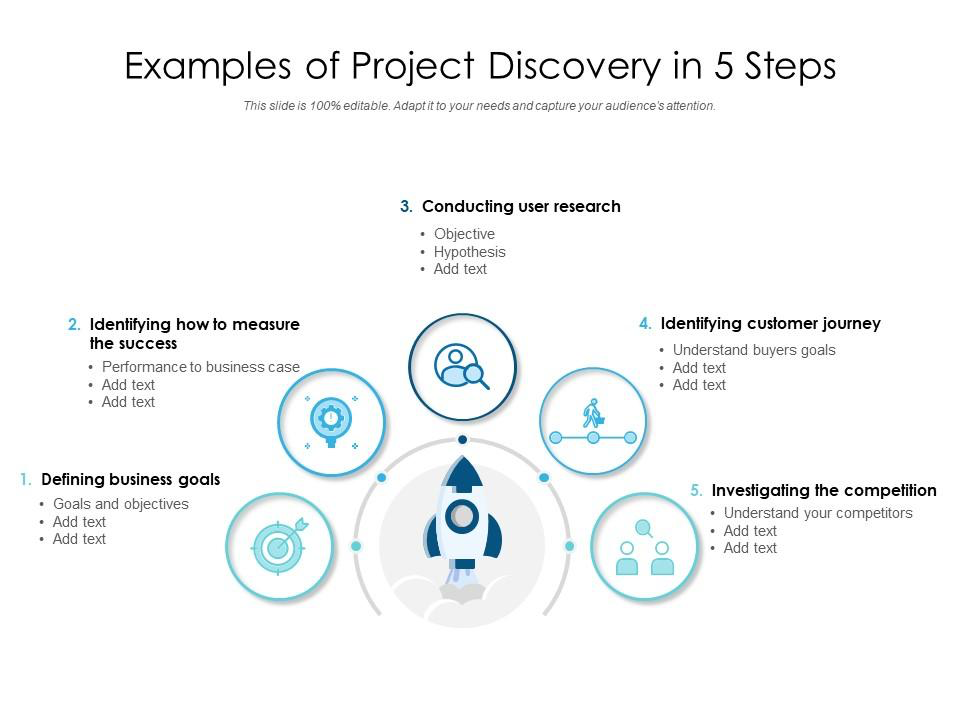
Template 3: Examples of Project Discovery in 5 Steps
You can explain to your audience what a typical project discovery process looks like with this PPT Template. The use of descriptive icons creates a visual impact and engages audiences. Paired with text content, they help reiterate your messaging. The five steps covered in the slide are defining business goals and performance metrics, conducting user research, identifying customer journeys, and understanding competition.
Template 4: Core Tasks of Project Discovery Session Phase
The slide below lists the core tasks carried out during the project discovery phase. The retro-inspired, warm-toned template has an inviting appeal while being easy on the eyes, a combination that encourages engagement. The five core tasks highlighted on the slide are exploring the subject area, identifying bottlenecks, discussing high-level solutions, scope definition, schedule, and budget planning.

Template 5: Process to Create a Project Discovery
You can provide an overview of the project discovery phase using the design-based template below. It uses playful icons and a creative layout to highlight the major steps of the discovery process. These steps include a project overview, competitor analysis, visual design, technical plan, and more. Each step has a short list section available wherein you can mention specific tasks to be carried out.

Template 6: 2 Steps in Project Discovery Process
If you want to highlight the two steps of the discovery process using an eye-catching graphic, the slide below is for you. It uses a colorful ribbon graphic with arrows at the opposite end to highlight the two steps. The first step includes a discussion of the project wherein you will determine plans and techniques. The second step comprises reviewing key project artifacts such as the business case and contracts.

Template 7: Project Discovery to Launching Phase Wise Timeline
From idea to working product - what does the project timeline look like? You can answer the question using the timeline template below. It uses a sequential layout with different colored labels and descriptive icons to highlight project phases. You start with project discovery, create a proposal, implement and test it for quality assurance, and finally launch the product for the target segment.

Template 8: Business Project Scope Discovery Cycle
Here is a professional-looking slide that presents the business project scope within the discovery cycle. It utilizes a hexagonal graphic with descriptive icons to create visual interest and engage the audience. The steps highlighted in the slide are research, ideation, creation, validation, refinement, and alignment. Each step is explained using a one-liner; for example, validation involves testing project capabilities through qualitative techniques.

Template 9: Initial Project Discovery with Agile Architecture
The initial project discovery with agile architecture helps companies build a flexible foundation that can grow as the project scope is being explored. The slide below presents the detailed steps involved in this agile process. Some of the steps highlighted are identifying opportunities, problems, and solutions. At the end of the incremental layout is a circular graphic showing the iterative cycle of building, measuring, and learning.

Template 10: Project Discovery Framework with Iterative and Non-Linear Feedback
The slide below shows the journey of a project from discovery to initiation. It uses a roadmap layout with colored circular icons to mark the steps along the process. You start by defining the problem, understanding how employees deal with it, setting benchmarks, and testing prototypes before project initiation. The slide helps promote team collaboration and ensure all stakeholders are on the same page.

Conduct Thorough Research with our Project Discovery Templates
Project discovery is the foundation on which you can implement a successful idea. The research and analysis steps involved help identify opportunities, risks, and solutions early on. The process helps provide direction to the technical steps that follow with the project launch. If you are new to the discovery process or want to explain its importance to stakeholders, our pre-designed templates can help you do so. From overview to detailed discovery steps, the PPTs cover them all. Our slides are 100% editable and can be customized to suit your business needs.
Do the above slides not meet your requirements? Here are some more project discovery templates for you to explore.
FAQs
-
What is the project discovery phase, and why is it important?
The project discovery phase is conducted before the project goes on the floor. It involves activities such as defining the scope and objectives, understanding user needs, market analysis, and assessing risk. Proactive research on such tasks helps teams align better, identify challenges early on, and be better prepared to handle issues. The discovery phase reduces uncertainty by providing a clear direction from the start and helping complete the project on time and within budget.
-
When should the discovery phase be conducted in a project lifecycle?
The discovery phase must be the first step to be conducted in a project lifecycle. Before you start working on a project, you must know what you are building, why, and for whom it is intended. You should know if the solution is feasible and the amount of effort, time, and money that will be required. The discovery phase helps get answers to these questions before you start with detailed technical plans. It enables you to make data-backed budgeting, scheduling, and resource allocation decisions.
-
Who should be involved during the discovery process (e.g., stakeholders, users, developers)?
The discovery process should involve members from cross-functional teams to ensure well-rounded analysis and insights. Stakeholders, such as clients, business owners, and end users, must be involved to gain an understanding of project requirements and the target audience. Project managers, technical leads, developers, and designers must be engaged for their expertise in management and technical aspects. Such diverse perspectives from the discovery team will help align expectations, identify potential challenges, and promote transparency and collaboration.