


Bowman organizational clock to determine strategy




Try Before you Buy Download Free Sample Product
 Impress Your
 Audience
 100%
100% Editable
 Save Hours
 of Time


Our Bowman Organizational Clock To Determine Strategy are explicit and effective. They combine clarity and concise expression.
People who downloaded this PowerPoint presentation also viewed the following :
Bowman organizational clock to determine strategy with all 2 slides:
Give your audience a fulfilling experience. They will find our Bowman Organizational Clock To Determine Strategy elevating.

FAQs for Bowman organizational clock
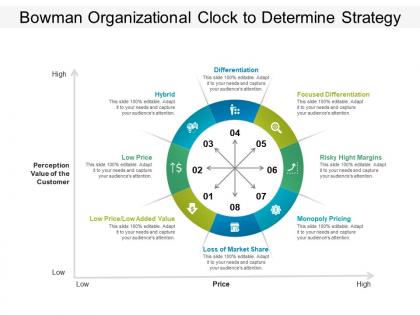
Bowman's Strategy Clock comprises eight strategic positions based on perceived added value and price, including low price/low value, low price, hybrid, differentiation, focused differentiation, risky high margins, monopoly pricing, and loss of market share positions. These components interact dynamically by enabling organizations to identify their competitive positioning, assess strategic movement opportunities across different market segments, and ultimately deliver sustainable competitive advantage through strategic alignment of value proposition and pricing strategy.
Businesses can determine their position on Bowman's Strategy Clock by conducting comprehensive market research, analyzing competitor pricing strategies, evaluating their current value proposition, and assessing customer perceptions of quality versus price. Through customer surveys, competitive benchmarking, and internal cost analysis, organizations can accurately map their strategic position while identifying opportunities for repositioning to enhance competitive advantage and market differentiation.
Cost Leadership strategies in Bowman's Strategy Clock include low price/low added value, low price positioning, and hybrid approaches that combine cost efficiency with acceptable quality levels. These strategies enable organizations to compete through operational efficiency, streamlined processes, and economies of scale, with many retail chains, budget airlines, and manufacturing companies finding that disciplined cost management delivers sustainable competitive advantage and market share growth.
Companies typically shift to a differentiation strategy when competing on price alone becomes unsustainable, market commoditization threatens margins, or unique capabilities emerge that competitors cannot easily replicate. This strategic pivot proves especially valuable for technology firms, luxury retailers, and professional services organizations seeking premium positioning, with many finding that differentiation enables higher profit margins, stronger customer loyalty, and sustainable competitive advantage.
Perceived value directly determines a company's positioning on Bowman's Strategy Clock by influencing customer willingness to pay premium prices relative to competitors offering similar benefits. When customers perceive higher value through superior quality, service, or brand reputation, companies can successfully occupy differentiation positions, while low perceived value constrains firms to cost-focused strategies, ultimately enabling strategic flexibility and competitive advantage in increasingly value-conscious markets.
Market analysis provides critical foundation data for positioning strategies within Bowman's Strategy Clock, enabling organizations to assess competitor positioning, customer price sensitivity, and value perceptions across different market segments. Through comprehensive market research, companies can identify strategic gaps, evaluate feasibility of low-cost versus differentiation approaches, and select optimal clock positions that deliver sustainable competitive advantage while avoiding unsuccessful hybrid strategies.
Bowman's Strategy Clock effectively applies to digital business models by helping companies position themselves across price-value dimensions, whether through low-cost automation, differentiated user experiences, or hybrid approaches combining efficiency with innovation. Digital companies like Netflix use differentiation strategies while Amazon leverages cost leadership through operational excellence, with many tech firms finding that strategic positioning enables sustainable competitive advantage in increasingly crowded digital markets.
Being stuck in the 'No Frills' strategy presents risks including competitor price wars, razor-thin profit margins, limited differentiation opportunities, customer defection to premium alternatives, and vulnerability to cost fluctuations. While this low-cost approach can capture price-sensitive segments, organizations often find that sustaining competitive advantage becomes increasingly difficult without operational excellence, ultimately requiring strategic pivots toward value-added services or enhanced efficiency.
Consumer perception fundamentally determines strategy success on Bowman's Strategy Clock by influencing how customers evaluate price-value relationships, quality expectations, and competitive positioning across different market segments. Organizations in retail, hospitality, and technology sectors find that misaligned consumer perceptions can undermine even well-executed strategies, while accurate perception management enhances market positioning, drives customer loyalty, and ultimately delivers sustainable competitive advantage in increasingly perception-driven markets.
Companies leverage Bowman's Strategy Clock to enter new markets by analyzing competitive positioning, identifying market gaps, and selecting optimal strategic positions based on price and perceived value combinations. Through strategic positioning assessment, organizations can target underserved segments, differentiate offerings, and establish competitive advantages, with many retail and technology companies finding that focused differentiation or hybrid strategies deliver sustainable market entry success.
Netflix exemplifies successful strategic transitions, moving from low-cost DVD-by-mail to differentiated streaming services, while Amazon evolved from cost leadership in books to hybrid differentiation across multiple sectors. These companies demonstrate that strategic repositioning requires substantial investment in new capabilities, technology infrastructure, and market positioning, with many organizations finding that gradual transitions minimize customer disruption while building competitive advantage in increasingly dynamic markets.
Bowman's Strategy Clock limitations include oversimplified positioning assumptions, static market analysis that ignores dynamic competitive environments, limited consideration of resource capabilities, and insufficient attention to external factors like regulatory changes or technological disruption. While useful for initial strategic positioning, many organizations find that complex multi-market strategies require more nuanced frameworks that account for operational flexibility, stakeholder expectations, and evolving customer behaviors, ultimately delivering more comprehensive strategic insights than single-dimension competitive positioning models.
Bowman's Strategy Clock focuses on competitive positioning through price and perceived value combinations, while Porter's Five Forces analyzes industry structure and competitive intensity through supplier power, buyer power, competitive rivalry, substitution threats, and entry barriers. These frameworks complement each other strategically, with many organizations finding that Porter's analysis identifies industry attractiveness and competitive pressures, while Bowman's clock guides specific positioning decisions, ultimately delivering comprehensive strategic insights.
Bowman's Strategy Clock guides product development by helping businesses identify optimal positioning strategies, analyze competitor offerings, determine pricing approaches, and align features with target market expectations. Through strategic positioning analysis, companies can develop products that differentiate through cost leadership, focused differentiation, or hybrid strategies, ultimately delivering competitive advantage and market success across various industry segments.
Understanding Bowman's Strategy Clock enhances competitive advantage in saturated markets by enabling organizations to identify optimal positioning strategies, assess competitor vulnerabilities, and pivot between cost leadership, differentiation, and hybrid approaches based on market dynamics. Through strategic positioning analysis, companies in sectors like retail, telecommunications, and financial services can streamline resource allocation, enhance customer value propositions, and ultimately deliver sustainable market differentiation.
No Reviews