


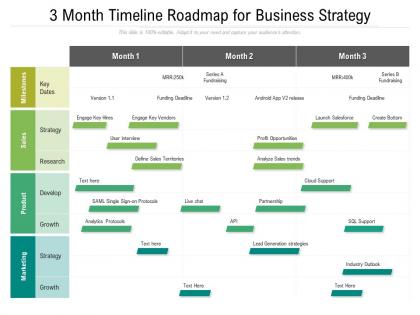
3 month timeline roadmap for business strategy




Try Before you Buy Download Free Sample Product
 Impress Your
 Audience
 100%
100% Editable
 Save Hours
 of Time


The success rate of business plans is hugely dependent on the plan of action, and this editable 3 Month Timeline Roadmap For Business Strategy rightly serves the purpose. Encapsulate all the information related to the project in a well structured manner to obtain maximum efficiency by incorporating our stunning PowerPoint theme. State the critical deliverable, steps involved, time frame, workforce allocation, and lots more in an easy to understand manner by utilizing this pre designed roadmap templates. You can also prioritize your tasks and discuss the problem areas with your colleagues by incorporating this tailor made PPT layout. Empower your work plan by employing this professionally designed PPT theme. Entrepreneurs can download 3 Month Timeline Roadmap For Business Strategy as a beneficial communication tool that facilitates in collaborating with different tasks and achieve targets.
People who downloaded this PowerPoint presentation also viewed the following :
3 month timeline roadmap for business strategy with all 2 slides:
Give your audience a fulfilling experience. They will find our 3 Month Timeline Roadmap For Business Strategy elevating.

FAQs for 3 month timeline roadmap
Here's what you need for a decent business roadmap: Start with your big picture vision - where do you want to be in 3-5 years? Then honestly assess where you're at right now. Map out your main objectives with actual deadlines, figure out what resources you'll need, and pick KPIs that actually matter. Quarterly check-ins are huge - seriously, most roadmaps just sit there collecting digital dust otherwise. Work backwards from your vision to create milestones that make sense. Build in some wiggle room because stuff always changes. The whole point is connecting today's reality with tomorrow's goals through specific actions you can actually take.
First thing - figure out what your team can actually do right now versus what you're dreaming about. Half the roadmaps I've seen are total fantasy! Find those gaps between current reality and your goals. Then bake gap-filling stuff right into your timeline - hiring, training, whatever tools you need. Here's the thing though: your milestones have to match when you'll actually have the capabilities ready. Don't promise a Q2 launch if you won't even have the right people until Q3. Learned that one the hard way.
Look, market analysis is basically your foundation for any decent strategy roadmap. Without it, you're flying blind trying to figure out where opportunities are and what might bite you later. Think of it like planning a road trip without GPS - yeah, you might get somewhere, but probably not where you wanted to go. Your analysis shows you which strategic moves will actually pay off instead of just draining your budget. Honestly, I've seen too many companies skip this step and wonder why their roadmap falls apart. Start with your top 3-5 market insights, then connect each one directly to the roadmap decisions you're facing.
Honestly, just use a simple 2x2 grid - plot impact vs effort for each project. Score them based on how much they actually move the needle for your business goals, then think about complexity and what resources you've got. Obviously go for the high-impact, easy wins first since those build momentum fast. The bigger strategic stuff can wait but don't forget about it entirely. Oh and definitely get your leadership team together to hash out the scoring - way better than trying to figure it out alone. Trust me on that one.
Honestly, just keep it super visual - swimlanes work great for showing different teams or time periods. Color-coding by priority is clutch too. Don't cram every little detail in there or people's eyes will glaze over (learned this the hard way lol). Focus on the big milestones and who owns what instead. Dependencies are key to call out. Make sure your timelines are actually realistic - nothing kills credibility faster than overly optimistic dates. The goal is telling a clear story at first glance. Oh, and definitely share a rough draft early to get feedback. You'll thank me later when you're not doing endless revisions.
Honestly, I'd check your roadmap every 2-3 months. Quarterly at the absolute minimum. Things change so fast now - customer preferences shift, competitors do unexpected stuff, new opportunities pop up. A yearly review? That's way too slow. Some companies do quick monthly milestone checks and save the heavy strategy stuff for quarterly deep dives. Both work, but you gotta pick something and stick to it. Oh, and put those review meetings on your calendar right now as non-negotiable time blocks. Trust me on this one.
Pick metrics that actually matter - mix some leading ones (pipeline growth, acquisition costs) with lagging ones (revenue, retention). Leading indicators give you heads up early. The lagging stuff shows what really happened. Honestly, most companies track way too much useless data that just looks good in meetings. Keep it to 3-5 metrics per goal, otherwise you'll go crazy trying to track everything. Set up a basic dashboard and check it monthly. That's frequent enough to catch problems before they get worse, but not so often you're obsessing over every tiny change. Works way better than quarterly reviews where it's too late to fix anything.
Honestly, ditch the gut-feeling approach and let data do the heavy work. Analytics tools are game-changers for tracking market trends and what competitors are up to. Monday or Asana make timelines way less messy than spreadsheets (though I still use Excel for random stuff lol). AI can spot blind spots you'd totally miss otherwise. Here's the thing though - don't go crazy with every new tool that pops up. Pick maybe 2-3 that actually talk to each other. I'd start with a solid analytics dashboard first, then build out from there. Way less overwhelming that way.
Honestly, don't try to map out every detail for the next 5 years - that's just setting yourself up for frustration. Everything takes way longer than expected, so those timelines you think are realistic? They're probably not. Get other teams involved early or you'll miss obvious dependencies that'll bite you later. Oh, and here's the thing that drives me crazy - people cramming every possible initiative onto one roadmap. It becomes this messy document nobody actually uses. Stick to your top 3-5 priorities max. Build in checkpoints to pivot when things inevitably change direction.
So here's the thing - a strategy roadmap basically shows everyone how their work connects to the bigger goals. Marketing can see how their campaigns tie into sales targets. Sales gets why their pipeline matters for operations. It's honestly like giving everyone the same map instead of wandering around blind. The visual part is what really clicks for people - suddenly they can spot where teams need to hand things off or work together. I'd start small though, maybe pick one big project that involves multiple departments and map that out first. You'll be surprised how fast things start flowing better when people actually understand what everyone else is doing.
Mix it up with different approaches depending on what you need. One-on-ones work best for sensitive stuff or when you're talking to executives. Workshops are gold for getting people to bounce ideas off each other. Surveys can reach tons of people quickly - good luck actually getting responses though, that's always fun. Focus groups are your friend when you need to dig deep into specific roadmap pieces. Oh, and don't forget regular steering committee meetings to keep the big decision-makers in the loop. Really just match your method to your audience and what you're trying to figure out.
Your roadmap's gonna change constantly because of outside stuff - that's just reality. Economy tanks? You're cutting costs instead of expanding. Competitor drops something crazy? Time to pivot or you're screwed. I've seen companies get blindsided by market shifts they totally didn't see coming. The trick is building in flexibility from the start. Don't make your roadmap so rigid that every change feels like starting over. When things shift (and they will), you want to be tweaking your plan, not panicking and rebuilding everything from scratch.
Honestly, you've gotta hit people from multiple angles or they'll just forget about it. Do an all-hands first to paint the big picture, then break into smaller team sessions so everyone gets how they fit in. Charts and timelines work way better than endless bullet points - trust me on this one. Set up regular check-ins, maybe monthly depending on your timeline. Don't be that person who brings it up constantly though. Create somewhere people can actually find the roadmap later, and let them ask questions. The whole thing should feel collaborative, not like some executive just handed down orders from their ivory tower.
Set up quarterly check-ins to actually look at your priorities again - market shifts, money situation, competition, all that stuff. Your roadmap shouldn't be set in stone (I've watched so many teams crash because they treated it like the bible). Keep the next 6 months pretty detailed, but anything past a year? Stay high-level and directional. Also figure out your "oh shit" triggers beforehand - revenue numbers, customer complaints, whatever would make you pivot. Way better than just scrambling when things go sideways. Flexibility needs to be planned, not improvised.
Leadership buy-in is huge - without it, your roadmap's just another forgotten document. They need to actually champion the strategy and keep everyone aligned when stuff inevitably gets chaotic. Plus someone has to make the tough calls when priorities shift (and trust me, they always will). The "why" behind decisions? That communication needs to come from the top. Honestly, I'd make sure your leadership team is genuinely committed before you even start building anything. Their energy - good or bad - spreads to everyone else fast. Don't skip this step.
No Reviews