


Broken process template 1




Try Before you Buy Download Free Sample Product
 Impress Your
 Audience
 100%
100% Editable
 Save Hours
 of Time


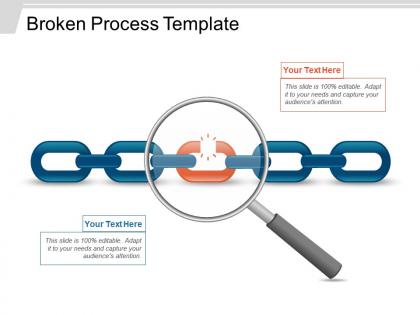
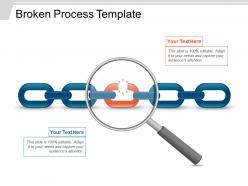
Use our new broken process template one to analyse the mishappening that took place in the working of your organisation. The business PPT template slide can be used in explaining process roadblocks to a number of workers in an organisation. This can only be used in production and manufacturing sector industries. This is a three stage process and the three stages are broken process, broken chain and broken link. It helps a manager in presenting a broken process and all the alternative solutions to the top level associates. Our experts have designed the template slide in such a manner that there are minor editings left that need to be done by you. The chain shaped slideshow helps the audience understand the concept easily as it shows the broken part in between the complete work done. You get to choose from thousands of icons to be used. Bring about the change they all desire with our Broken Process Template 1. You will be like a breath of fresh air.
People who downloaded this PowerPoint presentation also viewed the following :
Broken process template 1 with all 5 slides:
Inspire folks to dream with our Broken Process Template 1. Give them an ideal to aspire for.


FAQs for Broken
Start with whatever process is making everyone want to quit - that's your goldmine right there. Talk to the people actually doing the work since they'll tell you exactly what's broken. Map out how things currently flow so you can spot the obvious bottlenecks. Data beats hunches every time, trust me on this. Don't try fixing everything at once though, that's where teams crash and burn. Pick one thing, run a small test, see what happens. If it works, great - do more of it. Oh and this isn't a one-time thing, you've got to keep tweaking stuff. Customer needs should drive everything else.
Honestly, just ask your team where they're getting frustrated - they know exactly what's driving them crazy. Map out how things actually work right now, then look for the obvious stuff like bottlenecks and places where work just sits there forever. Your data will show patterns too... high error rates, things taking way longer than they should. Customer complaints are pretty much a roadmap to your biggest problems. I'd actually walk through the process myself if I were you - sometimes you catch weird inefficiencies that don't show up in documentation. Oh, and definitely tackle whatever's causing the most headaches first.
Dude, customer feedback is like your reality check - it shows you where your processes actually fall apart in real life. You think everything's running smooth, but customers will straight up tell you where stuff gets annoying or breaks down. They're living through your system daily, so they catch problems you'd never notice from your desk. Sometimes their complaints reveal issues I didn't even realize were happening! The trick is actually listening to what they say and doing something about it. Don't just collect feedback and shove it in some random folder to forget about.
Start with whatever your team already knows - don't overthink it. Lucidchart or Visio work great for flowcharts, but honestly? Sometimes sticky notes on a whiteboard get people way more involved in the conversation. Swimlane diagrams help you see those annoying handoffs between departments. Value stream mapping's perfect for spotting waste and bottlenecks. Time studies let you measure each step properly. SIPOC diagrams give you that bird's-eye view of inputs and outputs - super helpful once you get the hang of them. Focus on mapping your current state accurately first, then worry about fancy tools later.
Look, you gotta connect your process stuff to what the company actually wants - more money, happy customers, cutting costs, whatever. I've seen way too many improvement projects that just... exist for no reason and die a slow death. Figure out which processes actually matter for your big goals first. Then focus on changes that'll move those numbers. Map everything back to real business results and track metrics your boss cares about. Honestly, operational efficiency means nothing if it doesn't tie to strategic wins. Make sure there's always a clear connection between what you're fixing and why it matters to the bottom line.
Honestly, start simple with just 3-5 metrics or you'll drown in data. Focus on cycle time, throughput, and error rates for the basics. Customer feedback scores are clutch too. Don't forget employee engagement - I've seen so many projects tank because leadership ignored whether their team was actually on board. ROI and cost savings are no-brainers, but track the soft stuff like reduced rework too. That adds up fast. Once you get comfortable with your core metrics, then you can expand. But seriously, resist the urge to measure everything from day one.
Honestly, tech can totally save your process improvement or completely tank it. Map out your better process first, then pick tools that actually fit it. Don't do what half the companies I know did - buying fancy software before figuring out their workflow. That's just expensive chaos. Good tech cuts out those annoying manual handoffs and shows you where things get stuck in real time. Oh, and fewer mistakes obviously. Pick one process to test it on first. Once you see it working, you can roll it out everywhere else.
Honestly, people just hate change - that's your biggest headache right there. Your team will cling to the old way of doing things, and getting leadership to actually commit (not just say they support it) is like pulling teeth. Scope creep will kill you too, along with never having enough resources. Oh, and the data? It's always a mess, which makes proving your improvements nearly impossible. Communication between different departments is usually trash. Here's what works though: get some quick wins first to show people this isn't just another corporate initiative that'll disappear. Don't go after the big scary processes until you've got momentum.
Honestly, you've got to make improvement feel safe first - celebrate the small wins and even the experiments that flop. Give people actual time to work on their ideas too, because telling someone "great suggestion, now squeeze it into your lunch break" is soul-crushing. Regular team retrospectives help a lot, just make sure they don't turn into blame sessions. Leadership needs to walk the walk here, not just talk about it. Oh, and definitely track what's actually working and share those wins around - people need to see their effort matters. Nothing's worse than shouting suggestions into the void, you know?
Honestly, the people stuff matters way more than most managers realize. Your team won't get new procedures without solid training - that's obvious. But here's what trips everyone up: engagement is just as crucial. Disengaged employees will either phone it in or straight-up sabotage your changes. I've watched "flawless" improvements crash and burn because leadership ignored this part. Get your team involved from the start - let them spot problems and help design fixes. Once they understand why you're changing things (and feel heard), they'll actually champion the new processes instead of fighting them.
So lean is basically about spotting waste and getting rid of it. There are eight types - overproduction, waiting, defects, all that stuff. What's nice is you get actual tools to work with, like value stream mapping and 5S. These help you see where things are getting stuck. Honestly, the continuous improvement part is what sold me on it - you're making small tweaks constantly instead of doing huge scary changes. Just start by mapping your current process and mark where delays happen. I bet you'll spot problems you didn't even realize were there. Way easier than I thought it'd be.
Here's the deal - Kaizen is all about tiny daily improvements with your whole team chipping in. Six Sigma? That's the heavy artillery for big problems, complete with statistical analysis and certified specialists. Kaizen happens naturally on the floor when someone suggests a quick fix. Meanwhile, Six Sigma requires formal training and structured project phases (honestly can be overkill sometimes). Got a process that needs total reconstruction? Six Sigma's your move. Just want to keep getting better with what you've already got? Kaizen works perfectly for that.
Honestly, the biggest mistake people make is treating improvements like a one-time thing instead of baking them into how you actually work. Train your team properly and update all the procedures - but here's the real kicker: you've got to keep measuring the right stuff consistently. I can't tell you how many "successful" changes I've watched quietly fall apart after six months because nobody tracked them anymore. Someone needs to own these processes long-term, not just during the rollout phase. Do regular check-ins to catch problems early. Basically, weave it into your daily routine rather than just slapping it on top.
Oh man, Toyota's the classic example - they totally changed how cars get made by cutting waste and letting workers actually stop production when something's wrong. Pretty genius if you ask me. Amazon does something similar in their warehouses, using data to optimize picking routes and where stuff gets stored. Hospitals have gotten in on this too, reducing wait times and medication screwups through better processes. But here's the thing - none of these were quick fixes. They created environments where employees constantly hunt for problems and pitch solutions. It's like baked into how they operate now.
Totally depends on your industry, honestly. Manufacturing focuses on lean stuff and cutting waste, but healthcare? That's all about patient safety and staying compliant with regulations. Financial companies obsess over risk management - makes sense I guess. You can't just copy what works elsewhere and expect magic to happen. Six Sigma works great but you've got to tweak it for your specific situation. Look at what your actual competitors are doing instead of generic advice online. Each sector has totally different pain points and customer expectations, so start there first.
-
Innovative and Colorful designs.
-
Designs have enough space to add content.