

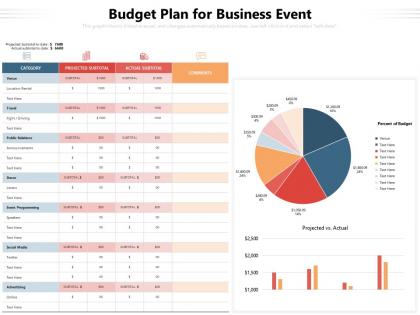
Budget plan for business event




Try Before you Buy Download Free Sample Product
 Impress Your
Audience
 100%
Editable
 Save Hours
of Time


Our Budget Plan For Business Event are topically designed to provide an attractive backdrop to any subject. Use them to look like a presentation pro.
People who downloaded this PowerPoint presentation also viewed the following :
Budget plan for business event with all 2 slides:
Use our Budget Plan For Business Event to effectively help you save your valuable time. They are readymade to fit into any presentation structure.


FAQs for Budget plan
A successful budget includes revenue forecasting, fixed and variable expense tracking, cash flow projections, contingency reserves, and performance metrics. These components work together by providing comprehensive financial visibility, enabling proactive resource allocation, and establishing measurable targets, with many organizations finding that strategic budgeting ultimately delivers enhanced operational control and sustainable growth opportunities.
Individuals can differentiate between essential and non-essential expenses by categorizing costs into needs versus wants, evaluating necessity for daily functioning, and assessing long-term financial impact. This approach enables better resource allocation by prioritizing housing, utilities, and healthcare over entertainment or luxury purchases, while many find that tracking spending patterns for 30 days reveals surprising insights, ultimately delivering improved financial control and strategic savings growth.
Effective budgeting techniques include the 50/30/20 rule, zero-based budgeting, envelope method, automated savings transfers, and regular expense tracking through apps or spreadsheets. These approaches streamline financial management by establishing clear spending boundaries, automating goal-oriented savings, and providing real-time visibility into spending patterns, ultimately delivering improved financial discipline and accelerated progress toward long-term objectives.
You should review your budget monthly for tracking progress and quarterly for strategic adjustments, with annual comprehensive reviews for major goal reassessment. This systematic approach enables businesses to respond to market changes, seasonal fluctuations, and growth opportunities while maintaining financial control, with many organizations finding that regular reviews improve resource allocation and competitive positioning.
Technology revolutionizes modern budgeting through automation, real-time data analytics, cloud-based collaboration platforms, and AI-driven forecasting tools. These solutions streamline budget creation, enhance accuracy through predictive modeling, and enable cross-departmental collaboration, with many organizations finding that automated systems reduce planning cycles by 50% while improving financial visibility and strategic decision-making capabilities.
Creating budgets for irregular income involves calculating your lowest monthly earnings baseline, building emergency reserves, prioritizing essential expenses first, and using percentage-based allocations rather than fixed amounts. Freelancers, consultants, and seasonal businesses find success by setting aside surplus income during peak periods, maintaining separate accounts for taxes and emergencies, ultimately delivering financial stability and predictable cash flow management despite income fluctuations.
Common budgeting pitfalls include underestimating costs, failing to account for unexpected expenses, setting unrealistic targets, neglecting regular review cycles, and poor communication across departments. These mistakes often lead to cash flow problems, project delays, and strategic misalignment, with many organizations finding that implementing structured monitoring processes and contingency planning significantly enhances financial predictability and operational efficiency.
Zero-based budgeting benefits personal finances by requiring you to justify every expense from scratch, eliminating unnecessary spending, and ensuring intentional money allocation toward priorities like savings, debt repayment, and goals. This approach enables greater financial awareness, reduces wasteful expenditures, and ultimately delivers improved cash flow control, with many individuals finding that it accelerates wealth building and debt elimination.
Cultural attitudes toward money significantly impact budgeting strategies through varying approaches to saving, spending priorities, debt tolerance, and financial planning horizons. These differences influence whether organizations emphasize conservative cash reserves, aggressive growth investments, or collaborative financial decision-making, with many multinational companies finding that adapting budgeting frameworks to local cultural contexts delivers better employee engagement and more realistic financial outcomes.
Budgeting software includes QuickBooks, Microsoft Excel, Sage Intacct, Oracle Planning and Budgeting Cloud, and specialized platforms like Adaptive Insights. These tools streamline financial planning by automating calculations, enabling real-time collaboration, and providing detailed forecasting analytics, with many organizations finding that integrated dashboards significantly reduce budgeting cycles while enhancing accuracy and strategic decision-making capabilities.
Budgeting reduces stress by providing clear visibility into income, expenses, and financial goals, enabling better decision-making and eliminating uncertainty about money management. Through systematic planning and expense tracking, individuals and households can build emergency funds, reduce debt burdens, and achieve financial milestones, ultimately delivering peace of mind and long-term financial stability.
Tracking spending habits provides crucial visibility into financial patterns, identifies unnecessary expenses, reveals seasonal trends, and highlights areas for optimization. This data-driven approach enables businesses and individuals to make informed decisions about resource allocation, streamline operational costs, and ultimately enhance financial control, with many organizations finding that consistent tracking delivers significant cost savings and improved budget accuracy.
Focused budgeting strategies for students and young professionals emphasize zero-based budgeting, envelope systems, automated savings, and expense tracking through mobile apps. These approaches enable young earners to build emergency funds, manage student loans, and establish credit responsibly, while many find that starting with simple 50/30/20 allocation rules ultimately delivers financial literacy and long-term wealth-building habits.
Savings goals significantly enhance long-term budgeting success by providing clear direction, measurable milestones, and sustained motivation throughout the financial planning process. These strategic targets enable individuals and organizations to prioritize spending decisions, streamline resource allocation, and maintain disciplined financial habits, with many finding that specific, time-bound goals ultimately deliver greater wealth accumulation and improved financial stability.
Family budgeting differs from individual budgeting by requiring coordinated decision-making, multiple income sources, shared expenses like housing and childcare, and long-term planning for dependents' needs. Successful strategies include regular family financial meetings, designated spending categories for each member, emergency funds scaled to family size, and collaborative goal-setting, with many households finding that transparency and defined roles ultimately enhance financial stability and reduce money-related conflicts.
-
Great quality slides in rapid time.
-
Easily Editable.
-
Presentation Design is very nice, good work with the content as well.