


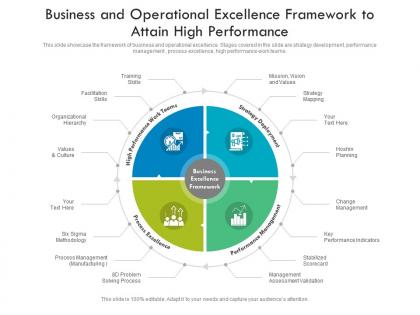
Business and operational excellence framework to attain high performance




Try Before you Buy Download Free Sample Product
 Impress Your
 Audience
 100%
100% Editable
 Save Hours
 of Time


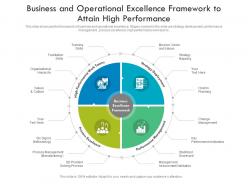
This slide showcase the framework of business and operational excellence. Stages covered in the slide are strategy development, performance management , process excellence, high performance work teams.
People who downloaded this PowerPoint presentation also viewed the following :
Business and operational excellence framework to attain high performance with all 2 slides:
Use our business and operational excellence framework to attain high performance to effectively help you save your valuable time. They are readymade to fit into any presentation structure.
FAQs for Business and operational excellence framework to
Key components of a Business Excellence Framework include leadership commitment, strategic planning, customer focus, process optimization, employee engagement, performance measurement, and continuous improvement initiatives. These elements work together by aligning organizational goals with operational execution, fostering innovation across departments, and establishing accountability metrics, with many organizations finding that this integrated approach delivers enhanced competitiveness and sustainable growth.
Organizations can effectively measure progress within a Business Excellence Framework through performance dashboards, customer satisfaction metrics, employee engagement surveys, financial indicators, and operational efficiency benchmarks. These measurement tools enable systematic tracking by establishing clear KPIs, conducting regular assessments, and benchmarking against industry standards, ultimately delivering actionable insights that drive continuous improvement and sustainable competitive advantage.
Leadership serves as the cornerstone of Business Excellence Framework implementation, driving strategic vision, cultural transformation, resource allocation, and sustained commitment throughout the organization. Effective leaders champion these initiatives by modeling excellence behaviors, empowering cross-functional teams, and maintaining long-term focus, with many organizations finding that strong leadership commitment directly correlates with framework success and measurable performance improvements.
Industries adapt the Business Excellence Framework by customizing evaluation criteria, performance metrics, and implementation timelines to align with their unique operational requirements and regulatory environments. Manufacturing companies emphasize quality control and safety standards, while financial services focus on risk management and customer data protection, and healthcare organizations prioritize patient outcomes and compliance, ultimately delivering sector-specific improvements that enhance competitive positioning.
Common challenges include resistance to change, lack of leadership commitment, insufficient resources, inadequate training, and difficulty measuring progress against excellence criteria. Organizations often struggle with cultural transformation and sustaining momentum, with many finding that phased implementation, clear communication strategies, and dedicated change management teams help overcome these barriers while delivering improved operational efficiency and competitive advantage.
Employee engagement can be enhanced through Business Excellence Framework principles by fostering transparent communication, empowering decision-making, recognizing achievements, providing continuous learning opportunities, and aligning individual goals with organizational objectives. These approaches streamline workplace satisfaction and productivity, with many organizations in healthcare, manufacturing, and financial services finding that systematic feedback mechanisms and skills development programs ultimately deliver higher retention rates and improved performance outcomes.
Key metrics include customer satisfaction scores, employee engagement levels, operational efficiency ratios, financial performance indicators, and process cycle times. These measurements enable organizations to track improvements across quality, productivity, and profitability dimensions, with many companies finding that balanced scorecards combining leading and lagging indicators ultimately deliver the most comprehensive assessment of strategic transformation success.
A Business Excellence Framework supports continuous improvement by establishing standardized assessment criteria, performance metrics, and systematic review processes that identify improvement opportunities across operations. Through structured evaluation methodologies, organizations streamline workflow inefficiencies, enhance quality standards, and accelerate decision-making processes, with many companies finding that regular framework application delivers sustained operational excellence and competitive advantage.
Business Excellence Frameworks increasingly integrate sustainability practices as core components, recognizing environmental and social responsibility as essential for long-term competitive advantage. These frameworks enable organizations to systematically embed sustainable operations, resource efficiency, and stakeholder engagement into their strategic planning, with many companies finding that sustainability-focused excellence models enhance brand reputation, reduce operational costs, and drive innovation while meeting regulatory requirements.
Technology integration significantly enhances Business Excellence Framework effectiveness by automating processes, enabling real-time performance monitoring, and facilitating data-driven decision making across organizational levels. Through advanced analytics and digital platforms, organizations streamline operations, improve quality control, and accelerate continuous improvement cycles, with many companies finding that integrated systems ultimately deliver enhanced operational efficiency and competitive advantage.
Toyota's implementation of the Toyota Production System exemplifies business excellence through continuous improvement, waste reduction, and quality management, while Singapore Airlines achieved operational excellence through service standardization, employee empowerment, and customer-centric processes. These frameworks enable organizations to streamline operations, enhance customer satisfaction, and maintain competitive advantage, with many companies finding that systematic excellence approaches ultimately deliver measurable improvements in efficiency, profitability, and market positioning.
Small and medium-sized enterprises can leverage the Business Excellence Framework by implementing systematic process improvements, establishing clear performance metrics, enhancing customer focus, and developing employee capabilities through structured approaches. These organizations often find that adopting framework principles like continuous improvement and stakeholder engagement delivers improved operational efficiency, better customer satisfaction, and sustainable competitive advantage, ultimately enabling scalable growth in increasingly competitive markets.
Strategies include establishing clear performance standards, implementing continuous improvement processes, recognizing and rewarding exceptional achievements, investing in employee development programs, and promoting accountability at all levels. These approaches enhance organizational culture by encouraging innovation, streamlining operations, and empowering teams to exceed expectations, with many companies finding that consistent excellence initiatives ultimately deliver improved productivity, higher employee engagement, and sustained competitive advantage.
The Business Excellence Framework aligns with customer satisfaction and quality management by integrating customer feedback mechanisms, continuous improvement processes, and quality metrics across all organizational levels. This strategic combination enables companies to streamline service delivery, enhance product quality, and accelerate response times, with many organizations finding that systematic excellence initiatives ultimately deliver superior customer experiences and sustainable competitive advantage.
Training and development can be incorporated through competency mapping, continuous learning programs, leadership development initiatives, skills gap analysis, and performance-based learning pathways. These approaches enhance organizational capabilities by aligning employee growth with strategic objectives, fostering innovation culture, and building adaptive skills, with many organizations finding that systematic development programs ultimately deliver improved productivity and sustainable competitive advantage.
-
Visually stunning presentation, love the content.
-
Innovative and Colorful designs.
-
Awesome presentation, really professional and easy to edit.
-
Good research work and creative work done on every template.
-
Great product with effective design. Helped a lot in our corporate presentations. Easy to edit and stunning visuals.
-
Use of icon with content is very relateable, informative and appealing.
-
Very well designed and informative templates.