


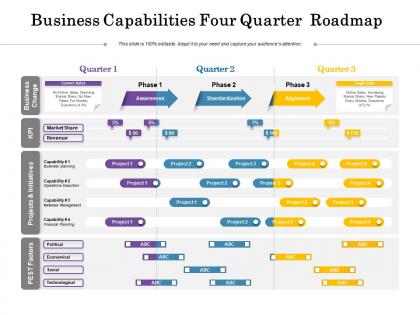
Business Capabilities Four Quarters Roadmap




Try Before you Buy Download Free Sample Product
 Impress Your
 Audience
 100%
100% Editable
 Save Hours
 of Time


Nutzen Sie unsere vorgefertigte Business Capabilities Four Quarters Roadmap, um Ihren Aktionsplan so effektiv wie möglich zu präsentieren. Reduzieren Sie den Papierkram und zeigen Sie, wie verschiedene Aktivitäten miteinander verknüpft sind, indem Sie dieses aufmerksamkeitsstarke PowerPoint-Thema integrieren. Dieses vollständig bearbeitbare Roadmap-PPT-Layout ist geeignet, um alle Ihre Anforderungen zu erfüllen und einen strukturierten Überblick über den gesamten Prozessablauf mithilfe von Farbcodierung zu erhalten. Stellen Sie Ihren Teamkollegen Richtlinien zum Fortschrittsprozess zur Verfügung, indem Sie unser PPT-Design verwenden. Teammitglieder können einfach in Teams eingeteilt werden, indem sie auf die innerhalb des Zeitrahmens zu erreichenden Arbeitsmeilensteine zugreifen. Sie können die PowerPoint-Folie ganz einfach an Echtzeitsituationen anpassen. Laden Sie unsere beeindruckende Business Capabilities Four Quarter Roadmap herunter, und schon können Sie Ihr Fachwissen in der strategischen Planung unter Beweis stellen.
People who downloaded this PowerPoint presentation also viewed the following :
Business Capabilities Roadmap für vier Quartale mit allen 2 Folien:
Verwenden Sie unsere Vier-Quartals-Roadmap für Business Capabilities, um effektiv dabei zu helfen, wertvolle Zeit zu sparen. Sie sind gebrauchsfertig und passen in jede Präsentationsstruktur.
FAQs for Business capabilities
A business capabilities roadmap includes capability assessments, strategic priorities, technology requirements, resource allocation plans, and implementation timelines. These components work together by identifying current gaps, aligning capabilities with business objectives, and establishing clear development pathways, with many organizations finding that structured roadmaps accelerate transformation initiatives while minimizing operational disruptions.
Organizations effectively identify core capabilities through comprehensive capability assessments, stakeholder interviews, competitive analysis, performance benchmarking, and strategic alignment reviews. These methods enable businesses to map current strengths against future needs, with many companies finding that capabilities directly supporting revenue generation, customer satisfaction, and operational efficiency should receive priority investment, ultimately delivering sustainable competitive advantage in increasingly dynamic markets.
Stakeholder engagement ensures capabilities roadmaps align with diverse business needs, strategic priorities, and operational realities across departments, leadership, and external partners. Through collaborative workshops, interviews, and feedback sessions, organizations gather critical insights on capability gaps, resource constraints, and strategic objectives, ultimately delivering roadmaps with broader buy-in and higher implementation success rates.
Business capabilities evolve through strategic investments, technological advancements, market demands, and organizational maturity, with companies typically progressing from basic operational functions to advanced strategic differentiators. This evolution is influenced by competitive pressures, customer expectations, regulatory changes, and digital transformation initiatives, with many organizations finding that successful capability development requires continuous assessment, targeted investments, and alignment with long-term business objectives.
Tools for visualizing business capabilities roadmaps include enterprise architecture platforms like TOGAF and ArchiMate, capability mapping software such as LeanIX and BiZZdesign, and strategic planning frameworks like balanced scorecards and value stream mapping. These technologies streamline roadmap development by enabling cross-functional collaboration, automating capability assessments, and providing real-time progress tracking, ultimately delivering enhanced strategic alignment and faster organizational transformation.
A capabilities roadmap aligns with strategic goals by mapping current capabilities against future requirements, identifying capability gaps, and prioritizing development initiatives based on strategic objectives. Through systematic assessment and planning, organizations streamline resource allocation, enhance operational efficiency, and accelerate strategic execution, with many finding that structured capability development ultimately delivers competitive advantage and measurable business outcomes.
Common pitfalls include creating overly detailed timelines without flexibility, failing to align capabilities with strategic objectives, neglecting stakeholder input, and underestimating resource requirements and dependencies. These challenges often lead to unrealistic expectations and implementation delays, with many organizations finding that regular reassessment and adaptive planning ultimately delivers more sustainable capability development and competitive advantage.
Organizations measure business capabilities implementation success through key performance indicators like operational efficiency gains, cost reduction percentages, customer satisfaction scores, and time-to-market improvements. Many companies track metrics such as process automation rates, resource utilization optimization, and revenue growth attributed to new capabilities, ultimately delivering measurable competitive advantage and strategic alignment with business objectives.
A capabilities roadmap facilitates better resource allocation by providing clear visibility into capability gaps, prioritizing investments based on strategic impact, and aligning funding with business objectives. Through systematic capability mapping, organizations can optimize budget distribution, reduce redundant investments, and accelerate critical capability development, ultimately delivering enhanced operational efficiency and competitive advantage.
A capabilities-based approach enhances operational efficiency by standardizing processes, eliminating redundant activities, optimizing resource allocation, and aligning technology investments with business outcomes. Through strategic capability mapping, organizations streamline workflows, reduce operational costs, and accelerate service delivery, with many enterprises finding that this systematic approach delivers measurable improvements in productivity and competitive positioning.
A capabilities roadmap focuses on developing specific organizational abilities and competencies over time, while a traditional business plan emphasizes financial projections, market analysis, and strategic objectives. The roadmap prioritizes capability maturity and cross-functional development, enabling organizations to adapt more dynamically to market changes, whereas business plans typically follow fixed timelines and revenue targets, ultimately delivering greater operational flexibility and competitive responsiveness.
Technology trends significantly reshape business capabilities roadmaps by introducing automation opportunities, data-driven insights, cloud scalability options, and digital transformation pathways. These technological advances enable organizations to reimagine core processes, accelerate capability development timelines, and create more agile roadmaps, with many enterprises finding that emerging technologies unlock previously unattainable competitive advantages and operational efficiencies.
Competitive analysis identifies capability gaps, emerging market trends, and strategic opportunities that directly inform roadmap priorities, timelines, and investment allocation. Through benchmarking competitor strengths and weaknesses, organizations can prioritize differentiating capabilities, anticipate industry shifts, and allocate resources strategically, with many companies finding that competitor insights accelerate roadmap execution and enhance competitive positioning.
A business capabilities roadmap supports innovation and agility by identifying capability gaps, prioritizing strategic investments, and aligning resources with emerging market opportunities. This structured approach enables organizations to rapidly adapt their operational foundations, streamline technology integration, and accelerate product development cycles, with many companies finding that systematic capability planning ultimately delivers faster time-to-market and sustained competitive advantage.
**INPUT**: What metrics should be established to track capability development over time? **OUTPUT**: Key metrics include capability maturity scores, resource allocation efficiency, time-to-implementation benchmarks, business outcome improvements, and strategic alignment indicators. These measurements enable organizations to track progress systematically, identify development gaps, and demonstrate ROI, with many companies finding that consistent capability tracking accelerates strategic transformation and competitive positioning. **Word count: 54 words**
No Reviews