

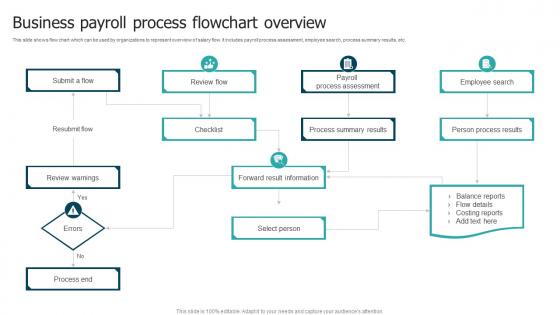
Business Payroll Process Flowchart Overview




Try Before you Buy Download Free Sample Product
 Impress Your
 Audience
 100%
100% Editable
 Save Hours
 of Time


This slide shows flow chart which can be used by organizations to represent overview of salary flow. It includes payroll process assessment, employee search, process summary results, etc.
People who downloaded this PowerPoint presentation also viewed the following :
Business Payroll Process Flowchart Overview with all 6 slides:
Use our Business Payroll Process Flowchart Overview to effectively help you save your valuable time. They are readymade to fit into any presentation structure.





FAQs for Business Payroll
Key components of a business payroll process flowchart include employee data collection, time tracking verification, gross pay calculation, deductions processing, and compliance reporting. These elements streamline payroll operations by automating calculations, ensuring tax compliance, and maintaining accurate records, with many organizations finding that structured flowcharts reduce processing time and minimize costly errors.
Automating payroll improves accuracy by eliminating manual data entry errors, ensuring consistent tax calculations, and maintaining compliance with regulatory requirements across all pay periods. Through automated systems, organizations streamline processing times, reduce administrative overhead, and enhance employee satisfaction with timely payments, while HR teams can focus on strategic initiatives rather than repetitive tasks, ultimately delivering cost savings and operational efficiency.
Common software tools for creating payroll process flowcharts include Microsoft Visio, Lucidchart, Draw.io, Creately, and SmartDraw. These platforms streamline flowchart development by offering pre-built templates, drag-and-drop functionality, and collaborative features, with many HR departments finding that visual process mapping enhances payroll accuracy, reduces processing time, and improves compliance documentation across organizations.
A payroll process flowchart aids compliance by systematically mapping tax calculation steps, withholding requirements, filing deadlines, and regulatory checkpoints throughout the entire payroll cycle. This visual framework enables HR teams to track federal, state, and local tax obligations accurately, ensure timely submissions to authorities like the IRS, and maintain audit trails, ultimately minimizing compliance risks and avoiding costly penalties.
Proper employee classification requires verifying employment status (W-2 versus 1099), confirming exempt or non-exempt designations under FLSA guidelines, validating job descriptions against actual duties, and conducting regular compliance audits. These systematic checks help organizations avoid misclassification penalties, ensure accurate wage calculations, and maintain regulatory compliance, with many companies finding that structured classification processes significantly reduce legal risks while streamlining payroll operations.
Businesses can handle overtime and irregular hours by incorporating automated time-tracking systems, establishing clear approval workflows for non-standard hours, and integrating wage calculation rules directly into their payroll flowchart. These processes streamline compliance with labor regulations, reduce manual errors in complex pay calculations, and ensure accurate compensation, with many organizations finding that automated systems significantly minimize payroll disputes while enhancing employee satisfaction.
Benefits and deductions serve as critical adjustment mechanisms in payroll processing, encompassing health insurance premiums, retirement contributions, tax withholdings, garnishments, and voluntary deductions like parking or meals. These components require precise calculation and systematic tracking throughout each pay cycle, with many organizations finding that automated systems streamline compliance, reduce errors, and ensure accurate net pay calculations while maintaining regulatory adherence.
A payroll flowchart visually maps each process step, enabling HR teams to pinpoint delays, redundancies, and inefficient approval chains that slow compensation delivery. By analyzing workflow patterns, organizations can streamline data collection, automate repetitive calculations, and eliminate unnecessary verification steps, ultimately reducing processing time and enhancing employee satisfaction while minimizing compliance risks.
Legal considerations for payroll process flowcharts include tax compliance verification, wage and hour law adherence, record retention requirements, data privacy protections, and employment law compliance checkpoints. These safeguards streamline regulatory adherence by automating compliance checks, ensuring accurate documentation, and maintaining audit trails, with many organizations finding that structured legal oversight ultimately delivers reduced liability risks and enhanced operational confidence.
Employee data verification ensures payroll accuracy by confirming personal details, tax withholdings, benefit deductions, and banking information before processing. This critical step minimizes costly errors, maintains compliance with tax regulations, and enhances employee trust, with many organizations finding that systematic verification streamlines operations and reduces administrative burden significantly.
A flowchart assists in resolving payroll discrepancies by providing structured diagnostic pathways, standardizing investigation procedures, and ensuring consistent resolution approaches across HR teams. This systematic visualization enables organizations to quickly identify error sources, track correction steps, and maintain audit trails, ultimately reducing resolution time and improving payroll accuracy for employees.
Key metrics include payroll accuracy rates, processing time per pay cycle, compliance audit results, employee query resolution time, and cost per payroll transaction. These measurements enable organizations to identify bottlenecks, reduce errors, and streamline operations, with many companies finding that tracking these indicators delivers improved accuracy, faster processing times, and enhanced employee satisfaction while minimizing compliance risks.
Different business structures significantly impact payroll processing through varying tax obligations, reporting requirements, and owner compensation rules, with LLCs treating owner payments as distributions rather than wages, while corporations must process owner salaries through standard payroll. These structural differences affect withholding calculations, employment tax responsibilities, and compliance documentation, with many organizations finding that proper structure alignment streamlines operations while ensuring regulatory adherence and optimizing tax efficiency.
Businesses should review their payroll process flowchart quarterly and update it whenever regulations change, new software is implemented, or organizational structures shift. Regular reviews help companies maintain compliance with evolving tax laws, streamline operations, and identify automation opportunities, with many organizations finding that consistent updates reduce errors by 40% and significantly enhance payroll accuracy.
Best practices for communicating payroll changes include creating clear visual timelines, using simple language with minimal jargon, highlighting key dates and deadlines, providing multiple communication channels, and incorporating feedback mechanisms. These flowcharts enhance transparency by outlining step-by-step processes, defining employee responsibilities, and establishing clear escalation paths, with many organizations finding that visual communication reduces payroll inquiries and improves employee satisfaction significantly.
-
It is my first time working with them and that too on a friend's recommendation. I would say, I am not expecting such a worldly service at this low price.
-
I have just started downloading templates for my presentations and I must say this is a great design. It helped accelerate my presentation design process and made it more visually appealing.