


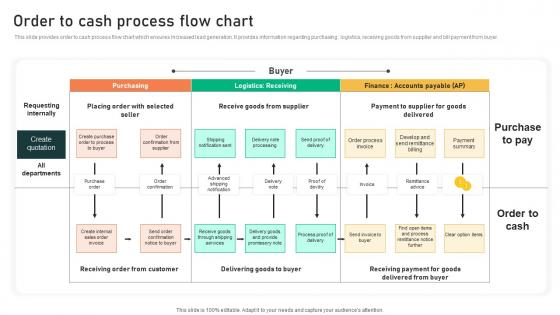
Order To Cash Process Flow Chart




Try Before you Buy Download Free Sample Product
 Impress Your
 Audience
 100%
100% Editable
 Save Hours
 of Time


This slide provides order to cash process flow chart which ensures increased lead generation. It provides information regarding purchasing, logistics, receiving goods from supplier and bill payment from buyer.
People who downloaded this PowerPoint presentation also viewed the following :
Order To Cash Process Flow Chart with all 6 slides:
Use our Order To Cash Process Flow Chart to effectively help you save your valuable time. They are readymade to fit into any presentation structure.





FAQs for Order To Cash
So basically there are five stages that connect: order management (getting and checking customer orders), credit management (making sure they can actually pay), fulfillment (the whole pick/pack/ship thing), billing (sending invoices), and collections (getting your money). Each step has to happen before the next one kicks in - like you can't ship stuff without credit approval first, right? Think of it like dominoes falling. The tricky part is when data gets stuck between stages and everything backs up. Honestly, I'd start by looking at where things currently hand off between departments - that's usually where the problems are hiding.
Honestly, just connect your systems so data flows automatically from order to payment. Start with order processing and invoicing - saves you from all that tedious data entry nobody wants to do anyway. Then tackle payment matching and credit checks. The magic happens when your CRM, ERP, and billing systems actually talk to each other instead of living in silos. Your team ends up handling exceptions instead of boring routine stuff. Cash comes in faster, fewer mistakes happen. Oh, and definitely start with your most common processes first - you'll see results way quicker that way.
Your CRM is like having a crystal ball for customer payments. All their history lives there - payment patterns, past disputes, how they like to communicate. Sales can't promise crazy terms without finance knowing anymore, which honestly saves everyone headaches later. The cool part? You can set up automatic flags for sketchy accounts or fast-track your best customers' orders. I'd map out where you're currently getting stuck first - probably way more spots than you think. Once you see those bottlenecks, it's obvious where CRM data could speed things up.
Honestly, data analytics is a game changer for your O2C stuff. You'll get real-time visibility into DSO, cash conversion cycles, payment patterns - all that good stuff. Spot bottlenecks before they bite you, like which customers are always late or where invoices get stuck in limbo. The dashboards look overwhelming at first but they're actually pretty intuitive. Plus you can predict cash flow and figure out which collection strategies actually work (spoiler: most don't). My advice? Don't go crazy trying to track everything. Pick 2-3 key metrics and master those first.
Oh man, data silos are the worst - nothing talks to each other properly. You're probably drowning in manual processes too, which kills your speed. Credit decisions become this impossible balancing act where you're either missing sales or chasing people who'll never pay. Invoice disputes? Total nightmare that drags on forever. I swear half the companies I know are still living in spreadsheet hell way too long. Start by actually mapping what you do now (sounds boring but trust me), find your biggest pain points, then automate the stuff that'll make the biggest difference first.
Dude, e-commerce is a game changer for getting paid faster. Customers order instantly, payments process automatically, and everything syncs with your inventory - no more manual nonsense eating up time. Digital payments clear way quicker than checks too, so cash hits your account in days instead of weeks. Though honestly, you'll probably deal with more returns and chargebacks than before. Still totally worth it if you set up decent automation workflows. My buddy saw his cash flow improve by like a week after switching online.
So AI is huge right now - it's making credit decisions automatically and predicting when payments will be late. RPA takes care of all that boring data entry stuff. Cloud platforms connect everything together, which is honestly pretty nice. Blockchain's doing interesting things with contracts and payments, though that's still kind of new territory. Mobile apps let customers handle way more on their own now. The cool part? You get visibility across your whole process when these work together. I'd say figure out what's bugging you most first, then grab whatever tech fixes that specific problem.
Map out your current O2C process first - find where the big risks live (usually credit management and revenue recognition, honestly). Build in automated credit checks and approval workflows for discounts. Don't let one person handle an entire transaction - split those duties up. Yeah, documentation is boring but it'll save your ass later. Set up monitoring dashboards to catch weird stuff early. Regular audits of customer data and payment processes are non-negotiable. Real-time reconciliations help too, way better than scrambling at month-end.
Start with hard credit limits and don't budge - yeah, even for those big accounts that sweet-talk your sales team. Credit checks before any terms, obviously. Your sales people need to know what they can actually promise instead of making stuff up on the fly. I'd set up alerts for when accounts hit those aging marks so you're not scrambling later. Honestly, the weekly aging reports are boring but they're everything. Jump on overdue stuff right away because the longer you wait, the more excuses people come up with.
Yeah dude, collaboration makes or breaks O2C. Sales needs to loop in finance on pricing stuff and credit terms. Finance has to coordinate with fulfillment on when invoices go out. Everyone should stay updated on customer problems too - I swear I've watched deals completely implode because departments weren't talking to each other. It's honestly frustrating to see. When sales, finance, fulfillment, and customer service actually communicate, you'll get faster collections and way fewer disputes. Set up some regular cross-department meetings. Make sure everyone can see the same customer data too.
Honestly, start with Days Sales Outstanding (DSO) - it shows how fast you're actually getting paid. Then track your order fulfillment time, like from when someone orders to when it hits their door. Cash conversion cycle is solid too. Invoice accuracy matters more than people think - catching mistakes early saves you so much headache later. Same with perfect order rate since that's what customers actually experience. But real talk? Don't try tracking everything at once or you'll burn out. Pick maybe 3-4 that actually move the needle for your specific business and stick with those consistently.
Good cash flow basically fixes everything in your O2C cycle. You can actually offer better payment terms to win customers instead of demanding everything upfront. Investing in automation becomes possible too - no more manual invoicing hell. Honestly, the best part is not panicking about your own bills while trying to collect from others. Once you're not in survival mode, you can actually improve the process instead of just getting through it. Look at where money sits the longest in your current setup first - that's usually where you'll see the biggest wins.
Honestly, order fulfillment can make or break your whole customer experience. Get it right with on-time delivery and good communication? Customers will stick around. Mess it up and they're gone - people have zero tolerance for late shipments these days. I've seen businesses lose customers over one bad delivery experience, which sucks because those same customers could've been writing great reviews and telling their friends about you. Your best move is staying on top of communication. Keep them updated throughout the process so they know exactly what's happening with their order.
Dude, AI can seriously streamline your Order to Cash process. Start with credit checks and invoice processing - that repetitive stuff gets handled automatically while your team deals with actual customer issues. Payment matching is where you'll see huge wins though. The ML side is cool too, it'll actually predict which customers might be late payers before it happens. Accounts receivable is probably your best bet to start since AI can match payments to invoices and catch weird discrepancies without anyone babysitting it. Honestly just pick one area first and see how it goes before going crazy with it.
B2B is way more complicated - you've got longer sales cycles, credit approvals, custom pricing deals. Plus they want 30-60 day payment terms, which is honestly a pain sometimes. There's usually tons of back-and-forth negotiation too. B2C? Super straightforward. Immediate payments, set prices, barely any credit checks. Way less headache. The big thing with B2B is you're dealing with multiple people on both sides who all need to approve stuff. Your processes have to account for that chaos. I'd just map out what your different customers actually need first - that'll show you where things need to split off.
-
Thanks to SlideTeam, we have an ideal template to present all the info we need to cover. Their slides give our numbers and projections a more clear and enchanting look.
-
The best part about SlideTeam is their meticulously prepared presentations (complete-decks and single-slides both), infused with high-quality graphics and easy to edit. All-in-all worthy products.