


Business plan executive summary model good ppt example





Try Before you Buy Download Free Sample Product
 Impress Your
 Audience
 100%
100% Editable
 Save Hours
 of Time


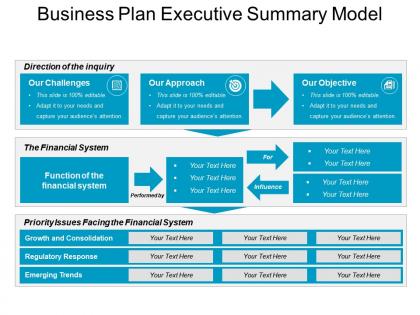
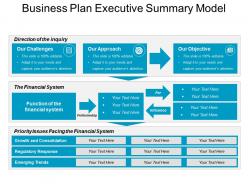
Introducing, business plan executive summary model good PPT example, for innovative and comprehensive solutions. Review the key points of a report for your readers, save valuable time and prepare for the upcoming content, through the example of a flat design. We have displayed a PowerPoint spreadsheet here with three stages with the help of block diagram and text boxes. Organize your tasks to display clear and concise summary points. stages showing the following design are the direction of the equity, financial system, and priority issues facing the financial system. Take full advantage of the business opportunity, make the most of marketing and sales strategy, engage the audience in your discussions, rectify challenges, improve your approach and work for the right objective to execute the business plan executive. Use this PPT design to improve your mission statement, and highlight key segments of your business. Download an excel with our business plan executive summary model good PPT example and reach logical conclusions for a better growth chart. Create the atmosphere for bright ideas to emerge with our Business Plan Executive Summary Model Good Ppt Example. Empowerment is the essence of it.
People who downloaded this PowerPoint presentation also viewed the following :
Business plan executive summary model good ppt example with all 5 slides:
Achieve your goal at an affordable cost with our Business Plan Executive Summary Model Good Ppt Example. It allows you to bid for it.

FAQs for Business plan executive summary model
Okay so your exec summary needs to cover five main things: what your business does and why it matters, who you're targeting and what problem you're fixing, how you beat competitors, money stuff (projections plus how much you need), and your team's background. Honestly, most investors barely glance at this part - maybe 30 seconds tops - so keep everything super tight. Just a few sentences per section. Think movie trailer vibes, not the full documentary. Start with whatever's your strongest point and wrap up telling them exactly what you want from them.
Grab them fast with the problem you're solving - investors basically decide in 30 seconds if they care. Show the pain point, your solution, and why timing matters now. Numbers are huge here. Market size, revenue projections, any traction you've got. Make it scannable with bullets because nobody wants to read paragraphs of dense text (learned that the hard way). Skip the fancy business jargon that puts people to sleep. Oh, and don't forget the clear ask at the end. They need to know exactly what you want - money, introductions, whatever it is.
Honestly, stick to 1-2 pages tops. One page is even better if you can pull it off. Look, busy executives barely give these things 2-3 minutes at first - they're skimming fast. Hit your best stuff upfront: what you do, why the market needs it, how you'll make money. Don't dump everything on them though. It's kinda like a movie trailer situation where you want them curious enough to ask for the full pitch deck later. Every sentence has to earn its spot. Oh and make sure someone who knows nothing about your industry could still get it after reading through once.
Dude, you've gotta tailor that thing to whoever's reading it. Investors? Hit them with the money stuff - ROI, market size, how they'll get rich. Partners want to know how you'll work together and grow mutually. I swear, sending the same boring summary to everyone is like... why even bother? Financial projections and exit strategies get investors excited. But partners? They're thinking about day-to-day operations and whether you're actually compatible. Oh, and always lead with what they care about most. Sounds obvious but you'd be surprised how many people mess this up.
Dude, biggest mistake? Writing it first - always do the exec summary LAST. Keep it one page, no longer. Skip all the boring technical stuff that'll just confuse investors. Don't just recap every section of your plan either, that's painfully dull. Hit the good stuff instead: what makes you different, why the market's ripe, and your money projections. Oh and please don't waste space on some generic "we strive to..." mission statement garbage. Write it like you're actually talking to someone who could cut you a check tomorrow.
Your executive summary is like the trailer for your business plan - hits the main points without getting bogged down in details. The full plan has all your market research, financial breakdowns, and operational stuff (which can get pretty dense tbh). But the summary? Just 1-2 pages of the big picture stuff investors actually want to see first. Same topics, way less data dumping. Here's the thing though - write it last even though it goes at the front. You'll know what's worth highlighting once you've wrestled through the whole plan first.
Yeah, totally rewrite it after you're done! I actually think writing the executive summary first is kinda backwards anyway. Like, how can you summarize something you haven't fully figured out yet? Once you've worked through all the numbers and strategy stuff, you'll know what actually matters. Your initial ideas probably shifted as you dug deeper - mine always do. Just grab the strongest points from each section and make sure it matches your final business model, not whatever you were thinking at the start.
Your market analysis section is basically proof that people actually want your product. Show investors you get your target market size and who you're up against. I always think of it as answering "why now" and "why your company" - honestly separates real deals from fantasy projects. Keep it high-level since it's just the summary part. Lead with your most killer market stats and trends that back up your whole business idea. The boring deep-dive stuff can wait for later sections. You want numbers that'll hook people right away and make them keep flipping pages.
Honestly, visuals are a game-changer for executive summaries. Nobody wants to read walls of text when they're going through a stack of business plans. Charts work great for revenue projections or market size - anything that shows your key numbers at a glance. They make your summary look way more professional too. I'd stick to maybe 2-3 really solid visuals though. More than that and it gets cluttered. Oh, and make sure they actually support what you're saying - don't just throw in random graphics because they look pretty. Clean, simple charts that tell your story will do the trick.
Dude, skip all the buzzword BS - investors hate that crap. Be direct and use real numbers when you can. Don't sound like a textbook, but don't be too casual either. I learned this the hard way, but reading your pitch out loud is clutch - if it sounds robotic, fix it. Mix up your sentence lengths so it flows better. Active voice hits harder than passive. Think of it like explaining your awesome idea to someone smart but busy. They'll respect straight talk way more than corporate speak that says nothing.
Skip the boring stats and start with a story instead. Picture this: "Sarah, a busy mom, wastes 30 minutes every day hunting for healthy meal ideas." Way more engaging than dry market data, right? Your solution becomes the hero that saves the day. Most execs barely read these things anyway - honestly, half of them just flip to the financials. A good story hook actually keeps them interested. When you get to your projections and market size, tie it back to solving real problems for real people. Draft it like a mini-story first, then clean it up later.
Focus on your strongest financial stuff - revenue forecasts, profit margins, customer acquisition costs. Market size data is huge for showing there's actually an opportunity there. Got any real traction? User growth, sales, pilot results - that kind of thing really matters. Investors are drowning in made-up projections, so actual data makes you stand out. Oh, and don't forget funding requirements and expected ROI. Here's the thing though - be picky about what you include. Three or four killer data points that directly back up your value prop will crush it way more than dumping every spreadsheet on them.
Start with what actually sets you apart - that's your money shot. What specific problem do you solve and why you're better/faster/cheaper than everyone else? Skip the bullshit buzzwords like "innovative" because literally every startup says that. Be concrete about your advantages - proprietary tech, exclusive partnerships, whatever makes you special. Two sentences in your exec summary, tops. Here's the test: if an investor can't immediately see why customers pick you over competitors, you've failed. Also quick tangent but I've seen so many pitches that sound exactly the same - don't be one of them.
Honestly, just compare your thing to stuff people already know - "it's like Uber but for dog walking" works way better than explaining your whole platform. Break everything down to 3-4 simple steps max. I get wanting to show off the cool tech, but focus on what problem you're solving instead. Real numbers beat vague promises every time. Ditch any jargon completely - if your mom wouldn't get it, reword it. Actually test this on someone outside your field first (trust me on this one). They'll catch the confusing parts you're blind to.
Your exec summary definitely needs those financial projections upfront - investors always flip there first anyway. Include revenue forecasts, profit margins, and how much funding you need for the next 3-5 years. I've literally watched investors toss aside solid business plans just because they had to hunt for the numbers on like page 50 or whatever. Keep it high-level but realistic in the summary part. Then you can get into the weedy spreadsheet stuff in your appendix. The key thing? Your numbers need to match the growth story you're telling throughout the rest of your plan.
-
Easy to edit slides with easy to understand instructions.
-
Great quality slides in rapid time.