


12 Week Timeline For Employee Individual Training And Development Program





Try Before you Buy Download Free Sample Product
 Impress Your
Audience
 100%
Editable
 Save Hours
of Time


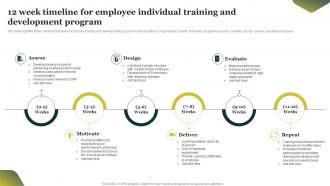
This slide signifies three months timetable for employee training and development program in order to optimize organisation growth. It includes stages like assess, motivate, design, deliver, evaluate and repeat.
12 Week Timeline For Employee Individual Training And Development Program with all 6 slides:
Use our 12 Week Timeline For Employee Individual Training And Development Program to effectively help you save your valuable time. They are readymade to fit into any presentation structure.





FAQs for 12 Week Timeline For Employee Individual Training
Honestly, most training fails because companies skip the practice part. You want four things: concrete goals tied to actual work stuff, content that doesn't suck (seriously, death by PowerPoint helps nobody), safe spaces to screw up and learn, plus follow-up sessions later. Practice is where people actually get it - that's the magic. Oh and build in ways to track what's working. Don't do the same generic training for everyone either. Figure out your biggest skill gaps first, then design everything around fixing those specific problems. Way more effective that route.
Honestly, just start by talking to your people - performance reviews work, but casual one-on-ones are where you'll get the real stuff. Survey them about what they actually want to learn too. Most employees know exactly what they're struggling with, which is kinda nice for once. Then flip it around and look at your business goals - what skills does your team need to hit those targets? I'd also peek at what competitors are requiring in job postings, gives you a decent sense of industry trends. Bottom line: mix what employees are telling you with what the business actually needs, then just prioritize the urgent stuff first.
Look, tech has totally changed how we do training at work. VR simulations let people practice stuff hands-on without breaking anything expensive (learned that one the hard way). LMS platforms handle all the content delivery, and AI can actually figure out how each person learns best - pretty wild honestly. Analytics show you what's actually sticking versus what's not. My advice? Check what tools you're already paying for first. Most companies have features they don't even know about. Those old-school conference room presentations where everyone's half-asleep? Yeah, we can do way better than that now.
So there's this framework called Kirkpatrick's four levels - reaction, learning, behavior, and results. Basically did they like it, did they get it, are they using it, and is it helping the business? Start with pre/post tests and skills assessments. Pretty basic stuff. The real trick is following up 3-6 months later to see if anything actually changed. Most places are terrible at this part, which is honestly why so much training feels pointless. Survey their managers too - they'll spot changes in behavior way before anyone else. Oh and set up your tracking system before you launch, not after when you're scrambling to prove it worked.
Honestly, time is the killer here - everyone's swamped and acts like training is this huge burden. Budget's always tight too, especially when you need actual materials or tech. People resist it hard, either thinking they know it all or that it's just more busy work. Oh, and retention is brutal - most folks forget everything within days unless you keep reinforcing it. Different skill levels make it impossible to hit the right sweet spot for everyone. I'd probably start with a small test group first. Getting managers on board early makes everything way smoother down the road.
Survey your employees first - seriously, just ask what they're struggling with instead of guessing. Too many companies build these training programs nobody actually wants or needs. Real workplace scenarios work way better than generic examples. Mix things up with videos, group discussions, maybe some hands-on stuff. Death by PowerPoint is still a thing unfortunately, so avoid that. Keep it interactive and actually listen to feedback so you can update content. Oh, and peer learning sessions are gold - people learn tons from each other. Start small though - grab three employees this week and ask what'd genuinely help them.
Yeah, training really works - I've seen teams jump 15-25% on most performance stuff when they actually invest in it. People get faster, screw up less, and don't panic when weird problems come up. Also they're just happier at work, which honestly makes my job easier too. The cool thing is it builds both the technical stuff AND critical thinking skills. So your team stops bugging you every five minutes with questions. If you're gonna do it, start with whatever skill gaps are slowing down your daily grind. You'll see changes pretty fast.
Honestly, just ask your team upfront what works for them - some people are total visual learners, others need to actually DO stuff to get it. I'm definitely one of those people who zones out during long presentations but thrives with interactive stuff. Create the same content in different formats... maybe do self-paced modules AND live sessions. Give people choices instead of cramming everyone through the same boring training. Oh, and don't try to do everything at once - start with like 2-3 formats for your next program and see what actually gets people engaged. You'll figure out the sweet spot pretty quickly.
Honestly, just ask your team what's stopping them from attending - that'll tell you way more than guessing. Make it obvious what they'll get out of it (promotions, cool new skills, whatever). Flexible timing is everything. Record sessions or offer different slots so people don't panic about conflicts. Your managers need to actually hype it up, not just forward calendar invites. That makes such a difference. Maybe throw in some incentives too? Certificates, free lunch during training, small rewards. I'm telling you, once people see the value and it fits their schedule, they'll show up.
Honestly, just pair your new people with someone who's been around from their first day. Skip the boring classroom stuff alone - have them work on actual projects while learning. Way more effective, trust me. Regular check-ins are clutch, and make sure your managers know coaching is literally part of their job now. Oh, and train your best mentors first so they don't wing it completely. The whole thing needs to be ongoing though, not some one-and-done workshop situation.
Honestly, cross-training is a lifesaver when people call out sick or quit without notice. No more panic mode trying to figure out who can handle what. Your team gets way more valuable too - they actually understand how other departments function, which makes working together less of a headache. People stay more engaged learning new stuff instead of the same boring routine. You'll also discover hidden gems who handle different roles really well. Oh, and start simple - maybe have two people from related areas trade spots for a few hours weekly. Way less overwhelming that way.
Feedback from your trainees is literally the difference between useful training and total waste of time. Ask specific questions - not just "how was it?" but stuff like "what will you actually use?" or "what confused you most?" That way you get real answers you can work with. People engage more when they feel heard (shocking, I know). You can spot content gaps and figure out if your delivery method sucks. I always forget this part but - follow up questions work better than generic surveys. Makes the whole thing way more effective next time around.
Oh man, training's changing fast! Companies are getting smart with AI that actually adapts to how you learn - no more sitting through stuff you already know. Microlearning is everywhere now (those bite-sized 5-minute sessions instead of marathon workshops). VR training for technical jobs is pretty wild too, way better than reading manuals. Remote platforms aren't going anywhere obviously. The whole shift is moving away from those cookie-cutter programs everyone hated. Now it's more about continuous learning that doesn't completely derail your day - which honestly makes so much more sense.
Honestly, the biggest thing is making learning feel like a reward instead of homework. Give your team actual work time for it - don't expect people to magically find hours after dealing with everything else. When someone finishes a course or picks up a new skill, celebrate it! Even just calling them out in meetings helps. What really works though? When managers actually do the learning too instead of just preaching about it. Also, let people teach each other - those lunch-and-learn sessions are gold. Start small this month. Maybe block off 30 minutes weekly where the team can share what they've picked up. You'll be surprised how much people actually want to learn when it doesn't feel forced.
Okay so there's definitely some legal stuff you can't ignore when setting up training. Safety training and anti-harassment are basically non-negotiable, plus whatever your industry requires. Keep detailed records of who did what training - trust me, you'll need those later. Don't forget ADA accommodations either. The tricky part? Employment laws change depending on which state you're in, which is honestly kind of annoying. Get your legal team involved early though - way easier than scrambling to fix things after the fact. Some of this gets surprisingly complicated fast.
-
SlideTeam’s pool of 2Million+ PPTs has really benefited my team, everyone from the IT department to HR. We are lucky to have crossed ways with them.
-
SlideTeam is very efficient when it comes to saving time. I am happy that I chose them for my presentation.