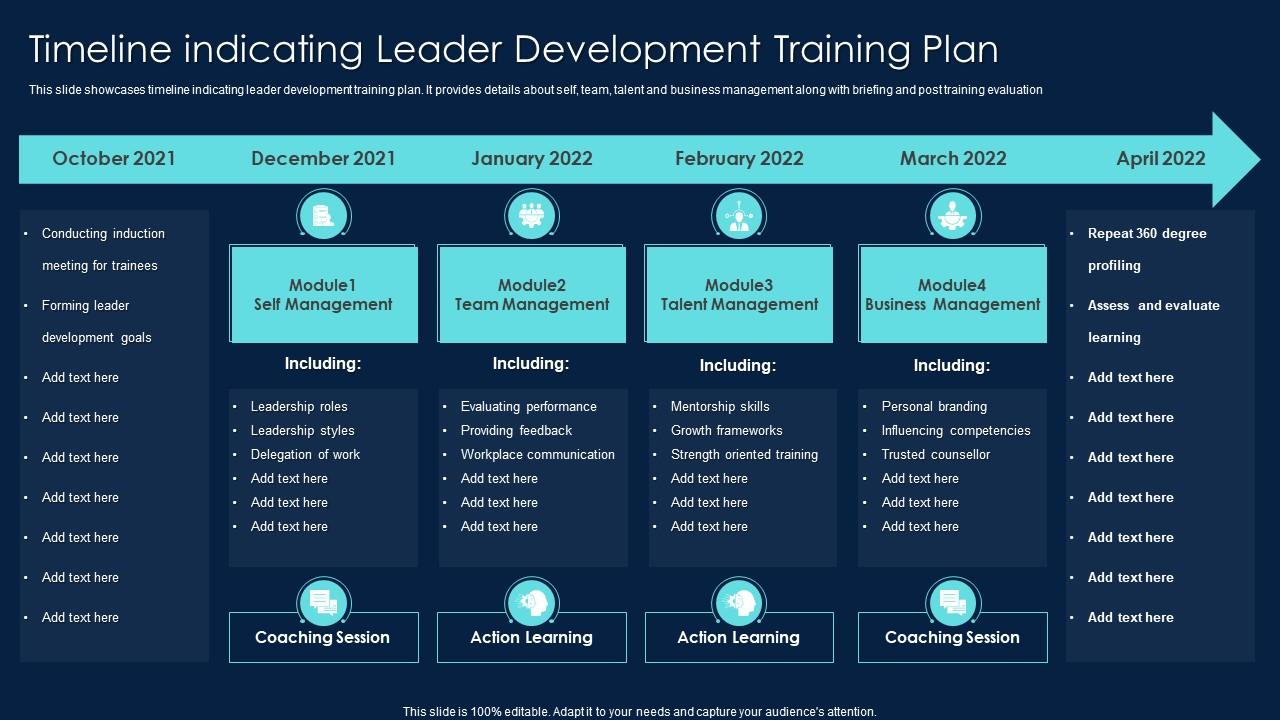
Timeline Indicating Leader Development Training Plan
Try Before you Buy Download Free Sample Product
Audience
Editable
of Time
This slide showcases timeline indicating leader development training plan. It provides details about self, team, talent and business management along with briefing and post training evaluation
People who downloaded this PowerPoint presentation also viewed the following :
Timeline Indicating Leader Development Training Plan with all 6 slides:
Use our Timeline Indicating Leader Development Training Plan to effectively help you save your valuable time. They are readymade to fit into any presentation structure.
FAQs for Timeline Indicating Leader
Start with self-assessment and 360 feedback - gotta know where you're at first. Hit them with core leadership training around months 3-6, then throw a real stretch assignment at month 9. That's honestly where you'll see who's got it and who doesn't. Set up coaching check-ins every quarter (people need the support), and do a formal review at 12 months. Add some peer learning sessions and external training around month 15 - mix it up a bit. The whole thing should take 18-24 months. Oh, and build in reflection time between milestones. Otherwise they're just going through the motions without actually learning anything.
Look, you've gotta track both the hard numbers and the softer stuff consistently. Do 360 reviews every 6 months and measure actual business results from their decisions. But honestly? Team engagement scores are where you'll really see what's up - people don't fake whether they want to work for someone. Document behavioral changes through regular mentor check-ins too. Create a dashboard showing progress over time, not just random snapshots. Oh, and start measuring from day one - don't wait around. The engagement data will probably surprise you with how revealing it is.
Honestly, mentorship is a game-changer for leadership stuff. You'll skip so many mistakes I made the hard way - like, wish someone had told me about office politics before I stepped in it lol. Good mentors call out your blind spots, which stings but you need it. They've got war stories that actually help when you're dealing with similar situations. Don't wait around for some formal program though. Just find someone whose style you dig but who won't sugarcoat things. The best ones challenge how you think about problems. It's basically getting someone else's experience downloaded into your brain faster than learning everything yourself.
Honestly, don't wait for those stupid annual reviews to get feedback - that's way too late. I'd set up touchpoints every quarter minimum. Get input from your team, peers, maybe even do 360 reviews if your company's into that. Your manager too, obviously. The trick is asking specific stuff like "what should I stop doing?" or "what should I start?" Generic feedback is useless. But here's the real key - you gotta close the loop. Tell people what you're actually changing based on their input. Ask them to call you out if you're not following through.
Don't do the same timeline for everyone - that's where most people mess up. Some need visuals like charts and diagrams right away. Others want to jump into hands-on stuff immediately. Then you've got people who actually love reading (weird, I know) versus those who'd rather listen to podcasts. Create different tracks maybe? Like a 6-month fast version for overachievers, 12 months for normal humans, and smaller chunks for people juggling kids or crazy work schedules. Same content, just packaged differently. I'd honestly just ask people what they prefer before building anything - saves you from guessing wrong.
There are a few frameworks that actually work well for this. The 70-20-10 model helps you balance stretch assignments with mentoring and formal training. Check if your company has leadership competency models too - those give you clear targets to hit. I really like the Center for Creative Leadership's pipeline framework since it shows exactly what skills you need at each level. But honestly? Sometimes a basic spreadsheet comparing your current skills to where you want to be works just as well. The trick is sticking with whatever tool you pick instead of constantly switching around.
Honestly? I'd do it twice a year if possible. Once a year feels too slow these days - everything changes so fast. Your January plan might be totally irrelevant by July, you know? People's career goals shift, new tech pops up, market stuff happens. I mean, just look at how much has changed in most industries lately. Do a quick check every six months, then go deeper once a year. Oh and definitely start by asking your current leaders what they're actually seeing day-to-day. They'll tell you what gaps are real vs what looks good on paper.
Dude, culture is everything when it comes to developing leaders. Like, if your workplace actually supports people trying new things and screwing up occasionally, you'll see way faster progress. People stretch themselves more. But those super rigid places where failure gets you crucified? Development crawls because nobody wants to stick their neck out. Plus you'll just lose good people to better companies anyway - which happened at my last job constantly. I'd honestly look at what kind of culture you're working with first, then set realistic timelines from there.
Honestly, tech makes leadership development way faster. AI coaches are available whenever you need them, which is clutch for busy schedules. The analytics piece is where it gets interesting - you can see skill gaps instantly and the system predicts what someone should learn next. Mobile learning means people squeeze in development during commutes or whatever. VR simulations let future leaders mess up in fake high-pressure situations without actual consequences (pretty genius if you ask me). I'd start basic with an LMS that tracks competencies, then add fancier tools once you figure out what clicks.
So first off, work on knowing yourself and how you communicate - can't lead others if you don't get your own style, right? Once you're managing people, delegation becomes huge (seriously, this trips up everyone I know), plus you'll need conflict resolution and strategic thinking down. Senior folks? They're all about setting vision and influencing the whole organization. Oh, and developing other leaders too. Here's the thing though - you gotta build these skills step by step. Don't try mastering everything at once. Pick maybe two skills per level and actually get good at them first.
Honestly, start by asking people around you for real feedback - your boss, coworkers, maybe people who report to you. I know it's awkward but you'll get way better info than just guessing. Do a 360 review if you can swing it. Compare where you are now to where you want to be in like a year or so, then figure out what's missing. Pay attention to when you're scrambling to react instead of staying ahead of things - that's usually a clue. Once you map all this out, you can actually prioritize which skills need work first and make a plan from there.
Honestly, most companies totally screw this up by assuming experienced hires will just figure it out themselves. Bad move. Three things that actually work: get them a solid peer mentor who actually knows how things work around there, map out their first 90 days so they're not wandering around lost, and do regular check-ins to catch problems early. The cultural stuff is usually what trips people up - like, their old job might've been way more formal or whatever. Don't skip the 30-60-90 day milestone meetings. Trust me on this one.
Market chaos basically forces you to fast-track certain leadership skills. New tech disrupting everything? Economic weirdness? You'll need adaptability and crisis management ASAP. It's like changing a tire while driving - not ideal but necessary. Stable markets are different though. They give you breathing room to work on strategic thinking without rushing. Honestly, I think the smartest move is building flexibility into your development plan right away. That way you can pivot when external stuff hits the fan. Check in regularly on what skills are suddenly becoming critical.
Honestly, EQ is what makes or breaks you in leadership roles. Technical skills get you in the door, but once you're managing people? Totally different game. You'll be dealing with tricky conversations, reading body language in meetings, figuring out how to motivate that one person who's always grumpy (we all have one). The best leaders I know aren't necessarily the smartest - they're the ones who can build real trust and handle conflict without everyone hating each other. Working on self-awareness actually pays off more than most people think.
Honestly, working with other people trying to figure out leadership is a game-changer. You get so many different ways to tackle the same mess - way more than any training program gives you. And practicing with peers first? Much less scary than jumping straight into leading your actual team. I learned more from our monthly coffee chats about leadership fails than most workshops. The real-time feedback hits different when it's coming from someone in the trenches with you. Short version: find some other people stumbling through leadership stuff and meet up regularly. You'll build confidence way faster.
-
SlideTeam’s readymade presentations have landed my unique images with my bosses in the past and it continues to reward me.
-
I’m not a design person, so I couldn’t make a presentation to save my life. Thankfully, they have all kinds of templates that I regularly use for my work.