


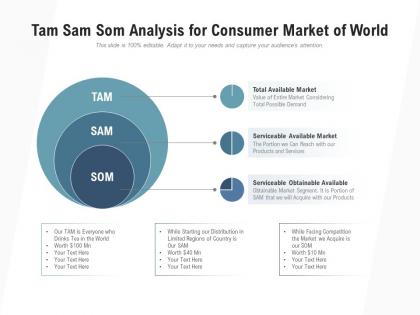
Tam sam som analysis for consumer market of world




Try Before you Buy Download Free Sample Product
 Impress Your
 Audience
 100%
100% Editable
 Save Hours
 of Time


Impress the experts with your innate intelligence due to our Tam Sam Som Analysis For Consumer Market Of World. Interact with them in an erudite fashion.
Tam sam som analysis for consumer market of world with all 2 slides:
Interact with the experts through our Tam Sam Som Analysis For Consumer Market Of World. Impress them with your innate intelligence.
FAQs for Tam sam som analysis for consumer
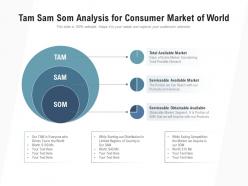
So TAM, SAM, and SOM are basically three ways to slice up your market size. TAM is like if you had unlimited money and could sell to literally everyone who might want your product - the whole universe. Then SAM gets more realistic about who you can actually reach with your business model and location. SOM is what you'll probably capture given your budget and competitors breathing down your neck. Honestly, most people way overestimate their SOM but that's another story. Start with industry reports to get your TAM baseline, then just keep narrowing it down based on real constraints until you hit something that doesn't sound completely ridiculous.
There are three ways to tackle TAM - top-down uses industry reports, bottom-up builds from your actual unit economics, and value theory projects what your product's worth. Honestly, I'd go with bottom-up since you're working with numbers you actually know. Figure out everyone who might buy your product, multiply by average revenue per customer. Then check that against industry data to see if you're being crazy. Oh and don't be that founder who thinks they'll grab like 30% market share right away - that never happens.
Just get way more specific about who you're targeting. Pick a geographic area first - like maybe just the Northeast or West Coast. Then add employee count, like 50-500 people max. Industry filtering works really well too. I'd honestly rather crush it in manufacturing or SaaS than try to sell to everyone and their mom. Revenue size is another good one - companies making $5M-50M usually have similar pain points. Short sentences work. You can also filter by tech stack if that matters for your product. Start with 2-3 filters that actually make sense for what you can handle right now.
Look, SOM basically shows you what you can actually win right now - not some fantasy number. Way better than chasing the whole TAM, which honestly never happens anyway. Focus your money and time on the chunk you can realistically grab with what you've got today. Your competition matters here too, obviously. Map it against your current goals and boom - you'll see exactly which stuff deserves your attention first. No more spreading yourself thin on pipe dreams. Start there and you won't waste time on opportunities that aren't even possible yet.
Look, without solid market research you're just throwing darts at a wall when it comes to TAM/SAM/SOM. Industry reports are your starting point - then dig into competitor analysis and customer interviews. I can't tell you how many founders I've met who pulled their market size out of thin air. Investors see right through that BS. You need real data to back up those numbers, whether it's from surveys, industry studies, or your own customer research. The research doesn't just give you credibility - it actually helps you figure out realistic penetration rates and segment sizes. Start broad with industry reports, then get specific with your own research.
So TAM/SAM/SOM basically shows you where the actual money is hiding. When your SOM is tiny compared to your SAM, that's screaming "fix your pricing or distribution" - maybe your product just isn't reaching people right. I run this every quarter (though honestly sometimes I forget) and it's clutch for figuring out what features to build next. You'll also spot adjacent markets you could pivot into pretty easily. The whole thing acts like a reality check - are you actually chasing the biggest opportunity or just building random stuff? Super helpful for keeping your dev team focused on what matters.
Honestly, just start with Excel or Google Sheets - they're perfect for the basic math and organizing your data. CB Insights is amazing for market research but costs a fortune (totally worth it if you can swing it though). Government sites like Census.gov are solid free options, plus IBISWorld if your company already pays for it. Tableau makes killer visuals for presentations. SurveyMonkey's great for actually talking to customers and checking your assumptions. Oh, and don't underestimate random Google deep-dives for industry reports. Begin with simple spreadsheets first. You can always get fancier tools later when things get complicated.
Look, TAM/SAM/SOM basically proves you're not just making stuff up about market size. Investors hate when founders say "we'll get 1% of this huge market" - it screams amateur hour. TAM shows the whole opportunity, SAM is what you can realistically serve, and SOM is your actual near-term goal. The progression shows you've done real research instead of just Googling some big number. Plus it demonstrates you understand the difference between a massive market and what you can actually capture. Smart investors want to see you can think strategically about growth, not just dream big.
Dude, the classic mistake is making your TAM ridiculously broad. Like saying "everyone eats food" when you're selling fancy dog treats - investors will roll their eyes so hard. Don't just copy-paste some random industry report either. Your SAM needs to reflect who you can actually reach, not some pipe dream. And honestly? The worst part is when people say "we'll get 1% because we're amazing" for their SOM. That's garbage. Use real data - pilot sales, what competitors are doing, actual customer feedback. Start conservative with bottom-up numbers. Way better than looking delusional in the pitch room.
Honestly, competitive analysis is your best friend for sanity-checking those TAM/SAM/SOM numbers. Look at what competitors are actually pulling in revenue-wise and their market share - way more reliable than guessing. Their pricing tells you tons about market reality too. I always dig into how they segment customers because it shows you which chunks of the market you can realistically grab for your SOM. Public financials are gold here. Start with maybe 3-5 direct competitors and work backwards from their approach - it'll validate your bottom-up math. Trust me, beats flying blind.
So TAM/SAM/SOM is basically your way to show investors you're not delusional but also not thinking too small. TAM gets their attention - proves the market's big enough to matter. Then SAM shows the realistic slice you can actually go after with your specific product. Honestly, SOM is where most founders mess up. It's your actual near-term target, and if it sounds made up, investors will notice. They want to see you've thought through the execution stuff, not just the big vision. Don't just dump numbers on them though. Walk through your logic for each layer. Big dreams are great, but they need to see you can actually execute.
So investors are obsessed with TAM/SAM/SOM in tech startups and SaaS - they won't even look at your deck without it. Healthcare and fintech companies rely on it too since market size drives everything from funding rounds to product decisions. Consumer goods brands use it constantly, though manufacturing tends to make it way more complex than needed (classic). What makes it work in these industries is that you can actually segment the markets cleanly and count customers. My advice? Start with SOM instead of those inflated TAM numbers everyone throws around - it's actually useful for planning stuff.
Look, annually is the bare minimum but twice a year is smarter given how crazy fast everything changes now. New product launch? Market expansion? Definitely refresh your numbers then. I've watched teams totally bomb investor pitches because their market sizing was ancient history - yikes. If you're in something wild like crypto, maybe even quarterly makes sense? Though that might be overkill for most people. Set whatever schedule works but don't be rigid about it. When competitors make big moves or the market shifts, just update the damn thing. Better to be current than sorry.
Stick with dollar amounts for all three - that's what investors actually want to see. TAM comes from industry reports and total market data. For SAM, get specific about your geography, demographics, and the segments you can realistically reach. SOM is the tricky one though - use your pricing, conversion rates, and competitive analysis to figure out what you can actually capture in 2-3 years. Honestly, percentages just look fluffy in presentations. Hard revenue numbers hit way harder and show you've done your homework on the financials.
Dude, you NEED visuals for those market sizing presentations. Those nested circles or funnel charts? They're perfect for showing how TAM narrows down to your actual slice. Nobody wants to stare at endless spreadsheets trying to figure out your numbers. Color-code your SOM so it pops against the bigger market - makes your projections way more believable. I learned this the hard way after bombing a pitch with just data tables (yikes). Pick diagrams that walk people through the story: huge market → your segment → what you can realistically grab. Trust me, stakeholders will actually remember your key points instead of glazing over.
No Reviews