


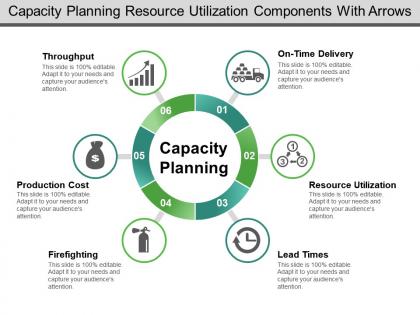
Capacity planning resource utilization components with arrows




Try Before you Buy Download Free Sample Product
 Impress Your
 Audience
 100%
100% Editable
 Save Hours
 of Time


Fight intolerance with our Capacity Planning Resource Utilization Components With Arrows. Build a foundation for harmonious co-existence.
People who downloaded this PowerPoint presentation also viewed the following :
Capacity planning resource utilization components with arrows with all 5 slides:
Create devoted followers with our Capacity Planning Resource Utilization Components With Arrows. Folks get highly impressed by your example.



FAQs for Capacity planning resource utilization
Effective capacity planning components include resource assessment, demand forecasting, skill mapping, workload analysis, and timeline optimization. These elements work together by identifying available talent, predicting project requirements, and balancing team capabilities across initiatives, with many organizations finding that strategic capacity planning reduces bottlenecks, minimizes resource conflicts, and ultimately delivers faster project completion.
Data analytics improves capacity forecasting accuracy by analyzing historical usage patterns, identifying seasonal trends, and predicting future demand through machine learning algorithms and real-time monitoring. Through predictive modeling, organizations streamline resource allocation, minimize over-provisioning costs, and enhance service reliability, with many enterprises finding that data-driven approaches deliver significantly better capacity utilization and operational efficiency.
Common capacity planning pitfalls include underestimating demand fluctuations, relying on outdated historical data, ignoring seasonal variations, overlooking resource dependencies, and failing to account for growth projections. These oversights result in inadequate infrastructure, bottlenecks during peak periods, and missed opportunities, with many organizations finding that proactive scenario planning and regular capacity assessments deliver more resilient operations.
Capacity planning directly influences resource allocation by forecasting demand patterns, identifying bottlenecks, and optimizing workforce deployment across departments and projects. Through strategic capacity analysis, organizations streamline operational costs, minimize resource waste, and enhance budget predictability, while enabling proactive scaling decisions that ultimately deliver improved efficiency and competitive advantage in increasingly dynamic markets.
Capacity planning adapts to rapid market demand changes through flexible resource allocation, scalable infrastructure, real-time monitoring systems, cross-trained workforce development, and strategic partnerships with external vendors. These approaches enable organizations to quickly scale operations up or down, with many retail and manufacturing companies finding that hybrid capacity models deliver both cost efficiency and responsiveness during volatile periods.
Technology serves as the backbone of modern capacity planning through predictive analytics, real-time monitoring systems, cloud scalability tools, automated resource allocation, and AI-driven demand forecasting. These technologies streamline planning processes by eliminating guesswork, accelerating response times, and optimizing resource utilization, with many organizations finding that automated systems deliver significantly faster scaling decisions and enhanced operational efficiency.
Businesses can balance flexibility and efficiency in capacity planning by implementing scalable infrastructure, utilizing cross-trained workforce strategies, and adopting modular resource allocation approaches. Through cloud technologies and flexible staffing models, organizations streamline operations while maintaining agility, with many companies finding that strategic capacity buffers and real-time monitoring ultimately deliver both cost optimization and rapid response capabilities.
Key capacity planning metrics include resource utilization rates, performance benchmarks, demand forecasting accuracy, cost per unit of capacity, and scalability thresholds. These metrics enable organizations to optimize resource allocation, anticipate bottlenecks, and maintain service quality, with many enterprises finding that tracking these indicators delivers improved operational efficiency and strategic competitive advantage.
Seasonal fluctuations significantly impact capacity planning by creating demand peaks and valleys that require strategic resource allocation, flexible staffing models, and scalable infrastructure investments. Retailers experience holiday surges, hospitality manages summer peaks, and tax services handle spring rushes, with many organizations finding that predictive analytics and cross-training ultimately deliver smoother operations and enhanced customer experiences.
Capacity planning enhances customer satisfaction by ensuring adequate resources meet demand, minimizing wait times, and maintaining consistent service quality across all touchpoints. Through predictive analytics and demand forecasting, organizations like banks streamline loan processing, hospitals reduce patient wait times, and retailers optimize checkout experiences, ultimately delivering faster services and more reliable customer interactions.
Strategies include demand forecasting refinement, flexible capacity models, diversification into new markets, strategic partnerships, and phased capacity scaling. These approaches enable organizations to redistribute resources efficiently, explore alternative revenue streams, and adjust production dynamically, with many manufacturers and service providers finding that diversified capacity utilization ultimately delivers improved resilience and competitive positioning.
Industries vary in capacity planning through distinct methodologies, timeframes, and demand drivers, with manufacturing focusing on production cycles, healthcare emphasizing patient flow optimization, and financial services prioritizing transaction volume management. These sector-specific approaches enable organizations to align resource allocation with industry dynamics, regulatory requirements, and customer expectations, ultimately delivering operational efficiency and competitive advantage across diverse market conditions.
Best practices for collaborative capacity planning include establishing cross-departmental communication protocols, implementing shared forecasting tools, conducting regular capacity review meetings, creating transparent resource allocation frameworks, and developing integrated demand planning processes. These approaches streamline coordination by aligning departmental goals, standardizing capacity metrics, and enabling real-time resource visibility, with many organizations finding that collaborative planning reduces bottlenecks while enhancing overall operational efficiency.
Just-in-time inventory relates to capacity planning by requiring precise demand forecasting, flexible production capabilities, and streamlined supplier coordination to minimize waste while meeting customer needs. This strategic combination enables organizations to reduce storage costs, accelerate response times, and optimize resource allocation, with many manufacturing and retail companies finding that synchronized capacity and inventory planning delivers competitive advantage in increasingly dynamic markets.
**INPUT**: What tools and software are recommended for effective capacity management? **OUTPUT**: Effective capacity management tools include cloud monitoring platforms like AWS CloudWatch, infrastructure management software such as VMware vSphere, and specialized solutions like IBM Turbonomic and Microsoft System Center. These technologies streamline resource allocation by providing real-time visibility, automated scaling recommendations, and predictive analytics, with many organizations finding that integrated platforms ultimately deliver cost optimization and enhanced operational efficiency. [Word count: 60 words]
-
Use of different colors is good. It's simple and attractive.
-
Attractive design and informative presentation.