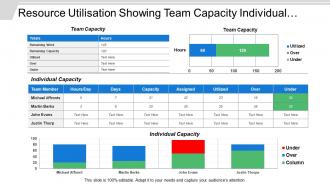
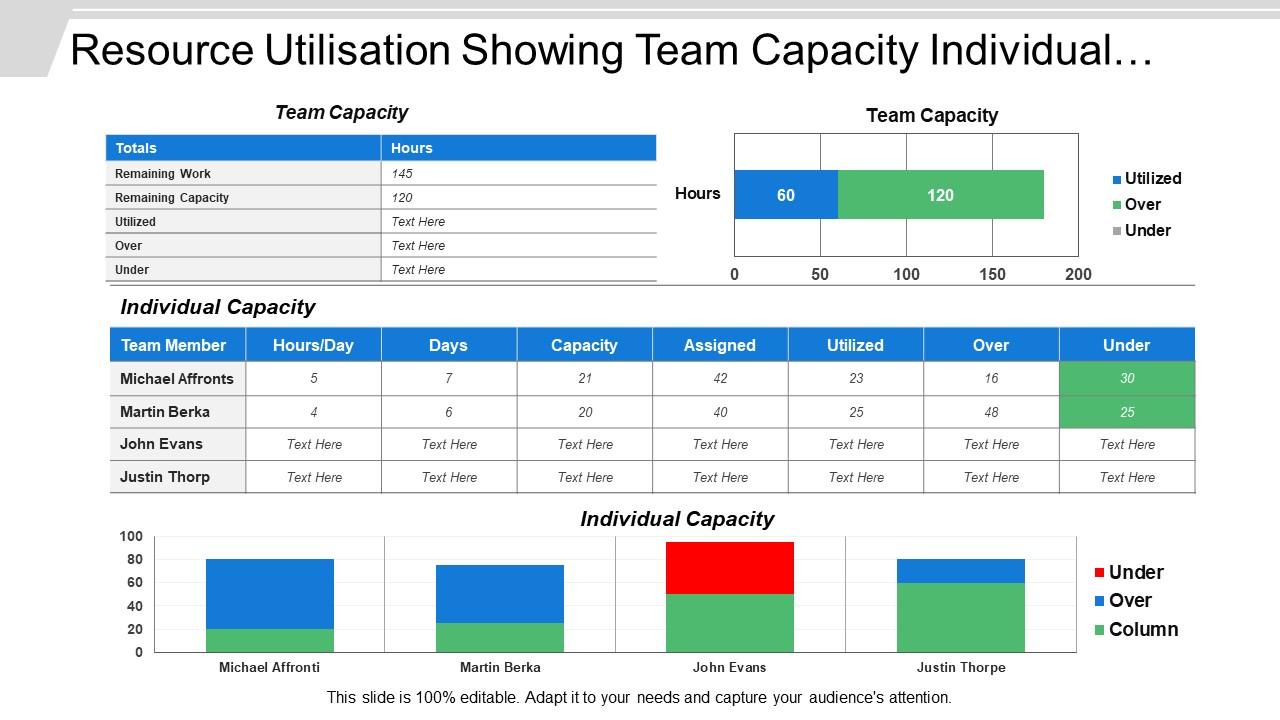
Resource utilisation showing team capacity individual capacity
Try Before you Buy Download Free Sample Product
Audience
Editable
of Time
Our Resource Utilisation Showing Team Capacity Individual Capacity are like an access card. They help entry into the minds of your audience.
People who downloaded this PowerPoint presentation also viewed the following :
Resource utilisation showing team capacity individual capacity with all 6 slides:
Extend full backing to brave folks with our Resource Utilisation Showing Team Capacity Individual Capacity. Encourage the attempts of intrepid explorers.
FAQs for Resource utilisation showing team
Honestly, start with resource productivity ratios and utilization rates - basically how much work your team cranks out versus what they could theoretically handle. Idle time kills everything. Also track cost per output and ROI on your resources. Don't sleep on employee satisfaction though, because miserable teams are stupidly inefficient (learned that one the hard way). Waste and rework rates matter too. Oh, and project completion times plus quality metrics. Pick maybe 2-3 that hit your worst problems and stick with measuring them for a few months consistently.
Start by figuring out where your money's actually going - people, tools, processes. Most companies are honestly pretty bad at this because they don't track usage well. Time tracking helps, but also just ask your teams how swamped they are. Look at your budget variances too. The real question is whether you're putting resources where they'll actually move the needle for your bigger goals. Are high-priority projects getting shortchanged while less important stuff eats up bandwidth? I'd pick one department first to test this out - way easier than trying to tackle everything at once.
Honestly, you'd be shocked at how much waste companies don't even see. Real-time IoT sensors show you what's actually happening with your resources. Predictive analytics catch problems before they hurt your budget - super useful. AI handles the scheduling optimization automatically so you don't have to micromanage everything. Most places have equipment just sitting idle or materials gathering dust without realizing it. The patterns are impossible to spot manually, but the data makes it obvious. Oh, and definitely start with whatever's burning through the most cash first - that's where you'll see results fastest.
So basically, resource utilization shows you how well you're turning what you have into actual results. If your team or equipment is sitting idle, you're literally wasting money on unused capacity. But pushing everything to 100%? That's how you get burned out people and sloppy work. I learned this the hard way managing a project last year - total disaster when we tried to max everyone out. Aim for like 70-85% utilization instead. Check your rates monthly and move work around when needed. It's honestly one of the best ways to spot where things are getting inefficient.
Honestly, the two big ones I see are overallocation and having zero clue what your team's actually doing day-to-day. People get fried when you're constantly giving them 100%+ workloads - random stuff always pops up that eats bandwidth. Most places still track this with spreadsheets which, ugh, becomes a total mess when priorities change. Oh and here's something people miss - not all work is equal. Fixing a bug vs designing a whole new feature? Completely different mental energy. Real-time tracking helps, but honestly just building in buffer time saves your sanity.
So basically, you gotta match your resources to how you actually use stuff. Spiky demand? Build in some buffer room. Steady usage means you can focus on efficiency instead. It's like meal prepping versus ordering DoorDash every single night - totally different game plans, right? Seasonal peaks show up in your data? Scale up early so you're not panicking later. Also watch for waste patterns - I swear, there's always something sitting unused that you can move elsewhere. Honestly, most people just guess at this stuff. Track your real usage first, then build your strategy around what actually happens.
Honestly, Lean methodology is your best bet for cutting waste and streamlining workflows. Agile's solid too if priorities keep shifting around. ITIL works well for IT stuff but feels pretty bureaucratic - my last company used it and ugh, the documentation. Kanban boards are surprisingly helpful for spotting bottlenecks, and resource capacity planning frameworks handle the bigger organizational picture. Don't overthink it though. Pick whatever fits your team's vibe and actually use it consistently. I'd start with something simple that builds on what you're already doing.
Start by actually measuring what you're using - energy, materials, water, whatever applies to your setup. Look for ways to cut waste and make stuff last longer through reuse or recycling. I know "circular economy" sounds like corporate BS, but it genuinely works if you do it right. Set targets that don't just focus on output - track things like energy per unit or how much recycled content you're using. Check these numbers regularly and tweak your processes. Honestly, don't try to fix everything at once. Pick one resource type first, get good at managing that, then expand from there.
Dude, bad resource management is like watching dominoes fall. Your budget gets wrecked - either you're paying too many people or panic-hiring crazy expensive contractors. Then timelines explode when key people vanish right when you need them most. Quality takes a hit too since rushed work never turns out great. Honestly, I've seen projects that looked solid just completely implode from this stuff. The trick is checking your resource situation every week and actually dealing with problems instead of crossing your fingers. Trust me, hoping things fix themselves is basically guaranteed failure.
Honestly, most companies have way more data than they realize - they're just not using it. Track how your team and resources actually get used versus what you planned. Super eye-opening stuff. You'll catch bottlenecks early, see which equipment isn't worth the cost, and figure out your real busy periods (not the ones you think you have). I'd start small though - pick like one thing to measure for a month. Maybe staffing levels or tool usage? The patterns that show up will probably surprise you, and then you can shift things around before you hit major problems.
Honestly, skip the boring theory sessions and jump straight into hands-on workshops with real project scenarios. Way more engaging that way. Get everyone tracking resources and spotting bottlenecks first - the basic stuff. You'd be surprised how competitive people get when you gamify it (kind of hilarious actually). Train teams together so they see how their choices mess with other departments' resources. Oh, and don't make it a one-and-done thing. Monthly check-ins work great - teams share their optimization tricks and help each other solve problems. It's gotta be ongoing or people forget everything.
Oh man, this stuff will totally catch you off guard if you're not careful. Some cultures are all about hoarding resources "just in case" - others share everything. Your German team will plan every detail months ahead, but Brazilian colleagues? Way more flexible and relationship-focused. Honestly, I learned this the hard way once. Deadlines mean different things too - some see them as rough suggestions rather than hard stops. You'll want to map out these patterns early and build systems that flex with different working styles instead of cramming everyone into the same box.
Honestly, cross-functional resource pools are a game changer - basically teams share people based on what projects need instead of hoarding them in departments. There are cloud platforms that track who's free and what they're good at. Some companies do these "resource dating" sessions (I know, sounds ridiculous) where teams pitch projects and swap people around. Works though! Time-boxing helps too. Don't make assignments permanent - just allocate folks for specific sprints. My advice? Start with one pilot between two departments and see how much more efficient you get.
Turn those numbers into stories each group actually cares about. Executives want high-level trends and cost impact - skip the server stats. Project managers need capacity planning stuff and where the bottlenecks are. Technical teams? Give them all the granular details and alerts they love. Dashboards work great since everyone can dig as deep as they want. Show comparisons over time, not just current snapshots. Always add context about what "normal" looks like - otherwise people panic over nothing. Set up automated reports though, because pulling data manually every week will drive you insane.
Honestly, if your boss doesn't give a damn about wasting resources, your whole team won't either. Managers need to actually walk the walk - like actually turning off conference room lights or questioning whether you really need that expensive software subscription. People notice that stuff way more than you'd expect. The good ones also build systems that make being efficient super easy instead of a hassle. They'll track waste numbers, give shoutouts when teams save money, and - this is huge - they won't throw you under the bus for calling out dumb wasteful processes. Maybe start small? Ask if your manager can add resource goals to your regular team check-ins.
-
Great quality slides in rapid time.
-
Graphics are very appealing to eyes.