


Capex Budget Planning And Approval Status Report




Try Before you Buy Download Free Sample Product
 Impress Your
Audience
 100%
Editable
 Save Hours
of Time


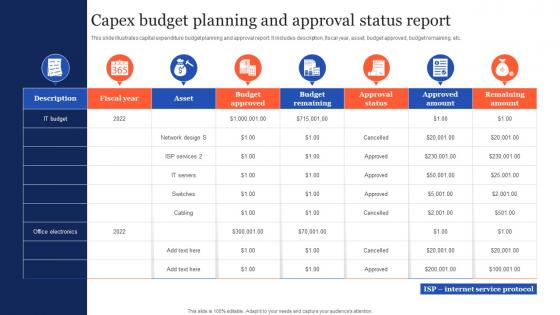
This slide illustrates capital expenditure budget planning and approval report. It includes description, fiscal year, asset, budget approved, budget remaining, etc.
People who downloaded this PowerPoint presentation also viewed the following :
Capex Budget Planning And Approval Status Report with all 6 slides:
Use our Capex Budget Planning And Approval Status Report to effectively help you save your valuable time. They are readymade to fit into any presentation structure.






FAQs for Capex Budget Planning And
Key components defining capital expenditure include property acquisitions, equipment purchases, technology infrastructure investments, facility improvements, and research and development assets with long-term value. These investments enhance operational capacity, streamline production processes, and deliver competitive advantages, with many organizations finding that strategic CapEx allocation ultimately drives revenue growth and market positioning.
Capital expenditure involves purchasing long-term assets like equipment, buildings, and technology that provide value over multiple years, while operational expenditure covers day-to-day running costs like salaries, utilities, and maintenance. Understanding this distinction enables organizations to optimize financial planning, improve budget allocation, and enhance strategic decision-making for sustainable growth.
Capital expenditure drives long-term growth by funding infrastructure upgrades, technology investments, equipment modernization, facility expansions, and strategic acquisitions that enhance operational capacity. These investments enable companies to streamline operations, deliver superior customer experiences, and maintain competitive advantages, with many organizations finding that strategic CapEx allocation ultimately determines their market positioning and sustainability in increasingly dynamic business environments.
Businesses can effectively budget for capital expenditures by conducting thorough asset assessments, forecasting future needs, prioritizing projects based on ROI, and establishing multi-year planning horizons. Strategic budgeting involves analyzing cash flow patterns, considering financing options, and aligning investments with growth objectives, with many organizations finding that systematic capital planning enhances operational efficiency while maintaining financial flexibility.
Common methods for evaluating capital expenditure ROI include net present value (NPV), internal rate of return (IRR), payback period, profitability index, and discounted cash flow analysis. These financial tools enable organizations to compare investment opportunities by assessing cash flows, risk factors, and time value of money, ultimately delivering strategic insights that enhance resource allocation and competitive advantage.
Capital expenditure significantly impacts cash flow management by creating immediate cash outflows while generating long-term value through asset acquisition, operational efficiency improvements, and revenue enhancement capabilities. While substantial CapEx investments initially reduce available cash, they ultimately strengthen competitive positioning and operational capacity, with many organizations finding that strategic capital investments deliver improved productivity, cost reductions, and enhanced market opportunities over time.
Organizations prioritize capital expenditures by conducting strategic alignment assessments, ROI analysis, risk evaluation, and stakeholder impact reviews to ensure investments support long-term objectives. Through systematic scoring frameworks and cross-functional committees, companies like manufacturing firms and healthcare systems streamline resource allocation, ultimately delivering enhanced operational efficiency and competitive advantage while minimizing financial risks.
Capital expenditures offer significant tax advantages through depreciation deductions, accelerated depreciation methods like Section 179 and bonus depreciation, and potential investment tax credits. These benefits enable businesses to reduce taxable income strategically, improve cash flow timing, and offset substantial equipment investments, with many organizations finding that proper CapEx planning delivers measurable tax savings while supporting growth initiatives.
Technology advancement significantly influences capital expenditure decisions by enabling predictive analytics for asset optimization, automating approval workflows, and providing real-time ROI modeling capabilities. Through advanced financial planning software and IoT monitoring systems, organizations streamline budget allocation processes, reduce maintenance costs, and enhance decision-making accuracy, with many finding that strategic technology investments ultimately deliver competitive advantages and improved operational efficiency.
Businesses face challenges including accurate ROI forecasting, securing adequate financing, managing lengthy approval processes, coordinating cross-departmental stakeholders, and timing market conditions appropriately. These complexities often result in budget overruns, delayed implementations, and suboptimal resource allocation, with many organizations finding that enhanced planning frameworks and stakeholder alignment ultimately streamline execution and deliver better strategic outcomes.
Common capital expenditure management mistakes include inadequate project evaluation, poor ROI forecasting, insufficient post-implementation reviews, lack of cross-departmental alignment, and neglecting maintenance costs in initial budgets. These oversights often result in cost overruns, delayed project timelines, and suboptimal resource allocation, with many organizations finding that implementing structured approval processes and regular performance assessments significantly enhances their capital investment outcomes.
Businesses ensure compliance with capital expenditure accounting standards by implementing robust documentation procedures, establishing clear capitalization thresholds, and conducting regular internal audits to verify proper classification. Through systematic tracking systems and standardized approval processes, organizations streamline financial reporting accuracy, enhance regulatory transparency, and minimize audit risks, ultimately delivering stronger stakeholder confidence and operational efficiency.
Capital expenditure drives asset management by establishing the initial asset base, determining depreciation schedules, and influencing long-term financial planning strategies. Through systematic tracking of CapEx investments, organizations streamline asset lifecycle management, optimize maintenance schedules, and enhance financial reporting accuracy, while enabling better resource allocation decisions that ultimately deliver improved operational efficiency and strategic competitive advantage.
Companies leverage data analytics to improve capital expenditure decisions through predictive modeling, real-time performance monitoring, scenario analysis, and ROI forecasting tools. These technologies enable organizations to optimize asset utilization, minimize operational risks, and accelerate project timelines, with manufacturing and energy sectors finding that data-driven CapEx strategies ultimately deliver enhanced resource allocation and competitive advantage.
Best practices for tracking capital expenditures include implementing robust financial systems, establishing clear approval workflows, conducting regular budget variance analyses, maintaining detailed asset registers, and performing periodic ROI assessments. These approaches streamline oversight by automating reporting processes, enhancing transparency across departments, and enabling data-driven decision making, with many organizations finding that systematic monitoring ultimately delivers improved resource allocation and stronger financial performance.
-
I had them make a presentation for an office retirement party. They were very helpful in understanding what we wanted and delivered the perfect presentation. Highly recommended!
-
Amazing product with appealing content and design.