

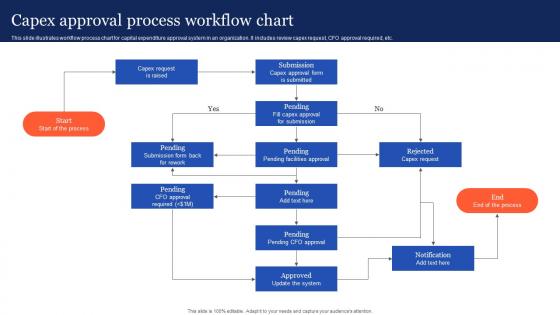
Capex Approval Process Workflow Chart




Try Before you Buy Download Free Sample Product
 Impress Your
 Audience
 100%
100% Editable
 Save Hours
 of Time


This slide illustrates workflow process chart for capital expenditure approval system in an organization. It includes review capex request, CFO approval required, etc.
People who downloaded this PowerPoint presentation also viewed the following :
Capex Approval Process Workflow Chart with all 6 slides:
Use our Capex Approval Process Workflow Chart to effectively help you save your valuable time. They are readymade to fit into any presentation structure.






FAQs for Capex Approval
You'll want to start with a solid request form that captures all the project details and costs upfront. Set up different approval levels based on dollar amounts - because honestly, a $500 software license shouldn't need the same sign-offs as a $50k equipment purchase, right? Track your actual spending against what you approved throughout the project. Budget tracking is huge here. Also build in some kind of review process afterward to see if you actually got the ROI you expected. I'd map out whatever process you have now first and figure out where things are getting bottlenecked. That's usually where the real problems are hiding.
Honestly, automation is a game-changer for Capex approvals. No more manually passing requests around - the system routes everything based on dollar amounts automatically. Your approval times drop from weeks to days because nobody's hunting down signatures or losing paperwork (which happens way more than it should). The best part? Real-time tracking so you actually know where your request is. It'll catch incomplete forms upfront too and bug people with reminders. I'd start by mapping your current process first - you'll spot exactly where you're wasting the most time.
Track your ROI, payback period, and NPV first - that's your money stuff. But don't stop there. You also need operational metrics like timeline adherence and budget variance. Are you actually hitting those performance targets you set? Here's what most people mess up: they launch the project and forget about it. Set check-ins at 6, 12, and 24 months to see if you're getting the benefits you expected. A simple dashboard helps you catch problems early. The real value doesn't show up until after implementation anyway, so those follow-up measurements are honestly more important than the launch itself.
Honestly, it really depends on what industry you're in. Manufacturing moves pretty fast on equipment stuff, but healthcare? They've got compliance checks out the wazoo for anything medical-related. Financial companies are obsessed with their risk matrices and getting regulatory approval for everything. Tech firms keep things simple since they need to scale quickly. Utilities though - man, they take forever because of all the environmental reviews. I'd say look at 2-3 similar companies in your space and see what their approval process actually looks like. No point reinventing the wheel when you can just copy what works.
Dude, you absolutely need everyone on board for Capex decisions - learned this the hard way. Finance has to crunch the numbers, ops needs to confirm it's actually doable, and leadership makes sure it fits the bigger picture. IT, legal, procurement - they all pile on depending how big the project is. The ones where you skip this step? Total disasters with budget explosions later. Trust me on this. Get people aligned from day one instead of scrambling to bring them in after you've already decided stuff. Oh, and document who weighs in when during your approval process.
Build the controls right into your approval workflow - that's where the magic happens. Each gate needs mandatory risk assessments and proper documentation for compliance stuff. Automate the routing based on spend amounts and project types too. Those spreadsheets everyone's still using? Total audit nightmare, trust me. You've gotta capture all signatures and keep clean audit trails through the whole thing. Real-time dashboards showing compliance status will save your butt - you'll spot problems way before they blow up. Start by mapping what you're doing now and find the gaps.
Dude, AI forecasting tools are absolutely crushing it right now - they handle all that tedious number crunching we used to hate. Cloud approval platforms are solid too. Digital twins let you test run projects virtually before dropping actual cash, which honestly feels like cheating in the best way. Mobile apps speed up field data collection like crazy, and IoT sensors give you live updates instead of those painful weekly check-ins. Oh, and approval workflows - start there first since it's usually the easiest quick win. My buddy's company saw results in like two weeks after switching.
Look, a good capex workflow is basically your safety net against throwing money at the wrong stuff. It gives you clear visibility into where every dollar's going, which honestly saves your ass when budgets get tight. Decision-making gets way faster too since nobody's confused about next steps. I've watched companies burn months just sitting in approval hell without any real process. Short sentences work. Longer ones help you spot opportunities and dodge expensive mistakes before they bite you. The trick is building something that actually fits how your team operates - not some fancy system that looks pretty but nobody uses.
Honestly, the worst part is always approval bottlenecks - requests just sit there forever while everyone's waiting for someone else to sign off. Half the time nobody even knows who approves what dollar amount, which is ridiculous. Then you've got incomplete paperwork bouncing around endlessly because people can't fill out forms properly the first time. Tracking your actual spend becomes this total mess when everything's spread across random spreadsheets and buried in email threads. Start by figuring out where your approval process usually gets stuck - that's where I'd focus first.
Honestly, twice a year works best for most places I've seen. Sure, the "official" answer is annually, but things move way too fast now - your January assumptions are probably trash by summer. I'd time these right after budget cycles since you're already in planning mode anyway. Check your approval limits, how long decisions take, ROI benchmarks, all that stuff. People complaining about delays? Projects getting stuck in limbo? That's when you know something's broken. Quick audit next quarter wouldn't hurt - even if it's just mapping out where things currently bog down.
First thing - make a standard template everyone has to use with project justification, ROI, timeline, all that stuff. Have departments categorize their requests too (growth vs maintenance vs compliance). Game changer right there. Set dollar thresholds for approvals and do regular review cycles instead of random submissions. Honestly, the year-end scramble is the worst part of this job if you don't plan ahead. Oh, and definitely train your department heads on what actually gets approved - saves everyone time when they stop asking for ridiculous things that'll never happen.
Honestly, just create a scoring system everyone can follow - ROI, how well it fits your strategy, risk levels, compliance stuff. We always used weighted scoring matrices where you rate each project on those factors and rank by total score. Emergency projects will obviously skip the line sometimes, but whatever. Getting leadership to first agree on what actually matters to your org is huge. Then make your criteria super transparent so when stakeholders whine about their favorite project getting rejected, you can point to the numbers. Saves so much drama later.
Dude, messy capex workflows will absolutely wreck your budget. Approvals get stuck in limbo while projects burn cash. Rush a decision and you'll overpay for equipment or buy the wrong stuff entirely. Finance gets cranky when they can't predict cash flow - honestly can't blame them there. You miss bulk discounts, departments buy duplicate equipment, it's chaos. Quick fixes that actually work: set clear approval limits, automate the boring requests, and track everything live so you catch problems early. Way better than explaining budget disasters to leadership later.
Honestly, data analytics can be a game-changer for Capex forecasting. It'll catch spending patterns you'd totally miss otherwise - like seasonal trends or early warning signs that a project's about to blow its budget. The predictive stuff is getting really good at flagging problems before they happen. You can also run "what if" scenarios to see how delays or market shifts might mess with your capital plan. Oh, and benchmarking against similar projects is super helpful too. I'd start by grabbing your last 3-5 years of project data and just look for patterns by department or project type. Way better than flying blind.
Honestly, most teams totally skip post-project reviews and it's such a waste. You get to see where your budget was completely wrong, which vendors actually came through, and why your timelines were fantasy land. The scope creep stuff is gold - figure out why it always happens. Also track those approval bottlenecks because they'll bite you again. I started keeping a basic tracker of patterns, like "IT projects always need 15% more budget" or whatever. Sounds boring but it actually saves your butt next time around. Cost overruns follow patterns if you pay attention.
-
Their templates are super easy to edit and use even for the one like me who is not familiar with PowerPoint. Great customer support.
-
“I've always gotten excellent slides from them and the customer service is up to the mark.”