


Accounts Payable Process Flow Chart




Try Before you Buy Download Free Sample Product
 Impress Your
 Audience
 100%
100% Editable
 Save Hours
 of Time


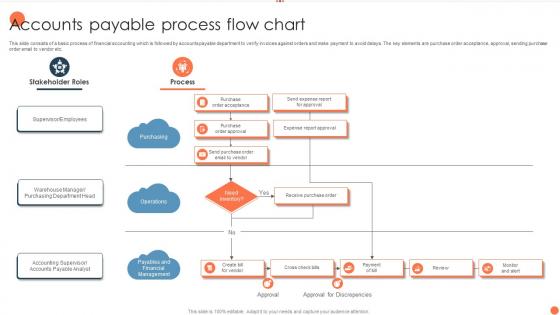
This slide consists of a basic process of financial accounting which is followed by accounts payable department to verify invoices against orders and make payment to avoid delays. The key elements are purchase order acceptance, approval, sending purchase order email to vendor etc.
People who downloaded this PowerPoint presentation also viewed the following :
Accounts Payable Process Flow Chart with all 6 slides:
Use our Accounts Payable Process Flow Chart to effectively help you save your valuable time. They are readymade to fit into any presentation structure.





FAQs for Accounts Payable
So basically you're gonna do this cycle over and over: Start with matching your vendor invoice to the purchase order and receiving docs - that three-way match thing is pretty important. Code it to the right accounts, then get whoever needs to approve it. Schedule when you'll pay (grab those early discounts if you can!). Actually process the payment through checks or ACH. Record everything and file it away. Honestly, the hardest part is just staying on top of tracking so invoices don't get lost in the shuffle.
Dude, start with invoice automation - that's where you'll save the most time right off the bat. OCR software pulls data straight from invoices so you don't have to type everything manually (seriously, life's too short). Electronic workflows are clutch too - no more hunting people down for approvals. Your ERP integration gives you real-time cash flow visibility, which is pretty sweet. Oh, and automated matching between POs, receipts, and invoices? Way faster at catching weird discrepancies than eyeballing everything yourself. The repetitive stuff just disappears.
Late payments are gonna be your biggest pain point - those approval processes drag on forever. Vendors get annoyed (rightfully so), and matching POs to invoices to receipts becomes this endless nightmare. Oh, and duplicate payments? Way more common than it should be. Cash flow forecasting is basically impossible when you can't predict timing. Manual tracking just makes everything worse tbh. If you can swing it, automate the invoice processing first - seriously, it'll fix most of this mess. That one change alone probably handles 60% of the headaches you're dealing with.
Think of accounts payable like getting an interest-free loan from your suppliers. You get their stuff but keep your cash longer - pretty sweet deal. Longer payment terms = better cash flow in the short run. Here's where it gets tricky though: you can't just string vendors along forever or you'll burn bridges. I learned this the hard way once, actually. Smart move is timing those payments so your cash stays put as long as possible without pissing anyone off. Also don't forget about early payment discounts - sometimes paying sooner saves you money.
So AP is basically all the money you owe suppliers - shows up as a big line item under current liabilities on your balance sheet. Timing matters a ton here because when you record it vs. actually pay affects your cash flow statements and working capital ratios. Month-end reconciliation is honestly such a pain, but you gotta stay on top of those accruals and cutoffs or your financial statements won't match reality. It's one of those things that looks straightforward until you're actually doing it. Really impacts your whole financial position more than people think.
Okay so first thing - get your approval workflows sorted and split up who does what. Nobody should control the whole payment thing alone. Three-way matching is where you check purchase orders against invoices and receipts. Total headache to set up but seriously saves you later when it catches mistakes. Document everything, audit your vendor files regularly to catch duplicates or weird vendors. Your chart of accounts needs to stay organized too, and actually train people on how to code things properly. Oh and automate your approval routing if you haven't - makes life way easier. The trick is building this stuff into what you already do daily instead of scrambling to be compliant later.
So for AP metrics, definitely start with Days Payable Outstanding (DPO) - basically how long you take to pay suppliers. Higher numbers mean better cash flow for you. Invoice processing time matters too, plus cost per invoice shows if your team's efficient. Oh, and early payment discount capture rate is huge because who doesn't want free money, right? Don't sleep on vendor payment accuracy either. That stuff keeps relationships smooth. Track what percentage of invoices go through without issues too. Honestly though, if you only pick two to start - go with DPO and processing time.
Honestly, the biggest win is getting rid of all that manual typing - that's where most mistakes happen anyway. Your team won't be entering vendor info by hand anymore since the system pulls data straight from digital invoices and matches everything against purchase orders. Three-way matching is pretty slick too - it checks that your PO, invoice, and receipt all line up automatically. Plus you get built-in checks for duplicate payments and weird discrepancies before they blow up. My advice? Start with your most common vendors first, digitize those invoices and you'll see the difference right away.
Honestly, most suppliers have wiggle room they won't tell you about upfront - you just gotta ask. Your payment history is gold if it's clean, so mention that when pushing for better terms or early pay discounts. Buying more obviously helps too. Try bundling orders or committing to longer deals. Oh and timing's everything - hit them up during their slow periods when they actually want your business. I learned this the hard way, but building real relationships instead of just ordering stuff makes a huge difference. Maybe set up quarterly calls to chat about terms before you need something?
So two-way matching is just comparing your purchase order to the invoice - did we order this stuff and does the price look right? Three-way throws in the receiving report too, so you're checking that you actually got the goods. Honestly, three-way is way more bulletproof but it slows things down. Most places do three-way for expensive stuff and two-way for the small routine orders. Makes sense - you don't need to triple-check every box of printer paper, but that $50K equipment purchase? Yeah, verify everything first.
Oh man, disputed invoices are such a pain. First thing - put that sucker on hold in your AP system so you don't accidentally pay it. Then get on the phone with whoever received the stuff and the vendor to figure out what went wrong. Could be anything really - wrong price, missing items, crappy quality. I always write everything down because these disputes drag on forever, I swear. You'll want to track disputed invoices separately with deadlines, otherwise they just sit there messing up your vendor relationships. Trust me, follow up religiously or you'll forget about them completely.
The big ones are invoice fraud and fake vendors - people literally create bogus companies to steal payments. Payment diversion is huge too, where scammers intercept legit invoices and swap bank details. Internal fraud happens more than you'd think - employees setting up shell vendors or whatever. That CEO email thing still works somehow? People fall for it constantly. For protection, do three-way matching on everything - purchase order, receipt, invoice all gotta line up. Set dual approval thresholds so no one person can authorize big payments. Audit your vendor list regularly because fake ones slip in. Oh, and train people to double-check weird payment requests through a different channel first.
So AP basically touches everything money-related in your business. Your general ledger needs it for tracking expenses, and cash flow forecasting depends on knowing when payments go out. Procurement uses that data for vendor stuff and payment terms. Can't do budgets without knowing what you owe either. The integration part? Total nightmare if your systems are ancient and don't play nice together. But when everything's synced up properly, you get real-time cash visibility. Makes it way easier to time purchases and manage working capital smartly.
Honestly, automation is huge right now - companies are using AI for invoice processing and fraud detection. Cloud systems are pretty much the standard now since they actually talk to your other financial tools. Digital payments are finally killing off checks, which is about time. Supplier portals are everywhere too so vendors can bug the system instead of bugging you about payment status. My take? Even if you're not ready to pull the trigger, start looking at automation tools now. Trust me, you'll thank yourself later when you don't have to scramble to catch up.
Honestly, just pay them on time and don't make them hunt you down for money - that's like 80% of it right there. Set up autopay where you can because nobody wants to be chasing invoices all day. If there's gonna be a delay, give them a heads up instead of ghosting them (I've seen companies do this, it's so awkward). Speed up your approval process too - invoices sitting around for weeks drives suppliers crazy. Oh, and actually talk to them like they're real people, not just another line item. Quick audit of your payment times will show you exactly where you're screwing things up.
-
One word for SlideTeam–Versatile!
-
Best way of representation of the topic.