

Career path showing associate team leader process manager vice president steps




Try Before you Buy Download Free Sample Product
 Impress Your
 Audience
 100%
100% Editable
 Save Hours
 of Time


We bring to you the best Career Path Showing Associate Team Leader Process Manager Vice President Steps PowerPoint Presentation. Through this PowerPoint slide you can prepare for your bright future. Educate yourself and your masses on how to conquer one of the best positions in the career with this intuitively designed PPT slide. This PowerPoint template helps you to take clever steps in your career, to gain success. In this PPT layout you can explain different approaches to career building giving you a competitive edge. Also use it to get a clear idea about the career path process. This PowerPoint presentation is made simple, so that confusion is avoided, and a fruitful result is attained. This PPT helps you to keep a clear visual in your mind, which guides you throughout your journey. Just download this PPT and find yourself on a different path.
People who downloaded this PowerPoint presentation also viewed the following :
Content of this Powerpoint Presentation
Description:
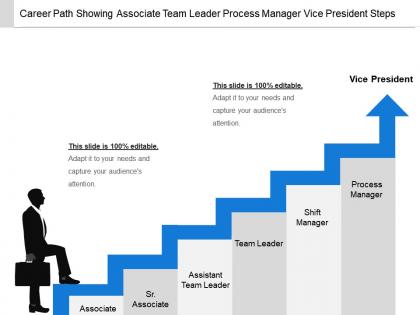
The image depicts a PowerPoint slide titled "Career Path Showing Associate Team Leader Process Manager Vice President Steps." It features a stylized staircase graphic, representing a typical career progression within an organization. The steps on the staircase are labeled with various job titles to illustrate a potential career path:
1. Associate:
The starting point of the career path, is often an entry-level position.
2. Senior Associate:
A position that reflects more experience or higher performance as an associate.
3. Assistant Team Leader:
A junior management role, likely involving some supervisory responsibilities.
4. Team Leader:
A mid-level management position, responsible for leading a team.
5. Shift Manager:
A role that could involve oversight of operations across different shifts or timeframes.
6. Process Manager:
A more senior management role focused on managing and optimizing business processes.
7. Vice President:
A high-level executive position with significant responsibility for company direction and strategy.
Each step is connected by a blue line that progressively leads to the top, symbolizing the pathway one might take to advance in their career. On the left side of the graphic, there is a silhouette of a person seemingly ready to ascend the steps, representing an employee's ambition to grow within the company.
Use Cases:
This type of career path visualization can be applied across various industries:
1. Finance:
Use: Illustrating the progression from financial analyst to executive roles.
Presenter: HR Director
Audience: New hires, existing finance team
2. Healthcare:
Use: Showing career advancement from clinical staff to healthcare administration.
Presenter: Chief Medical Officer
Audience: Medical staff, administrative employees
3. Technology:
Use: Mapping out the journey from junior developer to technology leadership.
Presenter: Chief Technology Officer
Audience: Software developers, IT staff
4. Retail:
Use: Depicting the path from sales associate to store management and beyond.
Presenter: Operations Manager
Audience: Retail employees, management trainees
5, Manufacturing:
Use: Demonstrating growth opportunities from line worker to plant manager.
Presenter: Plant Manager
Audience: Production staff, supervisors
6. Education:
Use: Outlining the career trajectory from teaching assistant to school administration.
Presenter: Dean of Faculty
Audience: Educators, administrative staff
7. Hospitality:
Use: Detailing the steps from hotel staff to executive management.
Presenter: Hotel General Manager
Audience: Hotel staff, department heads
Career path showing associate team leader process manager vice president steps with all 5 slides:
Our Career Path Showing Associate Team Leader Process Manager Vice President Steps facilitate your acceptance. Make a confident entry into the corporate environment.

FAQs for Career path showing associate team leader process manager
So basically you start doing the actual work as an individual contributor, then work your way up to senior roles with trickier projects. Team lead or supervisor comes next. Management is where you're dealing with people and budgets - honestly that's where it gets messy. Directors handle multiple teams, then there's C-suite if you're into that whole thing. Tech companies move way faster though, I've seen people jump levels there. You gotta build technical stuff AND leadership skills as you go. Really it's about expanding your impact, not just grinding out years.
Honestly, getting a good mentor is like having cheat codes for your career. They'll warn you about mistakes before you make them and introduce you to people you'd never meet otherwise. I've watched friends skip entire levels just because their mentor recommended them for something or gave them the inside scoop on timing. It's wild how much faster you can move when someone who's already done it is showing you the shortcuts. The networking alone is worth it - though finding the right person can be tricky. Start by asking someone you respect for just 15 minutes a month.
Honestly, continuous learning is a game-changer for your career. Everything moves so fast now - what I knew five years ago is basically useless (learned that one the hard way lol). Your boss will definitely notice when you're picking up new skills or getting certified. Shows you're not just coasting, you know? The cool part is learning stuff often leads to jobs you didn't even realize existed. I'd say start with something small - maybe one course this quarter that fits where you wanna go. Don't overwhelm yourself, but staying current is pretty much non-negotiable these days.
Talk to your manager during your next one-on-one about where you want to go career-wise. Be direct about it. Ask what skills you'd need to level up. Watch for internal job postings and volunteer for stretch projects - even the messy cross-functional ones nobody wants. Coffee chats with people from other departments are gold too, you'll learn how things actually work around there. Most people just sit around waiting for someone to notice them, which honestly drives me crazy. Don't do that. Make your goals obvious to the people who matter.
Dude, networking is way more important than I thought it'd be. Used to think it was all fake business card BS, but it's really just staying in touch with people. Coffee with old coworkers, maybe one industry thing - nothing crazy. You hear about jobs before they're even posted, which is honestly clutch. People can actually vouch for you instead of your resume sitting in some pile. Plus you learn what's out there - like roles you didn't even know existed. It builds up over time too. Start small though, don't go overboard right away.
Reviews are super important for getting promoted, trust me. They create this official paper trail of what you've done that higher-ups always check before moving anyone up. Your scores and documented wins basically determine if you'll get promoted and how quickly. Even when your boss already thinks you're amazing, HR still wants to see solid review history before they'll approve more money and responsibility. I learned this the hard way honestly. Keep track of your accomplishments all year long and definitely ask what specific things you need to work on to reach the next level.
Just be super direct about it - book a real meeting, don't try to sneak it into your usual catch-ups. Come with specifics ready: the role you want, skills you need, timeline that makes sense. I wasted so much time being wishy-washy about this stuff before! Ask for their guidance instead of sounding demanding. Do your homework first though - look up internal openings, find potential mentors. Oh and definitely ask what they think success looks like from their end. Most managers actually want to help with career growth, they just need you to make it easy for them.
Honestly, the worst thing you can do is rush it without actually getting good at your job first. People can smell when you're just using them to get ahead - I watched someone do this and it blew up in their face hard. Don't obsess over promotions while sucking at your current work either. Oh, and definitely talk to your manager about what you want! Sounds obvious but most people never do it. They can't read your mind. Yeah it's awkward but just bite the bullet. Way better than staying stuck forever.
Honestly, company culture makes or breaks your career path. Some places reward you for taking risks and thinking outside the box. Others? You better follow every single rule if you want that promotion. I've seen friends get stuck because their company only hires externally for good roles - meanwhile they're sitting there with all the experience but no title to show for it. You've got to decode the unwritten rules fast. Like, what actually gets people ahead versus what they say in meetings? Then decide if that matches how you work. Trust me, fighting against the culture is exhausting.
Honestly, just look at the obvious stuff first - salary bumps, title changes, bigger responsibilities. I keep a running list of new skills and projects I've led (makes performance reviews so much easier, trust me). Your network growing is huge too, plus how much decision-making power you actually have now. Compare where you were like 1-2 years ago to today. The difference might surprise you! Start writing this stuff down quarterly though - you'll totally forget half your wins by review time. Also track mentorship opportunities, whether you're giving or getting them.
Dude, you definitely want to get comfortable with basic data stuff and digital tools - even non-tech jobs expect that now. Communication skills are still massive, especially since remote work is everywhere. Problem-solving never gets old either. The AI thing is kinda everywhere right now (feels overhyped but whatever). Being adaptable matters more than specific skills honestly. Oh, and quick learning - that's what employers actually care about. I'd start with one relevant tech thing for your field. Maybe Excel if you're behind on that, or try a project management tool. Don't overthink it too much though.
Honestly, D&I can be a game-changer for your career. Companies that actually care about inclusion are hunting for talent from all backgrounds - they want different perspectives in leadership roles. Merit matters more than who you know or whether you fit some outdated mold. Diverse teams just perform better, so smart companies are finally catching on. The trick is finding places that actually practice what they preach instead of just virtue signaling. I've seen people advance way faster in truly inclusive environments because their skills get recognized instead of buried.
Honestly, I think lateral moves are super underrated. You get to explore different teams, see how other parts of the company work, and build connections everywhere. Vertical promotions are obviously great for the pay bump and authority, but they keep you in the same lane. My take? Do a couple laterals early on to figure out what you actually like, then start climbing. I made the mistake of just chasing titles at first - way better to think about what skills you're building. The network you create from moving around will help you way more than you'd expect later on.
Look, personal branding just makes you the person people think of first. You know how some colleagues always get the cool projects? They've built their reputation consistently. Share your expertise regularly and opportunities find you instead of the other way around. Honestly, decision-makers promote people they recognize as experts - not the ones hiding in cubicles. Figure out what you want to be known for first. Then keep sharing content around that thing. It's about standing out when everyone's fighting for the same roles. Trust me, consistency beats perfection every time.
Okay so LinkedIn Learning is solid for picking up new skills, and Coursera's great if you need actual certifications. For figuring out what you even want to do, try MyPlan or 16Personalities - those career assessments are surprisingly helpful. I'm weirdly obsessed with tracking everything in spreadsheets (I know, I'm ancient) but it actually keeps me on track. Check if your company has mentorship stuff through HR too - most people don't even know that exists. Oh, and don't ignore networking apps like Bumble Bizz. Start with a skills gap analysis, then just pick whatever tool fixes your biggest problem first.
-
Really like the color and design of the presentation.
-
Really like the color and design of the presentation.