


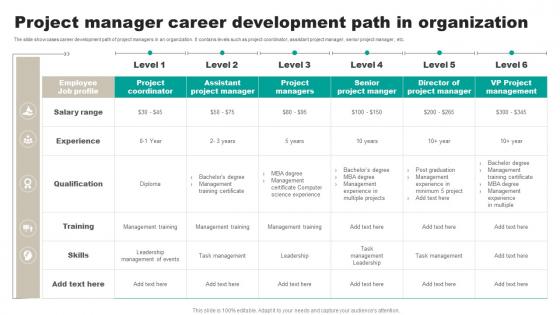
Project Manager Career Development Path In Organization




Try Before you Buy Download Free Sample Product
 Impress Your
 Audience
 100%
100% Editable
 Save Hours
 of Time


The slide showcases career development path of project managers in an organization. It contains levels such as project coordinator, assistant project manager, senior project manager, etc.
People who downloaded this PowerPoint presentation also viewed the following :
Project Manager Career Development Path In Organization with all 9 slides:
Use our Project Manager Career Development Path In Organization to effectively help you save your valuable time. They are readymade to fit into any presentation structure.
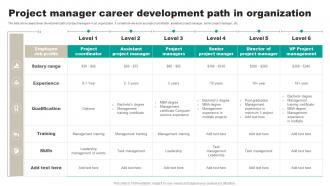








FAQs for Project Manager Career Development
Honestly, being a good PM is like being a translator between different teams who all speak their own language. Organization and time management are no-brainers, but the real trick is juggling 10 competing priorities without having a breakdown. Risk management helps too - catching issues before they explode saves everyone's sanity. Oh, and you'll definitely need solid leadership skills since you're basically herding cats who don't report to you. Negotiation comes in handy more than you'd think. I'd say pick whatever feels like your biggest weakness right now and work on that first.
Hey! So the main thing is grabbing bigger, messier projects that actually matter. Build real relationships with stakeholders - not just the easy ones. Mentor junior people when you can. Honestly, some PMs stay junior forever because they don't push for it. Ask your manager straight up what gaps you need to fill, then go fix them. Track your wins with actual numbers. The timeline's usually 2-4 years, but it depends on your company and how hard you go after it. Document everything because you'll forget half the good stuff you did when review time comes around.
Yeah, PMP is still the big one everyone knows. PMI-ACP is getting popular too since agile is basically everywhere now - probably worth looking into. PRINCE2 matters more if you're dealing with international stuff or European companies. Honestly, I'd go with PMP first since it opens the most doors. But definitely check what jobs in your area are actually asking for - some industries get weirdly specific about certs. My cousin works in healthcare and they only cared about certain ones, not the usual suspects. Just pick whatever matches where you want to end up and stick with it. Don't overthink it.
Cross-industry experience is honestly a game-changer for PM roles. You become so much more marketable when you can pull from different worlds. Tech taught me to move fast and iterate. Healthcare? That's where I learned to navigate insane regulatory hoops. Construction projects are all about safety first, no exceptions. Each industry handles risk and stakeholders totally differently, and you can mix those approaches in cool ways. Don't box yourself into one sector - that's limiting your potential. Document those transferable skills on your resume and show how your weird mix of backgrounds actually makes you stronger.
Dude, EQ is literally what makes or breaks PMs. Sure, you can learn all the technical stuff, but when your team's stressed and stakeholders are breathing down your neck, that's when emotional intelligence saves you. I've seen so many projects fail because the PM couldn't read the room or handle conflict well. You're basically a therapist half the time - picking up on what people aren't saying, calming everyone down when things get heated. Trust me, start really listening in meetings instead of just waiting for your turn to talk. It'll change everything about how your projects run.
Honestly, you're gonna need to communicate way more than feels normal. Daily check-ins are clutch - I swear by quick standups. Document everything because people can't just eavesdrop on decisions anymore, which is weirdly something you miss. Project management tools become your lifeline so everyone sees what's happening. Here's the thing though - don't skip the random chat stuff! It actually keeps teams sane. Be ridiculously clear about deadlines since you can't just pop over to bug someone. Start by doubling whatever communication you think you need. Trust me on that one.
Honestly, scope creep will drive you insane - people always want to add "just one more thing." Document everything from day one and don't be afraid to push back early. You'll also deal with resource conflicts constantly, but if you build good relationships with other department heads, negotiating gets way easier. Oh, and stakeholders? Over-communicate like crazy. I know it feels like overkill, but trust me - those surprise "everything's on fire" meetings are the worst. Start writing down your processes now too. When things get messy (and they will), you'll be so glad you did.
You can't just pick one side and ignore the other - both matter equally. I've watched way too many PMs crash and burn because they either get lost in technical stuff OR they're all about people but can't even understand a basic system diagram. That's just asking for trouble. Here's what actually works: spend a week shadowing your best technical lead, then do the same with whoever's great at managing people. You don't need to become an expert at either, but you've got to know enough to ask the right questions and call out BS when you see it. The real skill is being that bridge between engineering and everyone else.
Oh man, there's so many tools out there but I'd start simple. Asana or Monday.com for project tracking - Jira if you're doing software stuff. Slack is pretty much mandatory now (I live in it tbh). Miro's great for those brainstorming sessions where everyone's drawing boxes and arrows everywhere. You'll need Google Workspace or Office 365 obviously. Toggl's solid for time tracking if you care about budgets. Honestly just pick one from each category first. Don't go crazy trying to use everything at once - learned that the hard way!
You're basically the translator between big company dreams and actual getting-stuff-done. Those fancy strategic goals? Someone has to turn them into real deadlines and tasks - that's you. Managing resources, keeping teams on track, reporting back to the bosses so they know if their million-dollar ideas are working or flopping. Honestly, most strategic initiatives would just die without decent PMs holding everything together. Oh, and learn your company's key metrics inside and out - that's how you'll prove your projects actually move the needle instead of just burning budget.
Honestly, just match your project type first. Software dev? Go Agile since stuff changes constantly. Construction or manufacturing where everything's locked down? Waterfall makes way more sense. Team size matters too - small teams can pivot fast, bigger ones need more structure. Your boss's personality is huge here... some execs want detailed plans upfront, others get antsy and want quick wins. I've watched teams try to force methodologies that don't fit and it's just messy. Oh, and don't pick something just because it sounds cool. Look at your team's experience level and how much paperwork you actually need.
Dude, networking is everything in PM. Seriously - most good jobs never even get posted publicly. People in your network become walking referral machines, which matters tons since hiring managers want proof you can actually ship stuff and not be a nightmare teammate. You'll absorb so much random industry knowledge just chatting with other PMs too. I've watched people jump 2-3 levels up purely through who they knew. Join some PM communities and actually show up to meetups - but here's the key part everyone forgets: follow up afterward.
PM jobs are looking pretty good right now, honestly. Tech pays the most ($85-130K range) but man, everyone's trying to break in there. Healthcare and construction are solid too with similar pay scales. Government work is way more chill but you'll probably make 20-30% less. Definitely get your PMP cert - that's like table stakes now. Oh, and think about your background when you're applying. Finance experience? Go after fintech PM roles, that kind of thing. Most industries need PMs these days. You might have to start somewhere less sexy just to get that experience under your belt, but the demand's definitely there.
Honestly, PMI and Scrum Alliance are worth joining - great for networking and staying current. I listen to PM podcasts on my commute (way better than the news lately). LinkedIn's actually decent for following industry people, not just seeing everyone's job updates. Local meetups are hit or miss but sometimes gold. Block out like 30 minutes each week to browse new stuff. I try one new technique per quarter - sounds nerdy but it works. Don't wait until performance review season to cram everything. Oh, and those free webinars? They're surprisingly useful if you can stay awake.
Honestly, stakeholder management will make or break your PM career. Most of your day is spent managing people - keeping execs happy, getting teams aligned, juggling department priorities. It's draining but that's where you actually prove your worth as a leader. Good stakeholder skills = better project outcomes = stellar reviews = faster promotions. The PMs who nail this early are the ones climbing to senior roles while others are still figuring it out. Oh, and learn to say no nicely - you'll use that skill daily. Trust me on this one.
-
Professionally designed slides with color coordinated themes and icons. Perfect for enhancing the style of the presentations.
-
Commendable slides with attractive designs. Extremely pleased with the fact that they are easy to modify. Great work!