


Hr Career Development And Growth Path




Try Before you Buy Download Free Sample Product
 Impress Your
 Audience
 100%
100% Editable
 Save Hours
 of Time


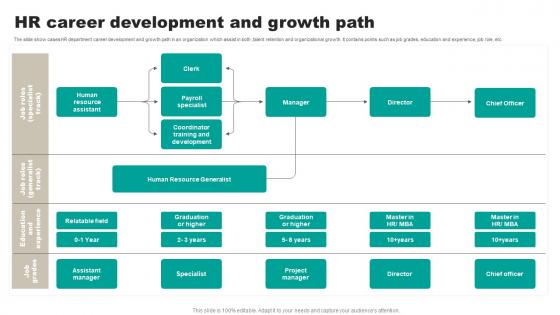
The slide show cases HR department career development and growth path in an organization which assist in both ,talent retention and organizational growth. It contains points such as job grades, education and experience, job role, etc.
People who downloaded this PowerPoint presentation also viewed the following :
Hr Career Development And Growth Path with all 9 slides:
Use our Hr Career Development And Growth Path to effectively help you save your valuable time. They are readymade to fit into any presentation structure.








FAQs for Hr Career Development
Key skills for HR career advancement include strategic thinking, data analytics, employment law knowledge, conflict resolution, and digital HR technology proficiency. These competencies enable professionals to drive organizational change, optimize talent management processes, and deliver measurable business outcomes, with many HR leaders finding that combining people expertise with analytical capabilities creates significant competitive advantage in today's data-driven workplace.
Networking contributes to HR career growth by providing access to industry insights, mentorship opportunities, knowledge of emerging trends, and visibility within professional circles. Through strategic relationship-building at conferences, professional associations, and industry events, HR professionals gain competitive intelligence, discover new opportunities, and build credibility, ultimately accelerating their career trajectory and professional influence.
Continuous education and certification significantly accelerate HR career advancement by demonstrating expertise, keeping professionals current with regulations, and building credibility with employers. These investments enable HR professionals to command higher salaries, qualify for senior roles like CHRO or VP positions, and deliver strategic value through specialized knowledge in areas like compensation, employment law, and organizational development.
HR professionals can leverage social media by building thought leadership through LinkedIn content, engaging with industry discussions, showcasing HR expertise through case studies, and connecting with recruiters and industry leaders. By consistently sharing insights on talent management, workplace culture, and HR trends while maintaining professional branding, professionals enhance visibility, expand networks, and attract opportunities in an increasingly digital recruitment landscape, ultimately delivering competitive advantage in career advancement.
HR leaders can implement strategies including structured mentoring programs, cross-functional project assignments, regular feedback sessions, skill development workshops, and exposure to strategic decision-making processes. These approaches enhance emerging talent by providing real-world experience, building critical competencies, and fostering leadership capabilities, with many organizations finding that systematic mentoring accelerates career progression while strengthening overall HR team effectiveness.
Diversity and inclusion significantly enhances career advancement by expanding networking opportunities, developing cultural competency skills, and creating more equitable promotion pathways within organizations. HR professionals who champion inclusive practices gain strategic visibility, build stronger stakeholder relationships, and position themselves as essential leaders, with many companies increasingly prioritizing D&I expertise for senior roles.
Emerging HR trends include AI-powered talent acquisition, employee experience design, data-driven people analytics, remote workforce management, and diversity and equity initiatives. These technologies and approaches enable HR professionals to streamline recruitment processes, enhance employee engagement, and deliver strategic insights, with many organizations finding that mastering these areas provides significant competitive advantage in talent management.
HR professionals can assess their current skills through 360-degree feedback, performance reviews, competency frameworks, skills gap analyses, and professional benchmarking against industry standards. These evaluation methods enable targeted development by identifying strengths and weaknesses across areas like talent management, employee relations, and strategic planning, with many organizations finding that structured self-assessment ultimately delivers enhanced career progression and competitive advantage.
Emotional intelligence drives HR career advancement by enhancing communication skills, conflict resolution abilities, stakeholder relationship management, and strategic decision-making capabilities. Through high EQ, HR professionals navigate complex workplace dynamics, build trust with executives and employees, and deliver measurable outcomes in talent retention and organizational culture, ultimately positioning themselves as strategic business partners rather than administrative functions.
HR professionals create personal brands by developing expertise in strategic areas like talent analytics and employee experience, sharing insights through LinkedIn articles and industry speaking, and building networks within professional associations. Through consistent thought leadership and showcasing measurable HR outcomes like retention improvements or culture transformations, professionals position themselves as strategic business partners, ultimately attracting opportunities from organizations seeking innovative HR leaders.
Best practices for negotiating promotions and salary increases in HR include documenting achievements with metrics, researching market compensation data, timing requests strategically, and presenting comprehensive business cases that highlight value contributions. These approaches work by demonstrating measurable impact through cost savings, efficiency improvements, and strategic initiatives, with many HR professionals finding that emphasizing organizational outcomes rather than personal needs ultimately delivers stronger negotiation results and career advancement.
Participation in HR associations and conferences enhances career success by expanding professional networks, providing access to industry best practices, and offering continuous learning opportunities through workshops and certifications. These platforms enable HR professionals to stay current with evolving regulations, connect with senior leaders across industries, and gain strategic insights, ultimately positioning them for promotions and leadership roles in an increasingly competitive talent management landscape.
HR professionals should master HRIS platforms, AI-powered recruitment tools, data analytics software, employee engagement platforms, and learning management systems. These technologies enhance talent acquisition, streamline performance management, and deliver predictive workforce insights, with many organizations finding that HR professionals skilled in automation and data analysis drive significantly better employee experiences and strategic decision-making.
HR professionals can transition from generalist to specialist roles by identifying their strongest competencies, pursuing targeted certifications in areas like compensation, talent acquisition, or learning development, and seeking specialized project opportunities within their current organization. This strategic approach enables professionals to build deep expertise while leveraging their broad HR foundation, with many finding that specialization in high-demand areas like analytics or employee experience significantly enhances their market value and career trajectory.
Common barriers to HR career advancement include limited strategic visibility, lack of business acumen, insufficient data analytics skills, narrow functional expertise, and weak executive relationships. These challenges can be overcome by pursuing strategic HR certifications, developing cross-functional business knowledge, mastering HR analytics and metrics, expanding into areas like talent management and organizational development, and actively building relationships with senior leadership, ultimately positioning HR professionals as strategic business partners rather than administrative support functions.
-
I'm happy to discover your PowerPoint presentations and templates. They met my expectations precisely. Very innovative!
-
A library of engaging, customizable and content-ready templates.