


Career Path Planning Powerpoint Presentation Slides






Try Before you Buy Download Free Sample Product
 Impress Your
 Audience
 100%
100% Editable
 Save Hours
 of Time


Utilize this Career Path Planning PowerPoint Presentation Slides to encompass varied paths of career progression. By employing this profession advancement PPT theme, you can give the process overview of employment succession PowerPoint layout. The procedure of identifying critical positions followed by an assessment, planning, development, training, and evaluation can be elucidated with this professionally designed occupation track PPT template. You can easily recognize the candidate’s performance and potential of a particular position by taking the assistance of this career growth PowerPoint complete deck. You can highlight the employee competency by assessment grid and succession flowchart by incorporating this career growth PPT layout. The various planning elements, objectives, and tools required for progression can be effectively demonstrated with this career progression PowerPoint slideshow. Furthermore, you can track the effectiveness of the occupation pathway by demonstrating the career pathway metrics and discussing the solutions to the roadblocks. Download this career development planning PPT template to suggest the necessary business advancement steps.
People who downloaded this PowerPoint presentation also viewed the following :
Content of this Powerpoint Presentation
Slide 1: This slide introduces Career Path Planning. State Your Company Name and begin.
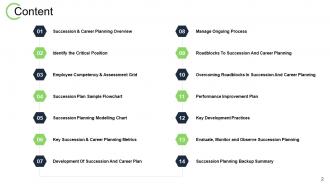
Slide 2: This slide shows Content of the presentation.
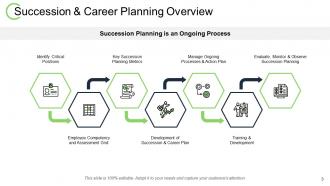
Slide 3: This slide presents Succession and Career Planning Overview.
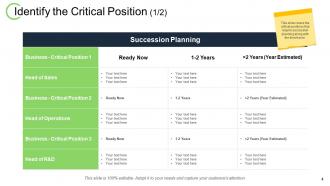
Slide 4: This slide displays Identify the Critical Position that require succession planning along with the time frame.
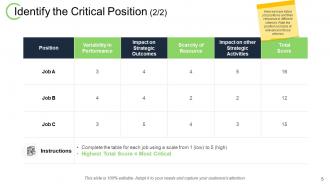
Slide 5: This is another slide representing Identify the Critical Position in tabular form.
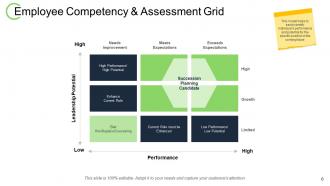
Slide 6: This slide showcases Employee Competency and Assessment Grid to identify individual’s performance and potential for the specific position in the coming future.
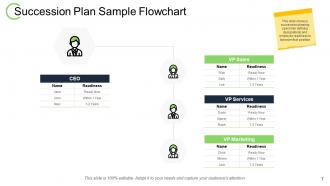
Slide 7: This slide shows Succession Plan Sample Flowchart defining designations and employee readiness to takeover that position.
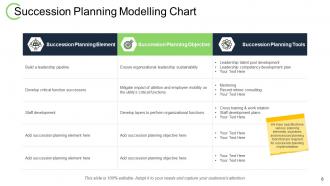
Slide 8: This slide presents Succession Planning Modelling Chart describing various planning elements, objectives and necessary planning tools that are required for succession planning implementation.
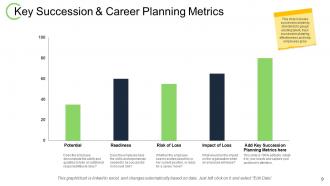
Slide 9: This slide displays Key Succession & Career Planning Metrics describing- Potential, Risk of Loss, Key Succession Planning Metric, Readiness, Impact of Loss.
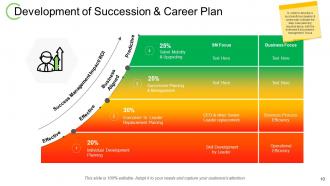
Slide 10: This slide represents Development of succession and career plan with data in percentage.
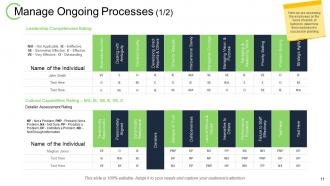
Slide 11: This slide showcases Manage Ongoing Process by assessing the employees on the basis of variety of factors to determine their readiness for succession planning.
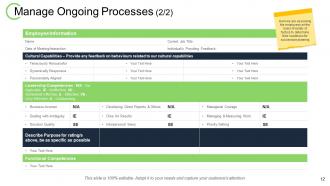
Slide 12: This is another slide for Managing Ongoing Processes.
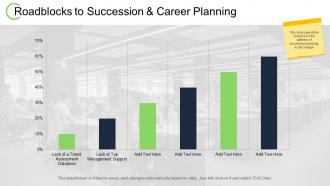
Slide 13: This slide shows Roadblocks to Succession and Career Planning.
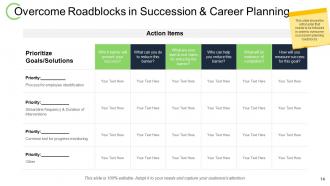
Slide 14: This slide shows the action plan that needs to be followed in order to overcome Roadblocks in Succession and Career Planning.
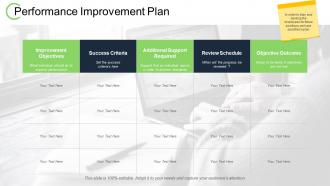
Slide 15: This slide presents Performance Improvement Plan to train and develop the employees for future positions.
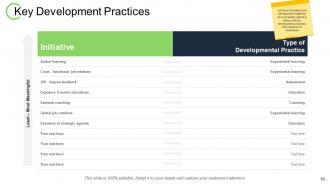
Slide 16: This slide displays Key Development Practices in tabular form.
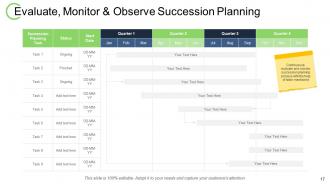
Slide 17: This slide represents Evaluate, Monitor and Observe Succession Planning.
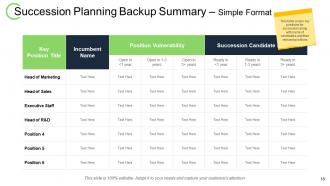
Slide 18: This slide showcases Succession Planning Backup Summary- Simple Format covering key positions for succession along with name of candidates and their relevant positions.
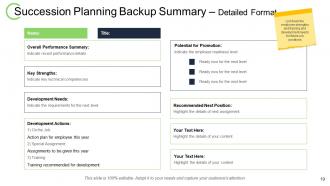
Slide 19: This slide shows Succession Planning Backup Summary- Detailed Format listing employee strengths and training and development needs for future job positions.
Slide 20: This slide reminds about a 30 minutes coffee break.
Slide 21: This slide displays Career Path Planning for Icons.
Slide 22: This slide is titled as Additional Slides for moving forward.
Slide 23: This is Our Mission slide with related imagery and text boxes.
Slide 24: This is Our Team slide with names and designation.
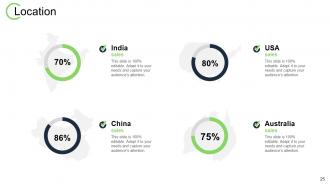
Slide 25: This is a Location slide with map to show data related with different locations.
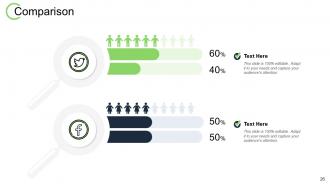
Slide 26: This is Comparison slide to state comparison between commodities, entities etc.
Slide 27: This is a Financial slide. Show your finance related stuff here.
Slide 28: This is an Idea Generation slide to state a new idea or highlight information, specifications etc.
Slide 29: This slide shows Magnifying Glass to highlight information, specifications etc.
Slide 30: This is a Thank You slide with address, contact numbers and email address.
Career Path Planning Powerpoint Presentation Slides with all 30 slides:
Use our Career Path Planning Powerpoint Presentation Slides to effectively help you save your valuable time. They are readymade to fit into any presentation structure.




FAQs for Career Path Planning
Honestly, start by figuring out what you're actually good at and what matters to you - sounds basic but most people skip this part. Research careers that match up with that stuff. Set some goals with real deadlines (not just "someday I'll do this"). Figure out what skills you're missing and make a plan to get them. Oh, and network like crazy in whatever field you're targeting - I know, I know, networking feels gross but it works. The biggest thing though? Just start doing something, even if it's tiny. I've seen so many people plan forever and never actually move. Better to take messy action than sit around perfecting some master plan.
Honestly, those personality tests are way more useful than they seem at first. Yeah, some feel totally bogus, but the decent ones actually show you patterns - like whether you need structure or hate being micromanaged, if you're energized by teamwork or prefer solo work. It's basically figuring out how your brain works best so you don't end up miserable in the wrong job. I mean, why force yourself into something that goes against every instinct you have? Look up careers that match whatever traits come up strongest. You'll save yourself years of feeling stuck.
Honestly, mentorship is huge for your career. You get access to someone's actual experience and connections - stuff you'd never figure out on your own. They'll help you dodge the politics nonsense and spot opportunities you'd totally miss. Plus introductions to the right people (which is like 80% of getting ahead, tbh). Don't just grab whoever's free though. Find 2-3 people whose careers you actually want, then ask for casual coffee first. Way better approach than formal "will you mentor me" emails that make everyone cringe.
Honestly, keeping up with industry trends is like having a roadmap for your career. Spend maybe 30 minutes each week scrolling through industry reports or following some smart people on LinkedIn - sounds boring but it's actually pretty useful. When you see stuff like AI starting to mess with your field, that's when you pivot. Either learn some AI skills or get really good at the human stuff robots can't do yet. Way better to make moves now than scramble later when everyone else is panicking. I learned this the hard way a few years back, trust me.
Honestly? Being adaptable is huge - like, really assess what skills you already have that transfer over. Communication matters too since you'll need to sell your story to employers who might be confused about your switch. Networking is annoying but you can't skip it. Research the hell out of industries you're targeting. Oh, and treat your job search like a project - stay organized or you'll go crazy. I'd start by listing out your current skills and figuring out which ones work anywhere. That prep makes interviews way less terrifying.
Honestly, you don't have to pick between passion and paying rent. Figure out what gets you excited first, then see which industries actually need those skills and pay decently. Sometimes your dream job isn't 100% perfect, but if you can use stuff you're genuinely interested in as actual valuable skills, that's pretty solid. Or go the stable job route and do passion projects on weekends - I know people who've made that work really well. We all need money, obviously, but there's usually some middle ground if you dig around enough.
LinkedIn's great for stalking people's career paths - you can see how they actually got where they are. Bureau of Labor Statistics has solid salary data, and O*NET breaks down what skills you'll need. But honestly? Just reach out to people for coffee chats. Most folks love talking about their jobs if you're not being weird about it. Glassdoor's useful for company dirt too. My advice though - pick like 2-3 roles max and really dig in. Otherwise you'll go down this endless research rabbit hole and never actually do anything.
Honestly, most good jobs come through people you know - not job boards. It's awkward at first (I literally used to pretend to check my phone at these things), but you're basically just asking people about their work and telling them about yours. The real benefit? People remember you when something opens up, and you'll hear about company drama before you waste time applying somewhere toxic. Coffee with someone from another department counts as networking, by the way. Or join a professional group if you're feeling ambitious. You don't need to work the room like some business card-throwing maniac.
Honestly, tech is completely flipping how careers work these days. Some jobs are getting wiped out by AI, but weird new ones keep popping up - like "prompt engineer" didn't even exist two years ago, which is wild. Remote work tech means you can literally work anywhere now instead of being stuck with whatever's in your city. The biggest thing? You've gotta keep learning constantly. I try to spend like an hour each month just seeing what new tools people are talking about in my field. It's annoying but necessary. Stay flexible and you'll be fine.
First thing - figure out what you're already good at and where you're totally lost. I'd pick maybe 2-3 concrete things you can knock out in the next year, like a certification or volunteering for that project nobody wants. Long-term stuff is weird because honestly, everything changes so fast now. But think about where you actually want to end up, then work backwards. Write this down somewhere you'll actually look at it - not buried in some random note app. Goals floating around in your head don't really count, you know?
Dude, you HAVE to keep learning new stuff or you'll get left behind. I've watched so many smart people hit a wall because they thought their degree would carry them forever - spoiler alert, it won't. Companies want people who can roll with changes and pick up new skills. The trick is starting small though. Like 30 minutes here and there reading up on trends or doing quick online courses. Don't wait until you're desperate and scrambling for a new job. Trust me, staying current opens doors you didn't even know were there.
Honestly, pay attention to Sunday nights - if you're dreading Monday every week, your gut's trying to tell you something. Check whether work energizes or drains you, and if you're actually growing skills you care about. Look at people 2-3 levels above you. Does their life excite you or make you want to bail? I always think that's such a telling exercise. Track your own goals, not just company ones. Are opportunities matching what you value? The biggest warning sign is feeling stuck for 6+ months with no clear way out. Set up quarterly check-ins with yourself to honestly assess where you stand.
Honestly, just get good at the basics that every job needs - talking to people, solving problems, managing projects. Excel is your friend, learn it. Volunteer for random stuff at work, even if it's slightly terrifying. I swear, saying yes to things you're not 100% ready for is how you actually grow. Pick up some coding or design skills too since they're useful everywhere now. After each project, write down what you learned but describe it in normal words, not job-specific jargon. That way your resume doesn't pigeonhole you into one industry.
Honestly, work-life balance can make or break your whole career trajectory. Burnt out constantly? You'll either hate your job or literally crash and burn. Been there! So when you're job hunting, don't just chase the flashy titles or fat paychecks. Look for places that actually respect your time off. Figure out what keeps you sane outside work first - maybe it's weekend trips, gym time, whatever floats your boat. Then build your career around that stuff instead of crossing your fingers it'll somehow work out later. Trust me, planning ahead beats scrambling to fix things when you're already miserable.
Okay so first off, career changes are terrifying and anyone who says otherwise is lying. What helps me is breaking down exactly what's freaking you out - is it money? What people will think? Not having the right skills? Once you know what you're actually worried about, you can start dealing with it. Build up some savings if you can, talk to people doing what you want to do (they're usually happy to help honestly), and start learning stuff on the side. Don't feel like you have to quit tomorrow - think bridge, not cliff. Small steps count too.
-
Professional and unique presentations.
-
Understandable and informative presentation.
-
It saves your time and decrease your efforts in half.
-
Design layout is very impressive.
-
Qualitative and comprehensive slides.