


Case competition overcome the challenge of cyber security in healthcare complete deck




Try Before you Buy Download Free Sample Product
 Impress Your
 Audience
 100%
100% Editable
 Save Hours
 of Time


Cyber threats and security flaws can risk patient protected health information (PHI) and distract healthcare staff, but this does not mean that the issues are insurmountable. The concentration and amount of healthcare data is the primary concern in this field. Researchers, doctors, and other healthcare professionals understand that having access to high-quality health data is critical to achieving improved results. However, having a huge volume of useful data comes with considerable security concerns that healthcare companies must be able to manage. If you're looking for more information on how to overcome the challenge of cyber security in healthcare, we've got you covered. Download our free cyber security PowerPoint templates now and get started planning your next presentation. With these templates, you'll have everything you need to make a powerful case for better cybersecurity in healthcare. And if you need help putting together your presentation, our team is here to help. Contact us today to learn more about our services and how we can help you take your presentations to the next level.
People who downloaded this PowerPoint presentation also viewed the following :
Content of this Powerpoint Presentation
Slide 1: This title slide introduces the Case Competition – Overcome the Challenge of CYBER SECURITY IN HEALTHCARE.
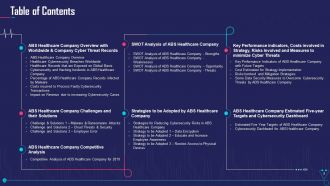
Slide 2: This slide contains the Table of Contents. It includes - ABS Healthcare Company Overview with Worldwide & Company Cyber Threat Records, ABS Healthcare Company Challenges and their Solutions, ABS Healthcare Company Competitive Analysis, etc.
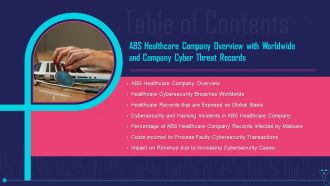
Slide 3: This is a table of content slide introducing the ABS Healthcare Company Overview with Worldwide and Company Cyber Threat Records.
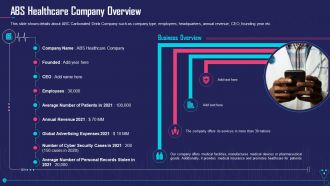
Slide 4: This slide presents the ABS Healthcare Company Overview. It shows details about ABC Carbonated Drink Company such as company type, employees, headquarters, annual revenue, CEO, founding year, etc.
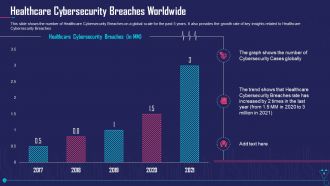
Slide 5: This slide presents the Healthcare Cybersecurity Breaches Worldwide. It shows the number of Healthcare Cybersecurity Breaches on a global scale for the past 5 years. It also provides the growth rate of key insights related to Healthcare Cybersecurity Breaches.
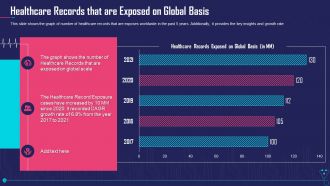
Slide 6: This slide presents the Healthcare Records that are Exposed on a Global Basis. It shows the graph of the number of healthcare records that are exposed worldwide in the past 5 years. Additionally, it provides the key insights and growth rate.
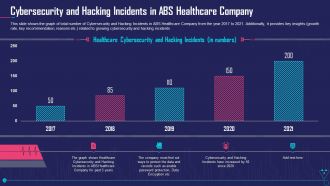
Slide 7: This slide presents the Cybersecurity and Hacking Incidents in ABS Healthcare Company. It shows the graph of the total number of Cybersecurity and Hacking Incidents in ABS Healthcare Company from the year 2017 to 2021.
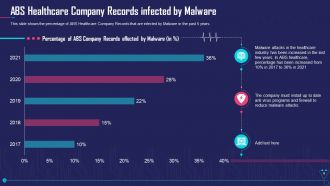
Slide 8: This slide presents the ABS Healthcare Company Records infected by Malware. It shows the percentage of ABS Healthcare Company Records that are infected by Malware in the past 5 years.
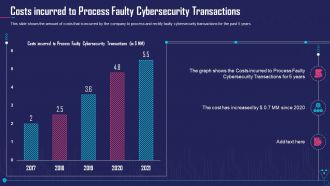
Slide 9: This slide presents the Costs incurred to Process Faulty Cybersecurity Transactions. It shows the number of costs that are incurred by the company to process and rectify faulty cybersecurity transactions for the past 5 years.
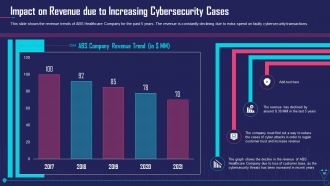
Slide 10: This slide presents the Impact on Revenue due to Increasing Cybersecurity Cases. The revenue is constantly declining due to extra spending on faulty cybersecurity transactions.
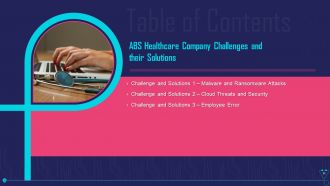
Slide 11: This is a table of content slide introducing the ABS Healthcare Company Challenges and their Solutions.
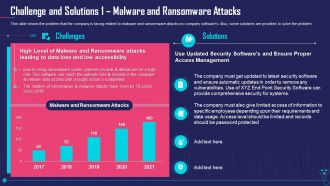
Slide 12: This slide presents the Challenge and Solutions 1 – Malware and Ransomware Attacks. It shows the problem that the company is facing related to malware and ransomware attacks on company software.
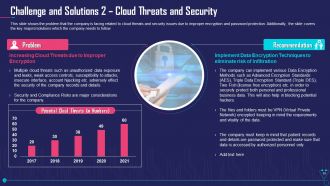
Slide 13: This slide presents the Challenge and Solutions 2 – Cloud Threats and Security. It shows the problem that the company is facing related to cloud threats and security issues due to improper encryption and password protection.
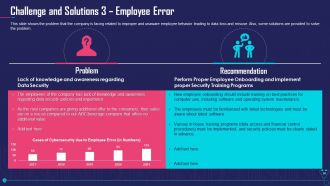
Slide 14: This slide presents the Challenge and Solutions 3 – Employee Error. It shows the problem that the company is facing related to improper and unaware employee behavior leading to data loss and misuse.
Slide 15: This is a table of content slide introducing the ABS Healthcare Company Competitive Analysis.
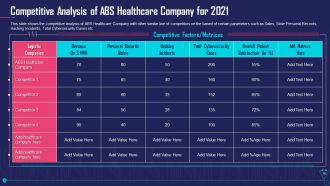
Slide 16: This slide presents the Competitive Analysis of ABS Healthcare Company for 2021. It shows the competitive analysis of ABS Healthcare Company with other similar lines of competitors based on certain parameters such as Sales, Stole Personal Records, Hacking Incidents, Total Cybersecurity Cases, etc.
Slide 17: This is a table of content slide introducing the Strategies to be Adopted by ABS Healthcare Company.
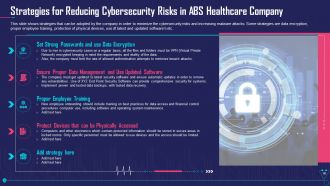
Slide 18: This slide presents the Strategies for Reducing Cybersecurity Risks in ABS Healthcare Company. It shows strategies that can be adopted by the company in order to minimize cybersecurity risks and increase in malware attacks.
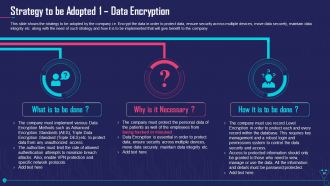
Slide 19: This slide presents the Strategy to be Adopted 1 – Data Encryption. It shows the strategy to be adopted by the company, i.e. Encrypt the data in order to protect data, ensure security across multiple devices, move data securely, maintain data integrity, etc.
Slide 20: This slide presents the Strategy to be Adopted 2 – Educate and Increase Employee Awareness. It shows the strategy to be adopted by the company, i.e. Educate and provide proper data security training to the employees, make them familiar with the latest security techniques, etc.
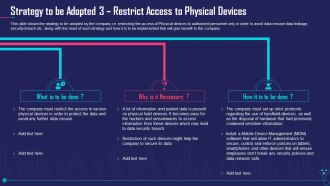
Slide 21: This slide presents the Strategy to be Adopted 3 – Restrict Access to Physical Devices. It shows the strategy to be adopted by the company, i.e. restricting the access of Physical devices to authorized personnel only in order to avoid data misuse data leakage, security breaches, etc.
Slide 22: This is a table of content slide introducing the SWOT Analysis of ABS Healthcare Company.
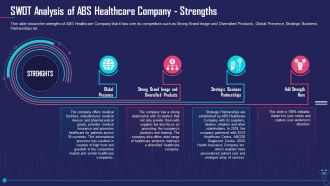
Slide 23: This slide presents the SWOT Analysis of ABS Healthcare Company – Strengths. It shows the strengths of ABS Healthcare Company that it has over its competitors such as Strong Brand Image and Diversified Products, Global Presence, Strategic Business Partnerships, etc.
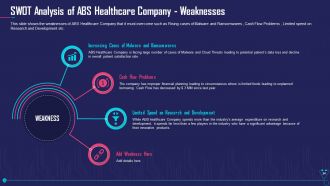
Slide 24: This slide presents the SWOT Analysis of ABS Healthcare Company – Weaknesses. It shows the weaknesses of ABS Healthcare Company that it must overcome such as Rising cases of Malware and Ransomware, Cash Flow Problems, Limited spending on Research and Development, etc.
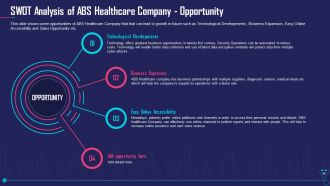
Slide 25: This slide presents the SWOT Analysis of ABS Healthcare Company – Opportunity. It shows some opportunities of ABS Healthcare Company that can lead to growth in the future such as Technological Developments, Business Expansion, Easy Online Accessibility, and Sales opportunities, etc.
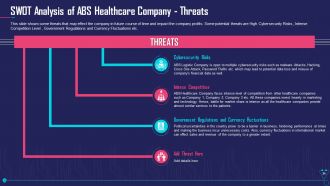
Slide 26: This slide presents the SWOT Analysis of ABS Healthcare Company – Threats. It shows some threats that may affect the company in the future course of time and impact the company's profits. Some potential threats are High Cybersecurity Risks, Intense Competition Levels, Government Regulations and Currency Fluctuations, etc.
Slide 27: This is a table of content slide introducing the Key Performance indicators, Costs involved in Strategy, Risks Involved, and Measures to minimize Cyber Threats.
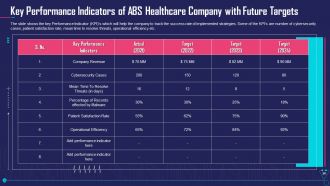
Slide 28: This slide presents the Key Performance Indicators of ABS Healthcare Company with Future Targets. Some of the KPIs are the number of cybersecurity cases, patient satisfaction rate, mean time to resolve threats, operational efficiency, etc.
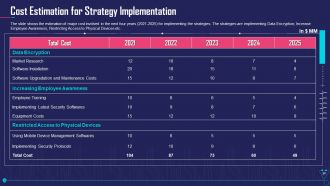
Slide 29: This slide presents the Cost Estimation for Strategy Implementation. The slide shows the estimation of major costs involved in the next four years (2021-2025) for implementing the strategies.
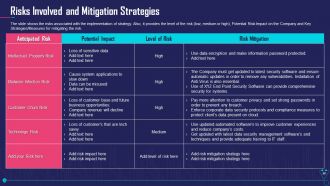
Slide 30: This slide presents the Risks Involved and Mitigation Strategies. It provides the level of the risk (low, medium, or high), Potential Risk Impact on the Company, and Key Strategies/Measures for mitigating the risk.
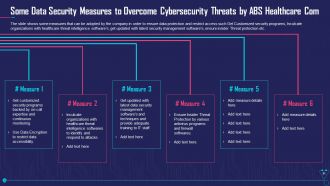
Slide 31: This slide presents the Some Data Security Measures to Overcome Cybersecurity Threats by ABS Healthcare Company. It shows some measures that can be adopted by the company in order to ensure data protection and restrict access.
Slide 32: This is a table of content slide introducing the ABS Healthcare Company Estimated Five-year Targets and Cybersecurity Dashboard.
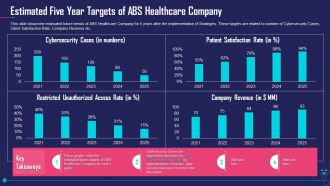
Slide 33: This slide presents the Estimated Five-Year Targets of ABS Healthcare Company. It shows the estimated future trends of ABS Healthcare Company for 5 years after the implementation of Strategies.
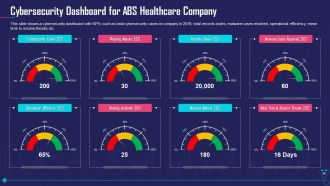
Slide 34: This slide presents the Cybersecurity Dashboard for ABS Healthcare Company. It shows a cybersecurity dashboard with KPIs such as total cybersecurity cases in the company in 2019, total records stoles, malware cases resolved, operational efficiency, mean time to resolve threats, etc.
Slide 35: This is the Icons Slides for Case Competition - Overcome the Challenge of Cyber Security in Healthcare.
Slide 36: This slide presents the Additional Slides.
Slide 37: This slide shows the members of the company team with their name, designation, and photo.
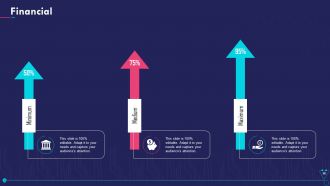
Slide 38: This slide presents the financial data with the data’s numbers at minimum, medium, and maximum percentages.
Slide 39: This slide provides the Mission for the entire company. This includes the vision, the mission, and the goal.
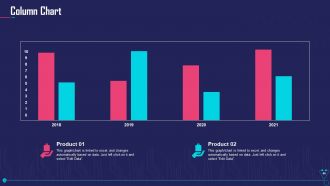
Slide 40: This slide shows a Column Chart that compares 2 products’ data over a timeline of years.
Slide 41: This slide shows a Bar Graph that compares 2 products’ sales over a timeline of financial years.
Slide 42: This slide is a Roadmap template to showcase the progress of the steps of a project with time.
Slide 43: This slide is a Roadmap template to showcase the stages of a project, for example.
Slide 44: This slide presents Our Goal for the company. Add your goals/target here.
Slide 45: This is a slide with a 30-60-90-Days Plan to set goals for these important intervals.
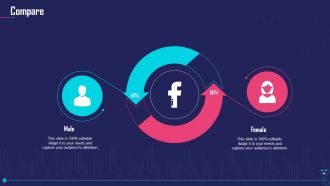
Slide 46: This slide presents the Comparison between the percentages of male and female Facebook users.
Slide 47: This slide is a Timeline template to showcase the progress of the steps of a project with time.
Slide 48: This slide contains Post-It Notes that can be used to express any brief thoughts or ideas.
Slide 49: This is a Thank You slide where details such as the address, contact number, and email address are added.
Case competition overcome the challenge of cyber security in healthcare complete deck with all 49 slides:
Use our Case Competition Overcome The Challenge Of Cyber Security In Healthcare Complete Deck to effectively help you save your valuable time. They are readymade to fit into any presentation structure.





FAQs for Case competition overcome the challenge of cyber security in
Dude, healthcare cybersecurity is honestly a nightmare. Legacy medical devices that can't get updates, patient data worth crazy money to hackers, and HIPAA compliance constantly looming over everything. Staff are swamped and sometimes skip security steps when they're literally trying to save someone's life - which, fair enough. Ransomware hits different in hospitals too since lives are actually on the line when systems crash. Oh, and good luck getting budget approval for new equipment when the current stuff "still works." Network segmentation helps tons though. Focus there plus continuous monitoring instead of fighting every ancient device.
Ditch those awful all-day training sessions nobody pays attention to. Break it into 15-minute chunks instead. Make it relevant - show them actual phishing emails targeting healthcare workers, walk through what ransomware does to patient systems. Those cheesy "click here for free pizza" phishing tests actually work pretty well, weirdly enough. Cover the basics: password managers, device security, spotting social engineering. Here's the key part though - people need to feel safe reporting weird stuff without getting in trouble. Maybe do monthly security check-ins? Keep it casual and ongoing rather than this once-a-year torture session approach.
Look, patient consent is literally the backbone of everything you do with health data. Without it? You're screwed legally. HIPAA doesn't mess around here - you need explicit consent before touching any PHI, and patients have to totally get what you're collecting and why. Here's what trips people up though: consent isn't some set-it-and-forget-it thing. Patients can pull it back whenever they want, so you better have solid systems tracking those changes. Your consent forms need to be dead simple to understand. And honestly, train your team to handle withdrawals fast - like, same-day fast. Trust me on this one.
So HIPAA boils down to three buckets: admin stuff, physical security, and tech safeguards. Encrypt everything - data storage, transmissions, all of it. Access controls are critical too, so only the right people can see patient info. You'll want logs tracking who looked at what. Training your team quarterly helps a ton since honestly, most data breaches happen because someone got careless with passwords or clicked a sketchy email. Don't forget the basics either - locked server rooms, no patient files scattered on desks. Oh, and audit your security regularly to spot problems early.
Honestly, just get multi-factor authentication set up first - seriously blocks like 99% of automated attacks. After that, you'll want encryption for your data (both stored and moving around) plus role-based access so employees can't peek at stuff they shouldn't. Zero-trust is the hot thing now where you verify literally everything instead of trusting it. Oh and don't skip vulnerability scans or training your team, because let's be real - most hacks still happen when someone clicks a sketchy link. MFA's your best starting point though, huge impact for minimal effort.
Start with a solid risk assessment - map out your systems, data flows, and who has access to what. Those ancient medical devices running Windows XP? Yeah, they're a nightmare but include them too. Regular pen testing and vulnerability scans are essential, plus test your staff with phishing simulations because humans are often the weakest link. Make it ongoing though - quarterly reviews work well. Update your risk matrix whenever you add new systems or change workflows. Honestly, treating this as a one-and-done thing is how breaches happen. It's tedious but worth it.
Ugh, vendor security is such a nightmare. Most breaches actually come from third-party companies, not your own systems - which is wild when you think about it. These vendors get crazy access to patient data but half the time their protections suck compared to yours. Before you sign anything, do deep security assessments on them. Set up regular audits too. Make sure contracts spell out exactly what they can do with your data (and what they definitely can't). Oh, and demand immediate breach notifications - you don't want to find out from the news. I'd start by ranking your current vendors by how much sensitive stuff they touch.
So encryption scrambles patient data into unreadable code. If hackers grab it during transfer between hospitals or steal a laptop, they just get gibberish without the decryption key. It's like having a safe only you know the combo to. Data moving between systems? Protected. Files sitting on servers? Also protected. I'd go with AES-256 since it's rock solid - honestly anything less feels sketchy these days. Just don't store your encryption keys in the same place as the encrypted stuff (rookie mistake). Pretty much turns your sensitive data into nonsense for anyone who shouldn't have it.
Dude, start by figuring out which systems actually keep patients alive - those are your top priority for protection and getting back online fast. Get clinical staff on your response team, not just IT people. HIPAA breach paperwork is honestly a nightmare, so nail down those communication workflows early. You'll want clear steps for isolating compromised medical devices without screwing up patient care. Sometimes you gotta call the cops, sometimes you handle it internally - work that decision tree out beforehand. Oh, and make sure your plan keeps patient care moving while the tech team is putting out fires. Trust me, hospitals can't just "go offline" like other businesses.
Honestly, ransomware in healthcare is terrifying. Patients literally can't get proper care when systems crash - no access to medical records, lab results, or monitoring equipment. Hospitals I've heard about had to postpone surgeries and turn away ambulances because everything was locked down. Doctors basically work blind without electronic records, which obviously increases medication errors and missed diagnoses. What really sucks is these attacks drag on for weeks sometimes. The only real protection? Keep solid offline backups and have a response plan that puts life-critical systems first. Pretty basic stuff but most places still mess it up.
Definitely get a HIPAA-compliant platform first - seriously, some of these companies are super shady about their security claims. End-to-end encryption is non-negotiable for calls and data. Multi-factor authentication for everyone too. You'll need regular security audits and honestly, training your staff on phishing scams is huge since that's how most breaches happen anyway. Keep everything updated and limit who can access patient data. Oh, and don't just take their word for it - actually verify their security certifications before you launch anything.
Look, AI and ML are honestly pretty incredible for healthcare cybersecurity. They spot weird network traffic and sketchy user behavior way faster than old-school methods. Machine learning can analyze your whole system to predict attacks before they even happen - which is wild when you think about it. You can automate incident response too, plus there's this cool behavioral biometrics stuff for authentication. Oh, and start with AI-powered SIEM solutions if you're just getting into this. They're probably the easiest way to dip your toes in without going crazy with implementation.
Dude, healthcare IoT is a nightmare waiting to happen. Most of these devices - insulin pumps, heart monitors, smart beds - weren't built with security in mind at all. Half of them still use default passwords (seriously?), and good luck updating firmware when a new vulnerability drops. The scary part? They're usually on the same networks as patient records and other critical stuff. Unlike regular data breaches, a hacked medical device could actually kill someone. That's what keeps me up at night. First thing you gotta do is map out every connected device you have, then isolate them from your main systems.
Definitely get multi-factor authentication set up first - that's like the bare minimum for healthcare stuff. VPN with solid encryption is obvious. Role-based access is smart so your receptionist isn't accidentally seeing surgery notes or whatever. Honestly, the training thing might be even more important than the tech side because these phishing attempts are getting ridiculously convincing. Set up session timeouts and watch for weird login patterns. Oh, and assume every connection could be sketchy - sounds paranoid but that's how you stay protected.
Honestly, ditch the annual training nightmare everyone ignores. Instead, throw 10-15 minutes into monthly meetings covering real threats you're actually seeing. Healthcare-specific phishing examples work way better than boring generic stuff - people pay attention when it's relevant to their world. Run quarterly phishing simulations but don't shame people when they mess up, celebrate when they improve. Find those security-savvy people on each team who can casually reinforce this stuff. Bite-sized and regular beats overwhelming people once a year every time.
-
Understandable and informative presentation.
-
Enough space for editing and adding your own content.
-
Unique research projects to present in meeting.