

Catering Service Company Organizational Structure Catering And Food Service Management BP SS




Try Before you Buy Download Free Sample Product
 Impress Your
 Audience
 100%
100% Editable
 Save Hours
 of Time


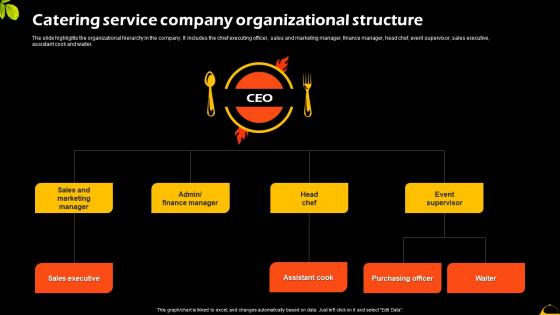
The slide highlights the organizational hierarchy in the company. It includes the chief executing officer, sales and marketing manager, finance manager, head chef, event supervisor, sales executive, assistant cook and waiter.
People who downloaded this PowerPoint presentation also viewed the following :
Catering Service Company Organizational Structure Catering And Food Service Management BP SS with all 9 slides:
Use our Catering Service Company Organizational Structure Catering And Food Service Management BP SS to effectively help you save your valuable time. They are readymade to fit into any presentation structure.








FAQs for Catering Service Company Organizational Structure Catering And Food Service
Key roles in a catering service company's organizational structure include executive chef, catering manager, event coordinator, kitchen staff, service team, sales representatives, and operations manager. These positions work collaboratively to streamline event planning, food preparation, and service delivery, with many catering companies finding that clear role definition enhances client satisfaction, operational efficiency, and ultimately delivers seamless events while maintaining competitive advantage in the hospitality market.
Larger catering companies typically develop multi-layered hierarchies with specialized departments for operations, sales, logistics, and finance, while smaller firms maintain flatter structures with owner-operators handling multiple functions. This scaling enables bigger organizations to streamline complex event coordination, enhance service delivery across multiple venues, and ultimately deliver more consistent customer experiences through specialized expertise and operational efficiency.
Essential departments in a catering service company include operations and kitchen management, sales and event coordination, procurement and inventory control, human resources, and finance and accounting. These departments work collaboratively to streamline service delivery, manage client relationships, and control costs, with many successful catering companies finding that integrated departmental communication ultimately delivers faster event execution and enhanced customer experiences.
Effective communication in catering organizations is maintained through regular briefings between management and front-line staff, digital platforms for real-time updates, and cross-departmental meetings linking kitchen, service, and logistics teams. These structured communication channels streamline coordination during events, minimize service disruptions, and ensure consistent quality delivery, with many catering companies finding that clear hierarchical communication protocols ultimately enhance client satisfaction and operational efficiency.
A catering manager serves as the operational hub, overseeing menu planning, staff coordination, client relations, budget management, and quality control across all service delivery. They bridge executive leadership and front-line teams, ensuring seamless execution of events while maintaining cost efficiency, client satisfaction, and brand standards, ultimately driving profitability and competitive advantage.
Catering service companies typically integrate event planning through dedicated coordinators who collaborate with kitchen operations, logistics teams, and client service departments to ensure seamless execution. These coordinators work closely with chefs, venue specialists, and service staff to manage timelines, menu customization, and resource allocation, ultimately delivering coordinated experiences that enhance client satisfaction and operational efficiency.
A designated finance team in a catering service company ensures accurate cost management, budget forecasting, vendor payment processing, and profit margin analysis across multiple events and clients. This specialized team streamlines financial operations by tracking food costs, labor expenses, and equipment investments, while managing cash flow fluctuations inherent to event-based businesses, ultimately delivering improved profitability and sustainable growth.
A catering company's organizational structure supports scalability by establishing clear departmental divisions for operations, sales, logistics, and quality control, enabling systematic expansion across multiple locations. This framework streamlines resource allocation, standardizes service delivery, and facilitates rapid team scaling, with many growing catering businesses finding that structured hierarchies ultimately deliver operational efficiency and consistent customer experiences across diverse markets.
Modern catering service companies are adopting flatter hierarchies, cross-functional teams, technology-integrated roles, outsourced specializations, and customer-centric divisions to enhance operational efficiency. These structural innovations streamline decision-making, improve service delivery, and enable rapid scaling, with many companies finding that flexible organizational models deliver competitive advantages in an increasingly dynamic hospitality landscape.
Catering services integrate technology through digital ordering platforms, inventory management systems, staff scheduling software, customer relationship management tools, and mobile payment solutions. These technologies streamline operations by automating order processing, optimizing resource allocation, and enhancing customer experiences, with many catering companies finding that strategic technology adoption ultimately delivers faster service delivery and significant competitive advantages.
Customer service functions as a critical bridge between operations and client satisfaction in catering organizational structures, often integrated across sales, event coordination, kitchen management, and delivery teams. This cross-functional approach enables catering companies to respond quickly to client requests, manage dietary requirements, and handle last-minute changes, ultimately delivering seamless experiences that drive repeat business and referrals.
Cross-functional teams enhance catering efficiency by streamlining communication between kitchen, service, and logistics departments, enabling faster decision-making during events, and facilitating seamless coordination across all operational aspects. These collaborative structures deliver improved menu execution, reduced waste through better inventory planning, and enhanced customer experiences, with many catering companies finding that integrated teams significantly reduce service delays and operational costs.
Growing catering companies face challenges including coordinating multiple event teams, standardizing service quality across locations, managing increased inventory complexity, and maintaining communication between departments. These operational pressures often strain existing hierarchies, with many companies finding that rapid expansion can dilute brand consistency and customer experience quality without strategic organizational restructuring and enhanced management systems.
A clear organizational structure enhances employee satisfaction and retention by establishing defined career paths, clear reporting relationships, and transparent communication channels throughout catering operations. This framework enables staff to understand advancement opportunities, reduces role confusion, and creates accountability systems, with many catering companies finding that structured environments deliver improved job security, better training programs, and ultimately stronger team cohesion.
**INPUT**: What are the best practices for training and developing staff within a catering company's structure? **OUTPUT**: Best practices include cross-functional skill development, standardized service protocols, food safety certifications, customer service excellence programs, and leadership pipeline creation. These approaches streamline operations by enhancing team versatility, ensuring consistent quality delivery, and building internal expertise, with many catering companies finding that comprehensive training programs ultimately reduce turnover while improving client satisfaction and operational efficiency.
-
I can always count on your designs for my professional needs. I believe I found a one-stop-shop for PPTs.
-
It makes easy work of my work presentations. I’ve never had to be nervous about my presentations for meetings.