


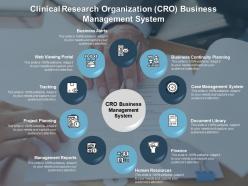
Clinical research organization cro business management system





Try Before you Buy Download Free Sample Product
 Impress Your
 Audience
 100%
100% Editable
 Save Hours
 of Time


Our Clinical Research Organization CRO Business Management System are topically designed to provide an attractive backdrop to any subject. Use them to look like a presentation pro.
People who downloaded this PowerPoint presentation also viewed the following :
Clinical research organization cro business management system with all 2 slides:
Use our Clinical Research Organization CRO Business Management System to effectively help you save your valuable time. They are readymade to fit into any presentation structure.
FAQs for Clinical research organization cro
A CRO business management system encompasses strategy development, operational efficiency, performance tracking, and client relationship management. These components work together to streamline processes, enhance communication, and deliver consistent results across campaigns. With many CRO agencies finding that a structured system leads to increased ROI and client satisfaction, it becomes a cornerstone for growth and success in the competitive landscape of digital marketing.
A CRO business management system streamlines project tracking and resource allocation by centralizing project data, automating workflows, and providing real-time visibility into project progress and resource utilization. With dashboards and reporting tools, teams can identify bottlenecks, optimize resource allocation across projects, and ensure efficient utilization of staff and budgets, ultimately leading to improved project delivery timelines and reduced operational costs.
Data management is fundamental to a CRO business management system, encompassing data collection, organization, analysis, and security across all stages of clinical trials. It enables informed decision-making by providing real-time insights into trial progress, resource allocation, and patient outcomes, ultimately streamlining operations, reducing costs, and enhancing the quality of data submitted to regulatory bodies. With many CROs finding that robust data management systems directly correlate with improved efficiency and client satisfaction, it becomes a cornerstone of success in the competitive clinical research landscape.
Automation can significantly enhance the efficiency of a CRO business management system by streamlining tasks, reducing manual errors, and accelerating processes. For example, automated workflows can manage study documentation, track patient data, and generate reports, freeing up CRO staff to focus on higher-value activities like strategic planning and client engagement. This ultimately delivers increased operational efficiency, faster turnaround times, and improved accuracy, giving CROs a competitive advantage in today's fast-paced clinical trials landscape.
Evaluating a CRO business management system requires tracking KPIs that reflect its impact on operational efficiency and revenue generation. Key performance indicators include conversion rate, cost per acquisition, customer lifetime value, lead generation volume, and average deal size. These metrics, when analyzed together, provide a comprehensive view of the system's effectiveness in driving profitable growth and optimizing campaign performance across various industries, with many marketing teams finding that a robust CRO system leads to significant increases in ROI.
A CRO business management system facilitates compliance with regulatory standards by streamlining documentation, automating workflows, and providing real-time visibility into processes. Through centralized data management and audit trails, these systems enable CROs to track activities, ensure adherence to protocols, and readily produce audit-ready documentation, ultimately minimizing risks and demonstrating compliance to regulatory bodies like the FDA and GCP guidelines.
Implementing a CRO business management system involves several key best practices: defining clear goals and metrics, establishing a robust testing process, fostering a data-driven culture, and prioritizing continuous optimization. These practices streamline operations by aligning teams around data-backed insights, enabling organizations to deliver personalized customer experiences, ultimately driving revenue growth and competitive advantage.
A CRO business management system can significantly improve client communication and relationship management by centralizing all client data, automating communication workflows, and providing real-time insights into client interactions. Through a unified platform, teams can access comprehensive client profiles, track campaign performance, and proactively address client needs, ultimately fostering stronger relationships, increasing client satisfaction, and driving higher retention rates.
A scalable CRO business management system should include features like automated workflow management, integrated CRM and analytics dashboards, and robust reporting capabilities. These features enable streamlined processes, data-driven decision-making, and real-time performance tracking, allowing businesses to efficiently manage growing teams and campaigns across diverse industries, ultimately leading to increased ROI and sustainable growth.
Integrating advanced analytics into a CRO business management system empowers data-driven decision-making by providing real-time insights into key performance indicators (KPIs) like conversion rates, customer acquisition costs, and campaign effectiveness. This enables CROs to identify high-performing strategies, pinpoint areas for improvement, and optimize resource allocation across various marketing channels, ultimately leading to increased ROI and accelerated growth.
Adopting a CRO business management system presents both challenges and opportunities, as organizations navigate changes in workflow, data management, and team collaboration. Common hurdles include integrating existing systems, ensuring data accuracy across platforms, and training staff on new processes. However, with careful planning and robust implementation strategies, many financial institutions find that these challenges are overcome, leading to streamlined operations, improved efficiency, and enhanced customer experiences.
A CRO business management system streamlines financial management and budgeting by centralizing data, automating processes, and providing real-time insights. Through integrated dashboards and reporting tools, it enables accurate forecasting, expense tracking, and performance analysis, empowering CROs to optimize resource allocation and make data-driven financial decisions, ultimately leading to improved profitability and sustainable growth.
A CRO business management system streamlines staff productivity and workload management by centralizing communication, automating tasks, and providing real-time data analytics. This enables teams to prioritize high-impact activities, minimize administrative burdens, and optimize resource allocation, ultimately leading to increased efficiency and improved project outcomes across financial services, healthcare, and retail sectors.
A customized CRO business management system caters to specific client needs by tailoring workflows, reporting dashboards, and integrations to their unique processes and requirements. For example, a pharmaceutical company might prioritize clinical trial management features, while a marketing agency might focus on campaign tracking and performance analytics. This level of personalization enables clients to optimize operations, improve efficiency, and ultimately achieve better business outcomes.
A CRO business management system is only as effective as the users who operate it, making comprehensive user training and ongoing support crucial for maximizing its benefits. These programs equip teams with the knowledge to leverage features like data analysis, campaign management, and performance tracking, leading to improved campaign efficiency, reduced costs, and ultimately, higher conversion rates. With many organizations finding that well-trained teams see significant ROI, dedicated support ensures smooth implementation and continuous optimization of the system, enabling businesses to stay ahead in a competitive landscape.
No Reviews