

Conversion rate optimization cro maturity model




Try Before you Buy Download Free Sample Product
 Impress Your
 Audience
 100%
100% Editable
 Save Hours
 of Time


Our Conversion Rate Optimization CRO Maturity Model are topically designed to provide an attractive backdrop to any subject. Use them to look like a presentation pro.
People who downloaded this PowerPoint presentation also viewed the following :
Content of this Powerpoint Presentation
Description:
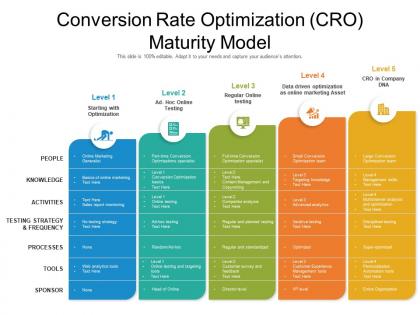
This image is a graphical representation of a Conversion Rate Optimization (CRO) Maturity Model. It is a slide from a presentation, designed to be 100% editable for customization to fit specific business needs. The model categorizes the maturity of a company's CRO efforts into five distinct levels:
Level 1 - Starting with Optimization:
-
People: Involve an Online Marketing Generalist.
-
Knowledge: Basic understanding of online marketing.
-
Activities: Sales report monitoring.
-
Testing Strategy & Frequency: No testing strategy is in place.
-
Processes: There are no established processes.
-
Tools: Web analytics tools are used.
-
Sponsor: There is no sponsor or dedicated leadership.
Level 2 - Ad-Hoc Online Testing:
-
People: Part-time Conversion Optimization Specialist.
-
Knowledge: Basics of conversion optimization.
-
Activities: Online testing.
-
Testing Strategy & Frequency: Ad-hoc testing.
-
Processes: Random/Ad-hoc.
-
Tools: Online testing and targeting tools.
-
Sponsor: Head of Online.
Level 3 - Regular Online Testing:
-
People: Full-time Conversion Optimization Specialist.
-
Knowledge: Copywriting management and content analysis.
-
Activities: Comparative analysis.
-
Testing Strategy & Frequency: Regular and planned testing.
-
Processes: Regular and standardized.
-
Tools: Customer survey and feedback tools.
-
Sponsor: Director level.
Level 4 - Data-Driven Optimization as Online Marketing Asset:
-
People: Small Conversion Optimization team.
-
Knowledge: Targeting knowledge, advanced analytics.
-
Activities: Iterative testing.
-
Testing Strategy & Frequency: Disciplined testing.
-
Processes: Optimized.
-
Tools: Customer Experience Management tools.
-
Sponsor: VP level.
Level 5 - CRO in Company DNA:
-
People: Large Conversion Optimization team.
-
Knowledge: Management skills, market trend analysis.
-
Activities: Multichannel analysis and optimization.
-
Testing Strategy & Frequency: Super-optimized.
-
Processes: Super-optimized.
-
Tools: Automation tools, Personalization tools.
-
Sponsor: Entire organization.
Each level describes a progressive sophistication in how a company approaches CRO. The model illustrates the evolution from an initial, informal approach to a strategic, data-driven one that is integrated into the company's core practices. It details the personnel involved, the knowledge required, the activities performed, the testing strategies employed, the processes followed, and the tools used, along with the level of leadership sponsorship at each stage of maturity.
Use Cases:
This CRO Maturity Model slide is a valuable resource for various industries aiming to enhance their online presence and customer conversion rates:
1. E-Commerce:
Use: To improve website conversion for online sales.
Presenter: E-Commerce Manager.
Audience: Marketing team, Sales staff.
2. Digital Marketing Agencies:
Use: For optimizing client's digital campaigns and conversion rates.
Presenter: Account Manager.
Audience: Clients, Marketing team.
3. Software as a Service (SaaS):
Use: To increase subscription conversion rates.
Presenter: Growth Hacker.
Audience: Product team, Executives.
4. Banking and Financial Services:
Use: For enhancing online application conversion rates for financial products.
Presenter: Digital Strategy Officer.
Audience: Financial advisors, Web team.
5. Travel and Tourism:
Use: To optimize booking systems and increase reservation conversions.
Presenter: Revenue Manager.
Audience: Marketing department, Sales team.
6. Healthcare Providers:
Use: For patient lead conversion on healthcare services.
Presenter: Marketing Director.
Audience: Administrative staff, Medical professionals.
7. Online Education Platforms:
Use: To increase course sign-up rates and student engagement.
Presenter: Online Programs Coordinator.
Audience: Educational staff, Marketing specialists.
Conversion rate optimization cro maturity model with all 2 slides:
Use our Conversion Rate Optimization CRO Maturity Model to effectively help you save your valuable time. They are readymade to fit into any presentation structure.
FAQs for Conversion rate optimization
So the CRO maturity model breaks down into five stages - Chaotic, Repeatable, Defined, Managed, and Optimized. Basically goes from having zero testing process to running advanced tests across your whole customer journey. Here's the thing though - most teams I've seen get totally stuck around stages 2 or 3. They're running A/B tests but don't have the processes nailed down yet. Don't try jumping ahead to the fancy stuff. Figure out where you're at right now, then just focus on getting really solid at that stage first. Way better than trying to skip steps and ending up with a mess.
Honestly, just do a quick reality check on four things: how often you're actually testing stuff, whether your data setup is solid, who's handling CRO work, and how mature your processes really are. Most teams totally overestimate where they're at - happens all the time. Rate yourself 1-5 on each area and be brutal about it. Is testing someone's random side project or do you have real resources? Are decisions based on actual data or just "feels right" moments? Once you score everything against basic maturity frameworks, the gaps become super obvious pretty fast.
So here's the thing - start with basic conversion rate and traffic volume if you're just getting into CRO. Don't overthink it early on. Once you've got that down, add segmented conversion rates and funnel drop-offs. Advanced stuff like micro-conversions and cohort analysis comes later (honestly gets pretty nerdy but totally worth it). I've watched teams completely mess this up by jumping straight to complex metrics they can't even use properly. Just start simple, show it's working, then build up your tracking as your team gets better at this stuff. Makes way more sense that way.
Honestly, the biggest pain points are leadership treating CRO like some optional side project and having literally zero budget for it. Most teams just wing it - they'll randomly test button colors without any real strategy behind it. Your data's probably a disaster too, different systems everywhere that don't sync up. Executives think testing is fluffy until they see actual revenue impact. My advice? Find one person who gets genuinely pumped about optimization wins, then ride that success to get proper resources. Oh, and figure out your tracking situation first - you can't optimize what you can't measure properly.
Honestly, the biggest thing is getting everyone access to the data - not just your analytics people. Build dashboards that show your key CRO stuff in real-time so teams can see how they're actually moving the needle. Train people to check the numbers before deciding anything (crazy how many places still go with their gut on everything). Share test results regularly across departments. Wins AND failures - that part's huge. Oh, and definitely celebrate when someone makes a data-backed call even if it flops. That's how you get people comfortable with the whole process instead of just winging it.
User feedback is what pushes you up the CRO ladder, honestly. Early on you're just guessing what people want. But then you start collecting feedback through surveys and user testing - the usual stuff. The magic happens when you combine this with your data though. Now you see WHY users do things, not just what they're doing. I've watched teams get stuck doing basic A/B tests forever because they totally ignored the feedback side. Pretty frustrating to see actually. Start collecting feedback early, even if it's just simple exit surveys at first. You'll thank yourself later.
Honestly, A/B testing is such a journey! You start with the basics - button colors, headlines, that stuff. Nothing wrong with it, we've all been there. As you get better though, you'll tackle bigger things like user flows and personalization. The game-changer is when you stop doing random one-off tests and start building actual experiment roadmaps based on real user data. Down the line you might have whole teams running multiple tests at once with proper stats behind them. One thing I wish I'd done earlier - document everything now. Trust me on this one, you'll thank yourself later when you can build on past learnings instead of starting from scratch every time.
Honestly, it depends where you're starting from. Just beginning? Stick with Google Analytics and maybe Hotjar for basic heatmaps - no need to go crazy yet. Once you get more serious (like doing actual A/B tests), grab Optimizely or VWO. The big companies usually have fancy enterprise stuff with all the statistical bells and whistles, but that's overkill for most people. Here's the thing though - only upgrade when what you have actually starts holding you back. I've seen too many people blow their budget on tools they barely use.
Dude, cross-functional collab is huge for CRO. When your marketing, product, and dev teams aren't talking, you end up with chaos - like everyone testing different things at once or spending weeks on pointless button tests while checkout is totally broken. Been there. The good stuff happens when teams actually share calendars and bounce ideas off each other. Weekly syncs with all the key people will save you so much frustration down the road. Otherwise you're basically optimizing blind while half your team is working on completely different priorities.
Document everything first - trust me on this one. Build one solid foundation before moving to the next step instead of rushing ahead. You'll need leadership backing because these transitions drag on way longer than anyone expects (and blow budgets). Train people constantly and write stuff down so you're not screwed if someone quits. Honestly, half these projects fail because nobody measures properly. Set up tracking at each phase or you won't know if you actually improved things or just made an expensive mess.
Honestly, most teams mess this up by jumping straight into fancy stuff. Start with the basics - get everyone trained on statistics and A/B testing fundamentals first. I've literally watched people make huge decisions based on like 50 visitors lol. Try Optimizely Academy or Google's courses. User research basics matter too, plus knowing how to actually read test results without panicking. Don't do complex segmentation yet - you'll just confuse yourselves. Pick one solid CRO course and work through it together. Build that foundation or you'll regret it later when everything falls apart.
Customer journey mapping is honestly a game-changer for finding where people bail on your site. Just trace every step from their first visit to buying something, then dump your analytics on top to see the worst bottlenecks. Most teams skip this step and just throw random tests at the wall - huge mistake IMO. Target your experiments where the data shows real struggle points. I'd start with mapping one main user type's path first. Way more efficient than testing random stuff. Once you spot those friction moments, that's where you run your CRO tests.
Honestly, you'll just *feel* it when you're ready to move up. Like when you're crushing those basic A/B tests but getting frustrated because you want way more sophisticated stuff - better segmentation, personalization, the works. Look for these signs: your team's asking for fancier tools, stakeholders are cool with spending more money, and you've got enough traffic for complex experiments. Oh, and make sure your data isn't a mess first - learned that one the hard way. The dead giveaway? Your current setup feels like it's holding you back from the insights you actually want. That's when you know it's time.
Dude, most companies jump straight to the crazy AI stuff and totally bomb. Start with basic geo-targeting or simple demographic splits first. Once you've got that down, add behavioral data - like showing different content based on where people came from or what they've browsed. The really advanced teams do real-time AI personalization with tons of signals, but honestly? That's overkill unless you're already crushing the basics. Focus on your biggest impact segments first, then slowly add more complexity as your data gets better. Way less sexy but actually works.
Look, if your CRO game is weak, you're basically watching money walk out the door. All those visitors hitting your site? Most are bouncing when they could've converted. Your acquisition costs go through the roof because you need way more traffic to hit revenue goals. Meanwhile, competitors with solid optimization are slowly stealing your lunch - which honestly just sucks to watch happen. Customer value stays flat too since you're not actually improving anything systematically. I'd start with an audit of where you stand, then pick one page that gets decent traffic and test the hell out of it.
No Reviews