

Cost Optimization Strategies Powerpoint Presentation Slides





Try Before you Buy Download Free Sample Product
 Impress Your
 Audience
 100%
100% Editable
 Save Hours
 of Time


Remove waste and improve processes to minimize cost of goods sold using content-ready Cost Optimization Strategies PowerPoint Presentation Slides. Outline a strategy for cost reduction without compromising the quality of the products with ready-made cost optimization strategies PPT templates. Intensify profitability and cash flow of an organization by implementing cost reduction strategies. Get access to the cost optimization strategies PowerPoint presentation slides for executing various strategies such as target costing, activity-based costing, enterprise resource planning, value engineering, and more. This deck covers various topics such as key levers to cost management, levers to achieve successful cost optimization, levels of strategic cost optimization, prioritizing IT cost optimization, IT cost optimization: three step approach, IT cost optimization initiative benefits, cost optimization techniques, cost optimization planning, cost cutting, cost management, cost design, cost positioning, and more. These templates are completely editable. You can use cost optimization strategies PowerPoint deck as per your need. Our Cost Optimization Strategies Powerpoint Presentation Slides help advancing your brand. Folks will get conscious of it's existence and benefits.
People who downloaded this PowerPoint presentation also viewed the following :
Content of this Powerpoint Presentation
Slide 1: This slide introduces to Cost Optimization Strategies. State Your Company Namea and get started.
Slide 2: This is Our Agenda slide. State your agendas here.
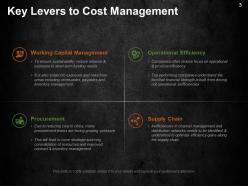
Slide 3: This slide presents Key Levers to Cost Management with the following sub headings- Working Capital Management: To ensure sustainability, reduce reliance & exposure to short-term funding needs, It is also subject to exposure and risks from areas including receivables, payables and inventory management, Procurement: Due to reducing cost in china, many procurement teams are facing growing pressure. This will lead to more strategic sourcing, consolidation of resources and improved contract & inventory management Operational Efficiency: Companies often reduce focus on operational & process efficiency, Top performing companies understand the fact that financial strength is built from driving out operational inefficiencies Supply Chain: Inefficiencies in channel management and distribution networks needs to be identified & understood to optimize efficiency gains along the supply chain
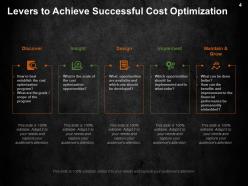
Slide 4: This slide shows Levers to Achieve Successful Cost Optimization with the following subheadings- Discover: How to best establish the cost optimization program? What are the goals / scope of the program Insight: What is the scale of the cost optimization opportunities? Design: What opportunities are available and which one should be developed? Implement: Which opportunities should be implemented and in what order? Maintain & Grow: What can be done better? How can the benefits and improvement to the financial performance be permanently embedded?
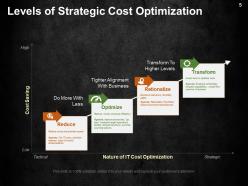
Slide 5: This slide presents Levels of Strategic Cost Optimization with the following points- Transform Agenda: Evaluate technology, broaden capabilities., create new sources of revenue. Invest more to optimize more Rationalize Agenda: Rationalize IT portfolio, reduce functional redundancies. Business relevance, flexibility, agility Optimize Agenda: Improve processes, “go lean,” evaluate target operations models (shared services), exercise sourcing options. Remove waste, increase efficiency Reduce Agenda: Cut IT costs, prioritize demand, span of control enhancements Reduce costs and prioritize spend
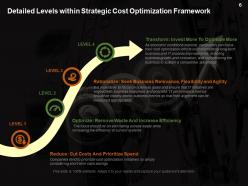
Slide 6: This slide displays Detailed Levels within Strategic Cost Optimization Framewor. The points are- Reduce: Cut Costs And Prioritize Spend Companies tend to prioritize cost optimization initiatives by simply considering short-term cash savings. Optimize: Remove Waste And Increase Efficiency The focus should be on eliminating excess waste while increasing the efficiency of current systems. Rationalize: Seek Business Relevance, Flexibility and Agility. It is imperative to focus on business goals and ensure that IT initiatives are aligned with business objectives and priorities. IT performance metrics should be closely tied to business metrics so that their alignment can be measured appropriately Transform: Invest More To Optimize More As economic conditions improve, companies can focus their cost optimization efforts on implementing long-term business and IT process improvements, enabling business growth and innovation, and repositioning the business to sustain a competitive advantage
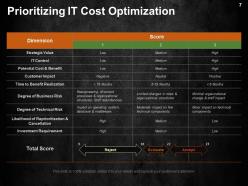
Slide 7: This slide shows Prioritizing IT Cost Optimization with the following parameters- Reject, Accept, Evaluate.
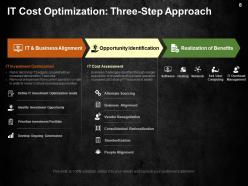
Slide 8: This slide showcases IT Cost Optimization: Three-Step Approach. The divided sub headings are- IT & Business Alignment (IT Investment Optimization) Flat or declining IT budgets, coupled with an increased demand for IT services, Removal of expenses from current spend or run rate in order to invest in future business opportunities, Define IT investment Optimization Goals, Identify Investment Opportunity, Prioritize Investment Portfolio, Develop Ongoing Governance. Opportunity Identification (IT Cost Assessment) Business challenges identified through merger, acquisition or divestiture of business operation, Increased utilization of IT resources & assets, Alternate Sourcing, Business Alignment, Vendor Renegotiation, Consolidation/ Rationalization, Standardization, People Alignment. Realization of Benefits- Software, Hosting, Network, End User Computing, IT Overhead Management.
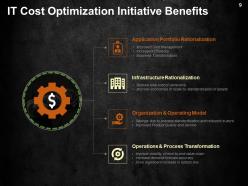
Slide 9: This slide presents IT Cost Optimization Initiative Benefits. The sub headings are- Application Portfolio Rationalization (Improved Cost Management, Increased Efficiency, Business Transformation) Infrastructure Rationalization (Reduce total cost of ownership, Improve economies of scale by standardization of assets) Organization & Operating Model (Savings due to process standardization and reduced re-work, Improved Product Quality and Service) Operations & Process Transformation (Improve visibility of end-to-end value chain Increase demand forecast accuracy Drive significant increase in bottom line).
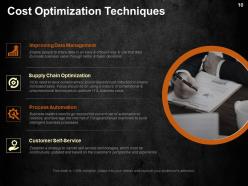
Slide 10: This slide displays Cost Optimization Techniques. The listed points are- Improving Data Management Enable people to share data in an easy & efficient way & use that data to create business value through better & faster decisions Supply Chain Optimization CIOs need to work collaboratively to look beyond cost reduction to enable increased sales. Focus should be on using a mixture of conventional & unconventional techniques to optimize IT & business costs Process Automation Business leaders need to go beyond the current use of automation to robotics, and leverage the Internet of Things and smart machines to build intelligent business processes Customer Self-Service Establish a strategy to handle self-service technologies, which must be continuously updated and based on the customer’s perspective and experience
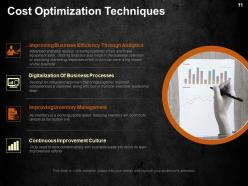
Slide 11: This slide also displays Cost Optimization Techniques. The listed points are- Improving Business Efficiency Through Analytics: (Advanced analytics helps in reducing customer churn and make equipment safer. Utilizing analytics also helps in the customer retention or improving marketing responses which in turn can have a big impact on the business). Digitalization Of Business Processes (Develop an integrated approach that brings together required competencies & expertise, along with buy-in from the executive leadership team). Improving Inventory Management (As inventory is a working capital asset, reducing inventory will contribute directly to the bottom line). Continuous Improvement Culture (CIOs need to work collaboratively with business leaders to focus on lean improvement efforts).
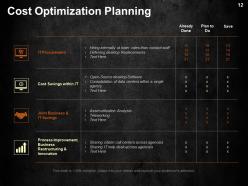
Slide 12: This slide showcases Cost Optimization Planning in terms of- Already Done, Plan to Do, Save.
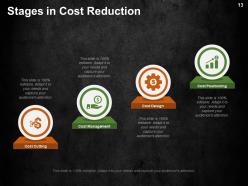
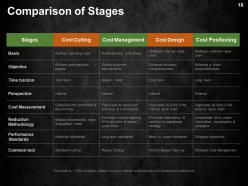
Slide 13: This slide presents Stages in Cost Reduction. The listed stages are- Cost Cutting, Cost Management, Cost Design, Cost Positioning.
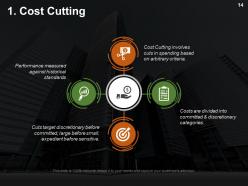
Slide 14: This slide showcases the first stage Cost Cutting. The points are- Cost Cutting involves cuts in spending based on arbitrary criteria, Costs are divided into committed & discretionary categories, Cuts target discretionary before committed; large before small; expedient before sensitive, Performance measured against historical standards.
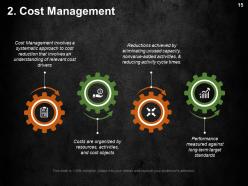
Slide 15: This slide shows Cost Management with the following points- Cost Management involves a systematic approach to cost reduction that involves an understanding of relevant cost drivers, Costs are organized by resources, activities, and cost objects, Performance measured against long-term target standards, Reductions achieved by eliminating unused capacity, nonvalue-added activities, & reducing activity cycle times.
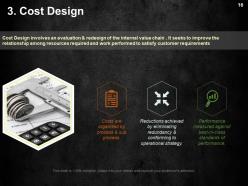
Slide 16: This slide shows Cost Design. It involves an evaluation & redesign of the internal value chain. It seeks to improve the relationship among resources required and work performed to satisfy customer requirements. The points listed thus are- Costs are organized by process & sub process. Reductions achieved by eliminating redundancy & conforming to operational strategy. Performance measured against best-in-class standards of performance.
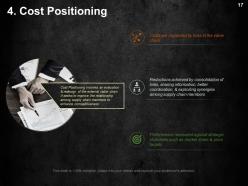
Slide 17: This slide showcases Cost Positioning with the following points- Cost Positioning involves an evaluation & redesign of the external value chain. It seeks to improve the relationship among supply chain members to enhance competitiveness. Costs are organized by links in the value chain Reductions achieved by consolidation of links, sharing information, better coordination, & exploiting synergies among supply chain members Performance measured against strategic objectives such as market share & price targets.
Slide 18: This slide presents Comparison of Stages.
Slide 19: This slide is titled Time For Tea Break! Halt here. You can change the image and text as per your requirement.
Slide 20: This is a Cost Optimization Strategy Icons Slide. Use them as per requirements.
Slide 21: This slide is titled Additional Slides to move forward. You may change the slide content as per need.
Slide 22: This is an About Us slide. State company/team specifications here.
Slide 23: This is an Our team slide with name, designation and text boxes to state information.
Slide 24: This is a Puzzle image slide. State specifications, information here.
Slide 25: This is Important Notes slide. State reminders, events etc. here.
Slide 26: This is a Target slide. State them here.
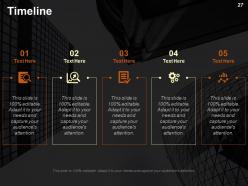
Slide 27: This is a Timeline slide to show milestones, growth, highlights etc.
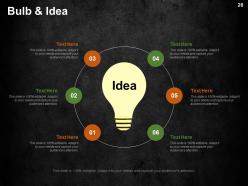
Slide 28: This is a Bulb/Idea image slide. State specifications, information, innovative aspects here.
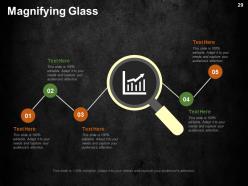
Slide 29: This is a Magnifying glass image slide. State specifications, information here.
Slide 30: This slide is titled Charts & Graphs to move forward. You may change the slide content as per need.
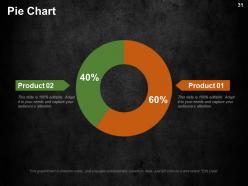
Slide 31: This is a Pie Chart image slide. State specifications, information here.
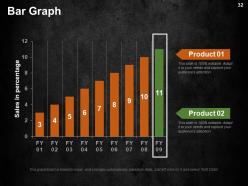
Slide 32: This is a Bar graph slide. State specifications, comparison of products/entities here.
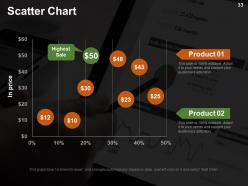
Slide 33: This is a Scatter Chart slide to show product/entity comparison.
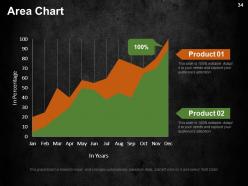
Slide 34: This is an Area Chart slide to show product/entity comparison.
Slide 35: This is a Radar Chart slide to show product/entity comparison.
Slide 36: This is a Thank You For Watching slide with Address# Street number, city, state, Email Address, Contact Numbers.
Cost Optimization Strategies Powerpoint Presentation Slides with all 36 slides:
Earth is your arena with our Cost Optimization Strategies Powerpoint Presentation Slides. They are applicable anywhere.




FAQs for Cost Optimization Strategies
Start with the biggest spenders - that's where you'll see real savings. You need visibility into where money's actually going (there's always weird stuff hiding in there). Automated policies are a lifesaver for scaling resources up and down, especially dev environments that people forget about. Regular rightsizing matters too - match what you're actually using instead of planning for worst-case scenarios. Good tagging strategy helps track costs per team. Honestly, continuous monitoring is probably the most boring part but catches the biggest waste. Oh, and set up alerts so you're not getting surprise bills.
Dude, tech can save you so much money if you do it right. Start with the boring stuff - automate invoicing and inventory instead of doing it manually. Cloud services are actually worth it because you're not buying expensive servers or paying IT guys to fix them. I love analytics tools for catching where you're bleeding money without realizing it. AI's getting pretty good at optimizing supply chains too. Oh, and it cuts way down on human errors which cost more than people think. Just pick your most annoying time-wasting tasks first and find tech solutions for those.
Okay so think of data analytics like having x-ray vision for your business costs. You'll catch spending patterns and waste that never show up in those boring monthly reports - honestly, most companies are hemorrhaging money without even knowing it. Start with your biggest expense buckets first, then work your way down. The cool part is you can actually forecast what's coming instead of just reacting to problems. Way better than making gut decisions when you've got real numbers backing you up. Plus you can benchmark against industry standards to see if you're getting ripped off somewhere.
Look for efficiency wins instead of stuff that'll hurt your product. Automate the boring repetitive tasks first - that's low-hanging fruit. Then hit up your suppliers for better rates and cut organizational bloat (you know, those meetings that could've been emails). Think of it like cleaning out your closet - there's always random junk you forgot you had. Map out which costs actually affect product quality versus which ones are just... there. I'd honestly start with vendor consolidation since you're probably paying three different companies for similar services. The goal is trimming operational overhead while keeping everything customer-facing intact.
Oof, the worst mistake is cutting too aggressively without thinking ahead. Like when companies slash marketing budgets to save money this quarter, then wonder why leads disappear six months later. Super frustrating to watch. Also hate those blanket "everyone cut 15%" emails - so lazy and ineffective. Way better to be strategic about what you're trimming. Don't touch customer service or quality stuff either, that always backfires spectacularly. Before cutting anything, think through what might break downstream. Protect whatever actually brings in money first.
Training your team is honestly one of the smartest ways to cut costs. Fewer mistakes happen when people actually know their stuff. You'll see less rework and things get done faster. Your employees are in the trenches daily - they spot money-saving opportunities you'd never notice from your desk. Plus trained people stick around longer because they feel competent and valued. That alone saves you from those insane hiring costs (seriously, recruiting is brutal these days). I'd focus on your biggest problem areas first rather than trying to train on everything at once.
First thing - be super specific about what you're outsourcing and how you'll measure success. Otherwise scope creep will eat your budget alive. Don't just go with the cheapest option either, trust me on this one. Quality matters way more because fixing bad work costs a fortune later (learned this lesson myself). Keep some stuff in-house though, you don't want to lose all your internal knowledge. Nearshore might cost a bit more than offshore but the communication is so much better. Oh and definitely start with a small pilot project first before you commit to anything major.
Honestly, start by looking at your supplier contracts - there's probably way more wiggle room than you think. Bundle your orders to fewer suppliers so you get volume discounts, then push for faster delivery times too. Good inventory software will save your butt by predicting what you actually need instead of panic-ordering expensive rush shipments. Regional warehouses cut both shipping costs and time, which is nice. But here's the cool part - cross-docking lets you skip warehousing completely and just move stuff straight through. I mean, it's not always possible but when it works, it's pretty slick. Bottom line: most companies don't negotiate hard enough with suppliers.
Track your cost per unit and gross margin percentage first - those are non-negotiables. ROI on cost-cutting moves is seriously underrated, most people skip this but it's where the real insights are. Also watch your operational ratios like customer acquisition costs or per-transaction expenses. Labor productivity metrics matter too since payroll usually eats up most of your budget anyway. Monthly dashboards work great, just compare quarter-to-quarter instead of monthly changes since those can be all over the place.
Dude, seriously start treating your vendors like actual partners instead of just people you buy stuff from. Build real relationships with them - I'm talking regular check-ins about your spending and what you're trying to accomplish. They'll hook you up with volume discounts, better payment terms, sometimes even free services just because they like working with you. Mine have saved my ass by giving me heads up about price increases coming down the pipe. Oh, and they're usually down to suggest cheaper alternatives that still work great. It's honestly wild how much money you can save just by being cool to work with and communicating openly about your needs.
Yeah, compliance totally screws with cost optimization - I've seen teams stuck paying way more just because cheaper options don't meet GDPR or SOX requirements. Can't exactly skimp on security when auditors are breathing down your neck, you know? But there's still wiggle room if you're smart about it. Map out what compliance stuff you actually need first (this step gets skipped way too often), then find ways to automate those processes. Also try consolidating vendors who are already compliant - kills two birds with one stone. Just don't make the mistake of treating compliance as an afterthought when planning your budget.
Be upfront about it from the start and explain the real reasons - market pressure, cutting costs, whatever it actually is. Don't sugar-coat but also don't make everyone freak out (budget cuts already stress people enough). Give them specifics: timelines, what's changing, who gets hit how. Mix up how you tell them - emails, meetings, casual conversations. Oh and definitely leave room for questions because people need to vent sometimes. The worst thing is making folks feel like they're just being told stuff instead of actually being part of the conversation, you know?
So I've been seeing companies kill it with dynamic pricing - basically Uber's surge pricing but for consulting, cleaning, whatever. Subscription models are huge too because they smooth out those crazy up-and-down revenue swings. You could also try shared service centers where departments pool resources together (setup's annoying but the savings are insane). Predictive analytics beats guessing at staffing every time. Honestly? Start with dynamic pricing if your demand bounces around - it's the quickest win you'll see.
Honestly, you can probably slash costs by like 20-30% switching to cloud. No more buying servers upfront that just sit there doing nothing half the day. You literally only pay for what you're using - kind of like how Netflix charges monthly instead of making you buy DVDs, you know? Your IT team won't need to babysit hardware anymore either. Scaling happens automatically when you need it. Oh, and updates are included which is nice. I'd start small though - move some less important stuff first and see how much you actually save. Way less risky.
Start with costs that move with your revenue - not the fixed stuff that'll wreck you when things get slow. Automate anything repetitive ASAP because manual work is just bleeding money. Outsource accounting and HR instead of doing it yourself. Payment terms with suppliers? Negotiate those hard for better cash flow. Shared everything - coworking spaces, part-time executives, contractors for projects. Way cheaper than full-time hires. Oh, and actually track what makes you money vs what doesn't. Most founders get obsessed with downloads or followers when they should be watching unit economics. That's where startups usually screw up.
-
Amazing product with appealing content and design.
-
Commendable slides with attractive designs. Extremely pleased with the fact that they are easy to modify. Great work!