


Collaborative Planning Forecasting And Replenishment Model For Supply Chain Management




Try Before you Buy Download Free Sample Product
 Impress Your
 Audience
 100%
100% Editable
 Save Hours
 of Time


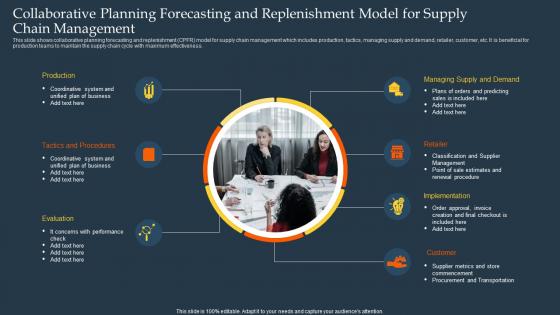
This slide shows collaborative planning forecasting and replenishment CPFR model for supply chain management which includes production, tactics, managing supply and demand, retailer, customer, etc. It is beneficial for production teams to maintain the supply chain cycle with maximum effectiveness.
People who downloaded this PowerPoint presentation also viewed the following :
Collaborative Planning Forecasting And Replenishment Model For Supply Chain Management with all 6 slides:
Use our Collaborative Planning Forecasting And Replenishment Model For Supply Chain Management to effectively help you save your valuable time. They are readymade to fit into any presentation structure.





FAQs for Collaborative Planning Forecasting And Replenishment Model For
CPFR's core principles include shared demand forecasting, synchronized planning processes, collaborative exception management, joint business planning, and integrated replenishment strategies across trading partners. These principles streamline supply chain operations by enhancing forecast accuracy, reducing inventory costs, and improving service levels, with many retailers and manufacturers finding that collaborative approaches ultimately deliver competitive advantage and stronger customer satisfaction.
Organizations can effectively implement CPFR by establishing shared data platforms, aligning forecasting processes across partners, creating joint business plans, and implementing real-time inventory visibility systems. Through collaborative demand planning and synchronized replenishment cycles, companies in retail, manufacturing, and consumer goods significantly reduce stockouts, minimize excess inventory, and enhance customer service levels, ultimately delivering improved margins and stronger supplier relationships.
Data sharing serves as the foundation of CPFR, enabling trading partners to exchange demand forecasts, inventory levels, promotional plans, and sales data in real-time. This transparency allows retailers and suppliers to collaboratively develop more accurate forecasts, synchronize replenishment cycles, and respond quickly to market changes, ultimately delivering reduced stockouts, lower inventory costs, and enhanced customer satisfaction across the supply chain.
CPFR reduces stockouts and overstocks by enabling real-time demand visibility, synchronized forecasting, and coordinated replenishment between retailers and suppliers. Through shared data analytics and collaborative planning processes, retail partners can anticipate demand fluctuations more accurately, optimize inventory levels, and respond to market changes faster, ultimately delivering improved product availability and reduced carrying costs.
Key challenges include data integration complexities, organizational resistance to collaborative processes, technology infrastructure limitations, trust-building between partners, and standardizing forecasting methodologies across different systems. While these obstacles require significant upfront investment in both technology and relationship management, companies implementing CPFR successfully often find that enhanced supply chain visibility and reduced inventory costs ultimately deliver substantial competitive advantages.
Technology facilitates better collaboration in CPFR by enabling real-time data sharing, automated forecasting algorithms, and integrated communication platforms that connect suppliers, manufacturers, and retailers seamlessly. Through cloud-based systems and AI-driven analytics, organizations streamline demand planning, reduce forecast errors, and enhance inventory optimization, with many retail chains and consumer goods companies finding that these digital tools ultimately deliver improved supply chain visibility and stronger partner relationships.
Demand forecasting accuracy in CPFR significantly impacts inventory management by reducing stockouts, minimizing excess inventory, optimizing safety stock levels, and improving cash flow management. Retailers like Walmart and suppliers in consumer goods find that enhanced forecast precision enables better warehouse allocation, reduces carrying costs by 15-20%, and ultimately delivers improved customer satisfaction through consistent product availability.
Key CPFR success metrics include forecast accuracy improvement, inventory turnover rates, order fill rates, stockout reduction percentages, and collaborative process cycle times. These measurements enable organizations to track operational efficiency gains, cost reductions, and service level enhancements, with many retail and manufacturing partnerships finding that combining demand planning accuracy with supply chain responsiveness metrics ultimately delivers measurable competitive advantage.
Different industries adapt CPFR practices by tailoring forecasting models, collaboration frequencies, and data-sharing protocols to their operational rhythms and demand patterns. Retail companies emphasize seasonal forecasting and promotional planning, while manufacturing sectors focus on production scheduling and raw material coordination, and healthcare organizations prioritize regulatory compliance and expiration date management, ultimately delivering enhanced supply chain responsiveness.
Involving multiple stakeholders in CPFR delivers enhanced forecast accuracy, improved inventory optimization, stronger supplier relationships, reduced stockouts, and better demand visibility across the supply chain. This collaborative approach enables retailers, manufacturers, and distributors to align their planning processes seamlessly, ultimately reducing costs while improving customer service levels and competitive positioning.
Cultural differences significantly influence CPFR effectiveness through varying communication styles, decision-making processes, relationship-building approaches, and trust development patterns across global partnerships. These cultural nuances impact data sharing transparency, forecasting methodologies, and conflict resolution strategies, with many multinational organizations finding that culturally-aware collaboration frameworks enhance supply chain integration and deliver more accurate demand planning.
**INPUT**: What tools and software are best suited for CPFR implementation and analysis? **OUTPUT**: CPFR implementation tools include SAP IBP, Oracle Demantra, JDA Demand Planning, Kinaxis RapidResponse, and Microsoft Dynamics 365 Supply Chain Management. These platforms streamline collaborative forecasting by integrating real-time data sharing, automated demand sensing, and exception-based reporting, with many retailers and manufacturers finding that strategic software selection ultimately delivers reduced inventory costs and enhanced supply chain visibility. [Word count: 58 words]
Organizations balance collaborative and individual forecasting by implementing hybrid models that leverage centralized data analytics while allowing departmental input, establishing clear governance frameworks that define when to use each approach, and creating feedback loops between teams. This strategic combination enables companies to maintain operational agility and local expertise while achieving enterprise-wide visibility, with many retail and manufacturing organizations finding that blended approaches deliver more accurate forecasts and stronger stakeholder buy-in.
Successful CPFR implementations include Walmart-Procter & Gamble's inventory optimization partnership, Nestlé-Tesco's demand forecasting collaboration, and Home Depot-supplier networks reducing stockouts by 30%. These partnerships streamline supply chain visibility, enhance demand accuracy, and minimize excess inventory, with many retail-manufacturer collaborations finding that shared forecasting data ultimately delivers faster replenishment cycles and improved customer satisfaction.
CPFR evolves with AI and machine learning by incorporating predictive analytics, automated demand sensing, and real-time supply chain optimization algorithms that enhance forecast accuracy and responsiveness. These technologies enable retailers and suppliers to anticipate market fluctuations, streamline inventory management, and accelerate collaborative decision-making, ultimately delivering reduced costs and improved customer satisfaction across increasingly complex supply networks.
-
Out of the box and creative design.
-
Graphics are very appealing to eyes.