Forecast Demand Planning Using Historical Data Supply Chain Management And Advanced
Try Before you Buy Download Free Sample Product
Audience
Editable
of Time
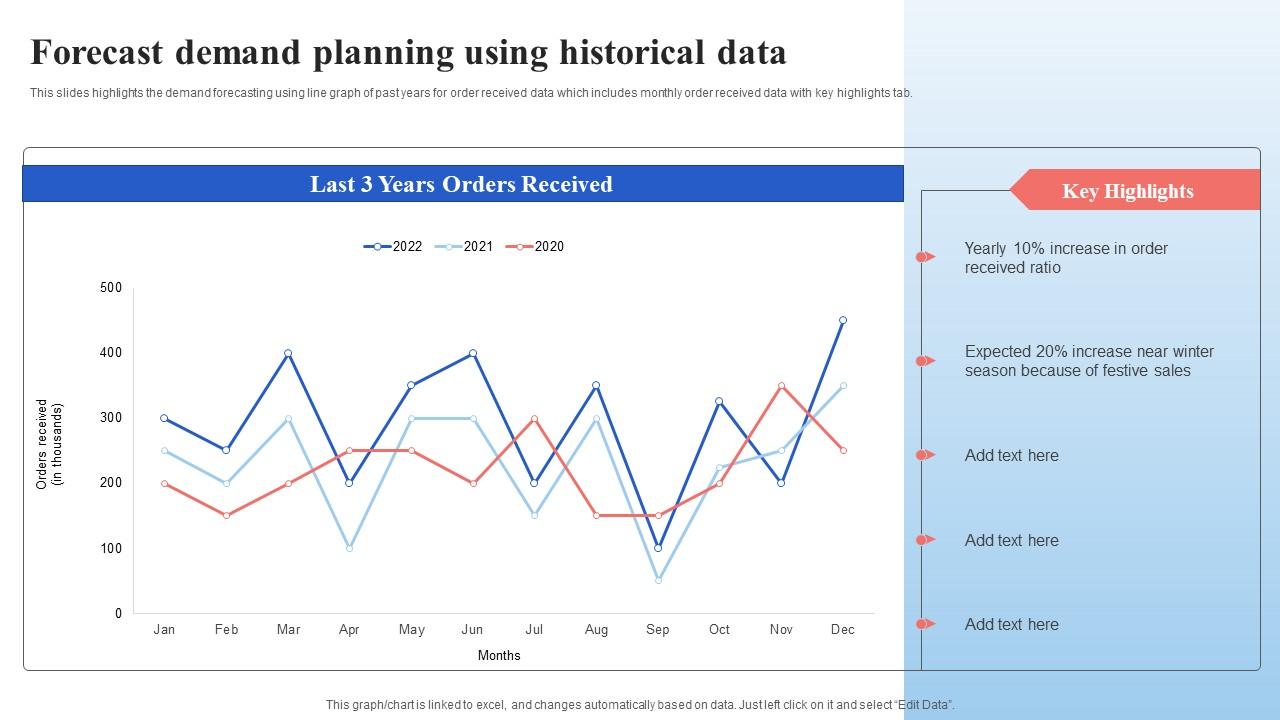
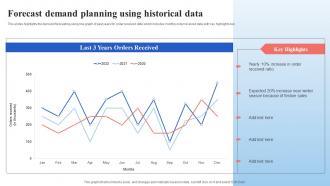
This slides highlights the demand forecasting using line graph of past years for order received data which includes monthly order received data with key highlights tab.
People who downloaded this PowerPoint presentation also viewed the following :
Forecast Demand Planning Using Historical Data Supply Chain Management And Advanced with all 7 slides:
Use our Forecast Demand Planning Using Historical Data Supply Chain Management And Advanced to effectively help you save your valuable time. They are readymade to fit into any presentation structure.
FAQs for Forecast Demand Planning Using Historical Data Supply Chain
Key factors include historical sales data, market trends, seasonal patterns, economic indicators, and competitor activities. These elements enable organizations to develop comprehensive forecasting models by analyzing past performance, identifying cyclical behaviors, and anticipating market shifts, with many retail and manufacturing companies finding that strategic combinations of these factors significantly enhance inventory optimization and reduce costs.
Advanced analytics improves demand forecast accuracy by incorporating machine learning algorithms, predictive modeling, real-time data processing, and pattern recognition capabilities that identify complex market trends. These technologies enable retailers, manufacturers, and supply chain organizations to analyze seasonal fluctuations, consumer behavior shifts, and external factors simultaneously, ultimately delivering more precise inventory planning and reduced stockout risks.
Seasonality significantly impacts demand planning by creating predictable fluctuations that require strategic inventory management, promotional timing, and resource allocation adjustments. Through advanced forecasting models, retailers and manufacturers anticipate seasonal peaks like holiday shopping or summer apparel demand, enabling optimized stock levels, reduced waste, and enhanced customer satisfaction while maximizing revenue opportunities.
Businesses effectively integrate sales data by implementing automated data collection systems, establishing real-time analytics dashboards, and utilizing machine learning algorithms that process historical patterns alongside current trends. Through advanced forecasting software, organizations streamline data synchronization across multiple channels, enhance prediction accuracy by incorporating seasonal variations, and ultimately deliver more responsive inventory management, with many retailers finding that integrated sales data reduces stockouts by up to thirty percent.
**INPUT**: What techniques can be employed to handle variability in consumer demand? **OUTPUT**: Techniques for handling demand variability include statistical forecasting models, demand sensing technologies, collaborative planning with suppliers, safety stock optimization, and flexible manufacturing systems. These approaches streamline operations by improving prediction accuracy, reducing inventory costs, and enhancing responsiveness, with many retail and manufacturing organizations finding that strategic combinations ultimately deliver better customer service and competitive advantage.
Collaboration between departments enhances demand planning by integrating sales insights, marketing campaign data, supply chain constraints, and financial targets into unified forecasts. This cross-functional approach enables organizations to anticipate market shifts more accurately, optimize inventory levels, and respond faster to customer demands, with many companies finding that collaborative planning reduces forecast errors by 20-40% while improving overall operational efficiency.
Supply chain flexibility significantly enhances demand forecasting effectiveness by enabling faster responses to market changes, reducing forecast errors through improved data visibility, and allowing dynamic adjustments to production schedules. Organizations with flexible supply chains can better accommodate demand variability, minimize stockouts and excess inventory, while ultimately delivering improved customer satisfaction and competitive advantage in increasingly volatile markets.
Machine learning technologies assist in demand planning by analyzing vast datasets, identifying complex patterns in consumer behavior, and automatically adjusting forecasts based on real-time market conditions. These algorithms enhance accuracy through predictive analytics, seasonal trend recognition, and inventory optimization, with retailers and manufacturers finding that automated demand forecasting reduces stockouts by up to 30% while minimizing excess inventory costs.
Common demand forecasting pitfalls include over-relying on historical data without market context, ignoring seasonal variations, failing to incorporate cross-functional insights, and using outdated forecasting models. These challenges can be minimized by integrating real-time market intelligence, collaborative planning across departments, and advanced analytics, with many organizations finding that diversified forecasting approaches ultimately deliver more accurate predictions and improved inventory optimization.
Companies ensure reliable data access through integrated ERP systems, real-time market analytics, customer relationship management platforms, supply chain visibility tools, and external market intelligence services. These technologies streamline data collection by automating inventory tracking, capturing consumer behavior patterns, and monitoring competitor activities, with many organizations finding that centralized data management ultimately delivers more accurate forecasts and enhanced operational efficiency.
Effective demand forecast communication involves presenting data through visual dashboards, providing clear confidence intervals, highlighting key assumptions, and translating forecasts into actionable business implications. Organizations streamline stakeholder alignment by scheduling regular forecast reviews, segmenting information by audience relevance, and including scenario planning outcomes, ultimately enabling faster decision-making and improved resource allocation across departments.
Customer feedback influences demand planning strategies by providing real-time insights into preferences, satisfaction levels, and purchasing intentions, enabling more accurate forecasting adjustments. Through systematic feedback collection, retailers and manufacturers can anticipate shifts in consumer behavior, optimize inventory allocation, and enhance product development cycles, while reducing stockouts and overstock situations, ultimately delivering improved customer experiences and operational efficiency.
Market research provides critical data inputs for demand forecasting through customer surveys, competitor analysis, economic indicators, and market trend identification. By incorporating consumer behavior insights, seasonal patterns, and industry benchmarks, organizations can significantly enhance forecast accuracy, reduce inventory costs, and improve service levels, with many retail and manufacturing companies finding that comprehensive market research reduces forecasting errors by 15-25%.
Businesses can adapt demand planning by implementing scenario-based forecasting models, diversifying supplier networks, maintaining flexible inventory buffers, and leveraging real-time market analytics. These approaches enable organizations to pivot quickly during economic shifts, with many companies in retail and manufacturing finding that dynamic forecasting algorithms help minimize stockouts while reducing excess inventory costs.
Inaccurate demand forecasts create significant inventory challenges including excess stock leading to increased carrying costs, stockouts resulting in lost sales, inefficient warehouse utilization, and poor cash flow management. These forecasting errors force companies to maintain higher safety stock levels, reduce inventory turnover rates, and ultimately compromise customer satisfaction, with many retailers and manufacturers finding their profit margins severely impacted.
-
The templates are handy and I can personalize them as per my needs. Glad to be your subscriber!
-
“Easy to use. I always wanted to have a quick search for products and SlideTeam has helped me have it.”