


Communication model showing sender noise receiver and encoding message




Try Before you Buy Download Free Sample Product
 Impress Your
Audience
 100%
Editable
 Save Hours
of Time


Create an impact across continents with our Communication Model Showing Sender Noise Receiver And Encoding Message. You will acquire global acceptance.
People who downloaded this PowerPoint presentation also viewed the following :
Content of this Powerpoint Presentation
Description:
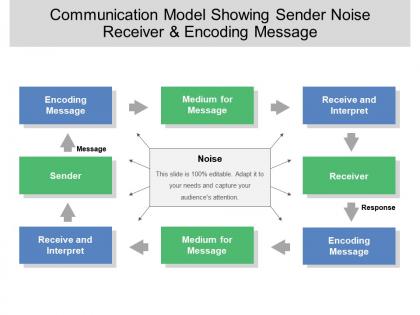
The image is a PowerPoint slide titled "Communication Model Showing Sender Noise Receiver & Encoding Message," which depicts a basic model of communication flow. The model includes the following elements:
1. Sender:
The originator of the message.
2. Encoding Message:
The process by which the sender frames the message.
3. Medium for Message:
The channel through which the message is sent.
4. Noise:
Interference that can distort or obstruct the message.
5. Receiver:
The recipient of the message.
6. Receive and Interpret:
The process by which the receiver makes sense of the message.
7. Response:
The feedback or reply from the receiver, which may involve encoding a new message and continuing the communication cycle.
Use Cases:
This communication model is a fundamental concept that can be applied across various industries to improve understanding and effectiveness in information exchange:
1. Marketing:
Use: Crafting and delivering marketing messages to consumers.
Presenter: Marketing Manager
Audience: Marketing team, advertising staff
2. Healthcare:
Use: Ensuring clear patient-provider communication.
Presenter: Healthcare Administrator
Audience: Medical staff, patient care teams
3. Education:
Use: Enhancing teacher-student and school-parent communication.
Presenter: Educational Consultant
Audience: Teachers, school administrators
4. Corporate Training:
Use: Training employees on effective workplace communication.
Presenter: HR Specialist
Audience: New employees, management
5. Information Technology:
Use: Designing user interfaces for clear user-system interactions.
Presenter: UX Designer
Audience: Software developers, product designers
6. Customer Service:
Use: Improving communication with customers for better service delivery.
Presenter: Customer Service Trainer
Audience: Customer support agents, service managers
7. Public Relations:
Use: Managing media and public communications for organizations.
Presenter: PR Strategist
Audience: PR professionals, media contacts
Communication model showing sender noise receiver and encoding message with all 5 slides:
Figure out the hard facts with our Communication Model Showing Sender Noise Receiver And Encoding Message. The actual events will come to the fore.


FAQs for Communication model showing sender noise receiver
Ok so there's five main parts: sender, message, channel, receiver, and feedback. Then you've got noise messing things up too. Someone sends info, there's the actual content, how it gets delivered (text, call, whatever), who gets it, and whether they actually understood. Honestly the feedback part is where everything usually goes wrong. Noise isn't just literal sounds - could be cultural stuff, bad timing, you name it. Oh and here's the thing - don't just assume your message worked. Always check if they got what you meant, otherwise you're basically just talking to yourself.
Feedback is like the missing piece that actually makes communication work. Those old linear models? Total dead ends - you send your message and just hope it sticks. But interactive models get it right because they build in that back-and-forth loop. You can actually tell if someone's getting what you're saying or if they're completely zoning out. Honestly, this is why I always try to check in when I'm explaining something complicated. Watch their face, ask "make sense so far?" - whatever works. Otherwise you're basically talking to a wall and wondering why nothing's clicking.
Oh man, culture totally changes everything about communication. Like, Japanese people pick up on all these subtle nonverbal hints that would fly right over my head, but Germans just tell you exactly what they mean. Some cultures want you to text back instantly, others think that's pushy and prefer when you take time to respond thoughtfully. Then there's the whole hierarchy thing - in some places you can challenge your boss openly, elsewhere that's career suicide. What sounds perfectly clear to you might come across as rude or confusing to someone else. Honestly, you've gotta stay flexible and check your assumptions early when working with different cultures.
Honestly, tech has blown up those old-school communication models where you just send a message and hope for the best. Now with Slack, social media, video calls - everyone's talking back instantly. It's way more chaotic than those textbook diagrams! Your message goes through algorithms, people can screenshot and share it, or just completely ghost you. Plus there's so much digital noise competing for attention. I guess the biggest thing is you can't just broadcast anymore - your audience will respond immediately (or very publicly ignore you). Design everything knowing they'll react in real time.
Honestly, mapping out how info moves through your team is a game-changer for catching communication breakdowns. Start with the basic sender-receiver thing - are messages actually getting through or stuck somewhere? I once worked with a team that spent weeks confused because half their emails were going to spam (whoops). Set up different channels for different stuff. Quick updates? Slack works great. Big decisions need actual meetings though. Make sure everyone knows what goes where - oh, and actually confirm people got your message. That feedback loop thing sounds boring but it'll save you so much headache later.
Honestly, visuals just make everything work better when you're trying to communicate. They cut through the noise in Shannon-Weaver's model - your message gets across cleaner. With Berlo's SMCR thing, you're giving people different ways to absorb info instead of just talking at them. Interactive models work great with visuals too because people actually pay attention (way better than staring at a wall of text, right?). The transactional approach shows how charts and graphics help everyone stay on the same page. Whether it's data, processes, or keeping people awake during presentations, visuals just hit different.
Ugh, noise totally screws with communication in so many ways. You've got physical stuff like that annoying construction outside, but also mental distractions - like when you're stressed and can't focus. Then there's confusing jargon that nobody understands. I swear I've watched entire presentations fall apart because of one stupid buzzing mic (why does that always happen at the worst moment?). Best thing you can do? Plan ahead. Repeat your main points a few times, maybe use slides AND handouts. Don't just assume people got it - actually ask them.
So basically, sender and receiver roles matter because communication isn't just talking - it's making sure your message actually lands. When you're the sender, you're turning thoughts into words or gestures. The receiver decodes what you mean. But here's what's wild - people flip between these roles constantly in conversations! This is why miscommunication happens ALL the time. You think you're being super clear, but they might interpret it totally differently based on their own experiences. That's just how brains work, I guess. Always worth checking if your point actually got across.
So it totally depends on what communication model you're dealing with. Shannon-Weaver is super basic - encode, send, decode, done. Linear models stay pretty simple too. Interactive ones though? Way more complicated since you're constantly processing feedback while trying to respond. Transactional models are honestly the worst - everyone's encoding AND decoding simultaneously, which is kind of exhausting if you think about it. The more complex the model, the more you'll be juggling different processes at once. Just something to consider when you're planning how to actually communicate your message.
So the Shannon-Weaver thing basically breaks down communication into parts - sender, message, channel, receiver, plus all the "noise" that screws things up. Pretty simple but actually super useful once you get it. What really clicked for me was realizing you should think about where stuff can go wrong FIRST, not just hope your message lands perfectly. Could be tech problems, people getting distracted, or honestly just basic miscommunication. I always start by figuring out what might interfere before I even worry about the actual content. Sounds backwards but it works.
Honestly, audience analysis is everything when you're trying to persuade people. Figure out what they actually care about and what objections they'll have before you even start. Structure it like problem-solution or show them the before/after picture. But here's the thing - you've got to be ready to pivot mid-presentation. Way more than normal talks. Watch their faces, listen to questions, notice when they check out. If your examples aren't landing, switch to different benefits that hit home for them specifically. Oh, and don't forget a super clear call to action at the end.
Honestly, the biggest thing is not being manipulative. Don't use sneaky psychology tricks to bypass people's common sense or push them toward stuff that'll hurt them. Be upfront about your biases too - we've all been in those presentations where someone's clearly got an agenda but won't admit it, and it's so annoying. You want to respect that your audience can think for themselves. Give them the full picture so they can actually make good decisions. I guess what I'm saying is: use your skills to help people understand things better, not to trick them into whatever you want.
Honestly, your body language can make or break what you're trying to say. When everything matches up - your words, tone, gestures - it's like putting your message on steroids. But mixed signals? Total disaster. Like, if you say "I'm fine" while crossing your arms and looking away, people won't believe a word of it. We're weirdly good at picking up on that stuff. The trick is paying attention to what your body's actually doing and - this sounds obvious but - actually meaning what you say. Also watch how people react to you.
So linear models are like giving a lecture - you talk, they listen, done. Interactive models? Way different. Both people are constantly sending AND receiving messages, adjusting based on what the other person says back. It's like the difference between a TV broadcast and texting (though honestly, even email can get pretty back-and-forth these days). One flows in a single direction, the other is more like a dance where you're reading each other's moves. When you're planning how to communicate something, just ask yourself: do I need their feedback, or am I just sharing info?
So basically, interpersonal is like texting back and forth - you get instant responses from just a few people. Mass communication? Totally different beast. You're broadcasting to tons of people but feedback takes forever, if you get any at all. Like when I post something vs when I'm just chatting with you - completely different vibes. With mass comm you've got all these gatekeepers and media filters, plus everyone interprets stuff differently. Short version: pick interpersonal if you need real-time back-and-forth. Go mass if you're cool with delayed responses.
-
Attractive design and informative presentation.
-
Qualitative and comprehensive slides.