

Communication Plan For Data Migration Project With Delivery Medium




Try Before you Buy Download Free Sample Product
 Impress Your
Audience
 100%
Editable
 Save Hours
of Time


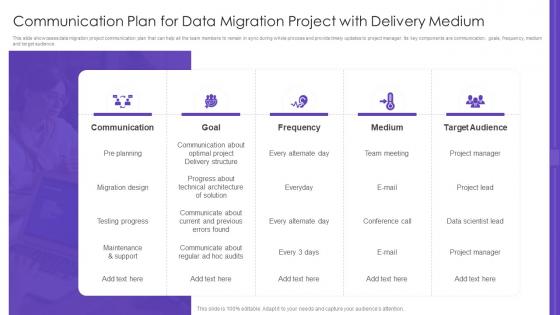
This slide showcases data migration project communication plan that can help all the team members to remain in sync during whole process and provide timely updates to project manager. Its key components are communication, goals, frequency, medium and target audience.
People who downloaded this PowerPoint presentation also viewed the following :
Communication Plan For Data Migration Project With Delivery Medium with all 6 slides:
Use our Communication Plan For Data Migration Project With Delivery Medium to effectively help you save your valuable time. They are readymade to fit into any presentation structure.






FAQs for Communication Plan For Data Migration Project
Key stakeholders in data migration projects include IT teams, business users, project managers, data owners, compliance officers, and executive sponsors. Effective communication requires tailored messaging through regular status meetings, detailed technical documentation for IT teams, simplified progress reports for executives, and hands-on training sessions for end users, ultimately ensuring stakeholder alignment and project success.
Organizations can assess team readiness through structured communication surveys, skills gap assessments, stakeholder feedback sessions, and cross-departmental readiness workshops that gauge technical capabilities and change management preparedness. These strategies enable leadership to identify training needs, address concerns proactively, and ensure alignment across departments, with many enterprises finding that early communication assessments significantly reduce migration risks and accelerate project timelines.
Change management plays a critical role in data migration communication plans by ensuring stakeholder buy-in, managing expectations, and facilitating smooth transitions across organizational levels. Through structured communication frameworks, organizations streamline user adoption, minimize resistance, and enhance operational continuity, with many enterprises finding that proactive change management ultimately delivers faster implementation timelines and reduced project risks.
Visual aids enhance data migration understanding by simplifying complex technical processes, illustrating data flow pathways, highlighting potential bottlenecks, and demonstrating timeline dependencies through charts, diagrams, and interactive dashboards. These presentations enable stakeholders across IT, operations, and executive teams to grasp migration scope and impact more clearly, ultimately facilitating better decision-making and smoother project approval processes.
Inadequate communication during data migration creates risks including project delays, data inconsistencies, stakeholder resistance, budget overruns, and system downtime. These communication gaps often result in misaligned expectations, inadequate user training, and poor change management, with many organizations finding that insufficient stakeholder engagement ultimately compromises data integrity and user adoption rates.
A communication plan should address data security concerns by establishing clear protocols for encrypted data transfer, access controls, and breach response procedures, while providing regular security status updates to stakeholders. Through transparent reporting on encryption methods, audit trails, and compliance measures, organizations can maintain stakeholder confidence and regulatory alignment, with many finding that proactive security communication ultimately enhances trust and project success.
**INPUT**: What methods can be used to gather feedback from team members about the data migration communication plan? **OUTPUT**: Feedback methods include structured surveys, focus group sessions, one-on-one interviews, collaborative workshops, and real-time communication platforms like Slack or Microsoft Teams. These approaches enable organizations to capture diverse perspectives, identify communication gaps, and refine messaging strategies, with many companies finding that combining multiple feedback channels ultimately delivers more comprehensive insights and smoother migration outcomes.
Varying technical expertise requires a multi-layered communication approach, using simplified visual dashboards for non-technical stakeholders, detailed technical documentation for engineers, and intermediate progress reports for project managers. Organizations streamline this challenge by creating role-specific communication channels, standardized terminology guides, and regular cross-functional briefings, ultimately ensuring all team members understand project status while receiving information appropriate to their expertise level.
**INPUT**: What are some best practices for communicating timelines and milestones during data migration? **OUTPUT**: Best practices include establishing regular stakeholder updates, creating visual progress dashboards, setting realistic milestone expectations, maintaining transparent risk communication, and providing detailed rollback procedures. These approaches streamline coordination by reducing uncertainty, enhancing team alignment, and building stakeholder confidence, with many organizations finding that proactive communication ultimately delivers smoother migrations and stronger business continuity.
Organizations can tailor communication strategies by identifying each department's specific data dependencies, technical expertise levels, timeline requirements, and operational concerns during migration. Finance teams need detailed security protocols and compliance updates, while marketing focuses on customer data accessibility, and IT requires technical specifications and rollback procedures, ultimately ensuring all stakeholders receive relevant, actionable information that minimizes disruption.
Documenting communication processes during data migration ensures accountability, maintains project transparency, and creates valuable reference materials for future migrations. This systematic approach enables teams to track decisions, resolve issues efficiently, and minimize miscommunication risks, while organizations benefit from improved stakeholder alignment, reduced project delays, and enhanced knowledge retention for subsequent data initiatives.
Organizations can utilize collaboration platforms, automated reporting tools, real-time dashboards, migration management software, and integrated communication systems to streamline updates throughout data migration. These technologies enhance transparency by providing stakeholders with instant progress visibility, automated milestone notifications, and centralized information access, while minimizing manual reporting tasks, ultimately delivering faster decision-making and improved project coordination across all migration phases.
**INPUT**: What metrics can be used to measure the effectiveness of the communication plan in a data migration project? **OUTPUT**: Effective communication plan metrics include stakeholder engagement rates, feedback response times, issue escalation frequency, training completion percentages, and user adoption speeds. These measurements enable project managers to track information clarity, identify communication gaps, and ensure seamless knowledge transfer, with many organizations finding that robust communication tracking ultimately reduces migration delays and enhances overall project success rates.
Post-migration support should be communicated through multi-channel announcements detailing help desk contacts, escalation procedures, response timeframes, and available resources like user guides and training materials. Organizations enhance this by establishing dedicated support teams, implementing real-time monitoring dashboards, and scheduling regular check-ins with key departments, ultimately ensuring faster issue resolution and minimizing operational disruptions during the transition period.
A data migration FAQ should address timeline expectations, potential system downtime, data security protocols, rollback procedures, and user training requirements. These communications help stakeholders understand migration phases, access continuity plans, and support resources, while addressing concerns about data integrity, business continuity, and operational disruptions, ultimately building confidence and ensuring smoother organizational transitions.
-
It is my first time working with them and that too on a friend's recommendation. I would say, I am not expecting such a worldly service at this low price.
-
Templates are beautiful and easy to use. An amateur can also create a presentation using these slides. It is amazing.