


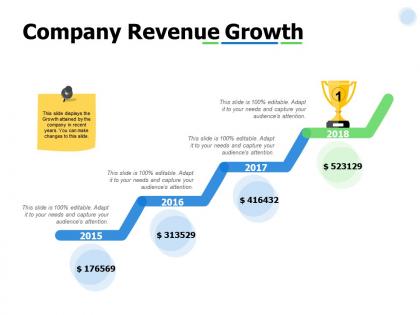
Company revenue growth year ppt powerpoint presentation professional templates




Try Before you Buy Download Free Sample Product
 Impress Your
 Audience
 100%
100% Editable
 Save Hours
 of Time


Highlight interdependence with our Company Revenue Growth Year Ppt Powerpoint Presentation Professional Templates. Encourage individuals to forge friendships.
People who downloaded this PowerPoint presentation also viewed the following :
Company revenue growth year ppt powerpoint presentation professional templates with all 5 slides:
Encourage individuals to forge friendships with our Company Revenue Growth Year Ppt Powerpoint Presentation Professional Templates. It helps highlight interdependence.


FAQs for Company revenue growth year ppt powerpoint
Honestly, three things are making the biggest difference right now: keeping your current customers happy, going digital, and squeezing more revenue from people who already buy from you. Retaining customers costs way less than finding new ones - like 5x cheaper, which is nuts when you think about it. Companies that actually listen to feedback and pivot fast are killing it. The winners are diversifying beyond their main thing - subscription models, premium options, whatever makes sense. Oh, and definitely audit what your best customers want next. That's where the money is.
Start with your customer data - what are they buying together? When are they most active? I've seen this uncover crazy opportunities, like a SaaS company that realized their small biz clients desperately needed consulting services. Look for gaps in what you're offering too. Check your operational stuff as well - inefficiencies you could flip into revenue or processes you could package up. Honestly, most companies are sitting on goldmines they don't even see. The main question is always "what else do these people need that we could actually deliver?"
Look, engaged customers are literally your money makers. They buy more stuff, stick around longer, and actually tell their friends about you. Building that connection through personalized messages or loyalty programs? Game changer. People shop with brands they trust - it's that simple. Your existing customers will upgrade services and become repeat buyers way easier than convincing strangers to try you out. I learned this the hard way, but honestly, nurturing current customers costs way less than chasing new ones all the time. Focus there first.
Honestly, innovation is what keeps the money flowing because it gives you an edge over everyone else. Better products mean you can charge more and customers actually stick around. Look at Netflix vs Blockbuster - that's what happens when you don't innovate. But here's the thing: don't just add random features because they seem cool. Actually figure out what's bugging your customers first. Then build solutions around those specific problems. That's how you get real, lasting growth instead of just a temporary bump.
Dude, market trends will absolutely wreck your revenue projections if you're not careful. Strong economy? People spend more and your numbers might actually be too low. But when things go south - recession, inflation, whatever - even your best forecasts can crash hard. I got burned by this in 2020 when literally everything fell apart overnight! What saved me was having backup plans ready. Build out three scenarios: best case, worst case, and something realistic in between. That way you won't be scrambling when the market inevitably does something weird.
Dude, it really depends on what you're selling. Tech and luxury stuff? Go premium - people literally think expensive equals better. Retail and commodities though... you're basically racing to the bottom on price. Volume becomes your best friend there. Some customers will throw money at anything that feels "premium" (I still don't get the $8 coffee thing), others won't budge even for a penny discount. Test small chunks of your market first with different prices. See what actually works before you commit to anything major. Way better than guessing.
Honestly, it all comes down to getting both teams chasing the same revenue numbers. Start with something small - maybe just nail down what counts as a "qualified lead" because that's where most of the fighting happens anyway. Set up weekly check-ins so marketing actually knows what sales needs (spoiler: it's not just more leads, it's better ones). Both teams should see the same dashboard data and definitely include everyone when you're setting goals. I'd avoid trying to fix everything at once though - pick that one lead handoff process first, get it working smooth, then tackle the next thing.
Track your leading and lagging indicators - stuff like customer acquisition cost, lifetime value, conversion rates. MRR growth is absolutely critical if you're SaaS (probably the metric that matters most, tbh). Revenue per customer tells you a lot too. But here's the thing - don't ignore what your sales team's saying about lead quality and those actual customer convos. Numbers only tell half the story. Set up a monthly dashboard so you can compare before/after metrics when you roll out new strategies. Makes it way easier to pivot quickly if something's not working.
Honestly, the two killers are gonna be your operations falling apart and cash getting tight. Your team and systems just can't scale as fast as your revenue - so customer service tanks, quality goes to shit, orders get backed up. Growth is expensive too since you're dumping money into everything before you see profits roll in. I've watched companies literally go bankrupt from growing too fast, which is wild when you think about it. You'll also probably lose some of that startup vibe when things get chaotic. Best move? Build out your backend stuff as you grow, not after you're already drowning.
Dude, networking is seriously underrated for growing revenue. Real relationships in your industry open up so many doors - referrals, joint ventures, cross-selling opportunities. I've watched companies literally double their money from one good partnership. But here's the thing - don't just collect business cards like pokemon cards or whatever. Focus on building actual connections with people who serve your same clients but aren't competing directly with you. Find 3-5 solid potential partners this week and reach out. It's way more effective than most marketing stuff you'll spend money on.
Honestly, start with your customer service - make sure your team actually fixes problems instead of just apologizing. People are so done with crappy support these days. Then get smart about using customer data for personalized stuff like recommendations. It makes people feel seen, you know? Loyalty programs work too - rewards, exclusive deals, whatever gets them coming back. Oh and definitely do regular check-ins and surveys to catch issues before they blow up. I'd map out your customer journey first though, see where people are getting frustrated. Those pain points are your starting line.
Honestly, subscription models are kinda genius for long-term growth, but yeah - you'll probably see revenue dip at first during the switch. The cool thing is you get that steady monthly income instead of constantly hunting for new sales. Customer lifetime value goes way up even though each person pays less upfront. Way easier to budget when you know what's hitting your account each month, you know? I'd look at your retention rates first though - if people already stick around, subscriptions will probably crush it for you. The predictable cash flow alone makes it worth considering.
Dude, automation seriously saves so much time it's ridiculous. Start with the boring stuff - data entry, invoicing, customer onboarding. Your CRM can nurture leads automatically while chatbots answer basic questions all night. The real win though? Your team stops doing mindless tasks and focuses on actual money-making activities. You'll respond to leads faster, get better insights from your data, and honestly the accuracy improvement alone is worth it. I'd just pick whatever's wasting the most time right now and automate that first.
Going international can really boost your revenue, but honestly it's gonna cost you upfront. Localization, compliance stuff, new hires - the bills add up quick. That said, if you execute well you'll usually see those investments pay off in 12-18 months when that bigger market kicks in. Just make sure you're already profitable at home first - I can't stress this enough. Oh and don't try to tackle multiple countries at once. Pick one market to test the waters. Way less risky than going all-in everywhere.
Look, when customers really trust your brand, they'll pay more without thinking twice about it. That's where the real money is. People become less obsessed with hunting for the cheapest option and just stick with you - honestly way better than constantly chasing new customers. Your brand basically becomes their mental shortcut, which saves them from decision fatigue every time. The cool part? Strong brands get shared more naturally, so you're not burning cash on ads as much. I'd start by checking if your brand looks the same everywhere - website, social, emails, all of it.
No Reviews