

Comparative Assessment Of Operational Technology Security Vendors




Try Before you Buy Download Free Sample Product
 Impress Your
Audience
 100%
Editable
 Save Hours
of Time


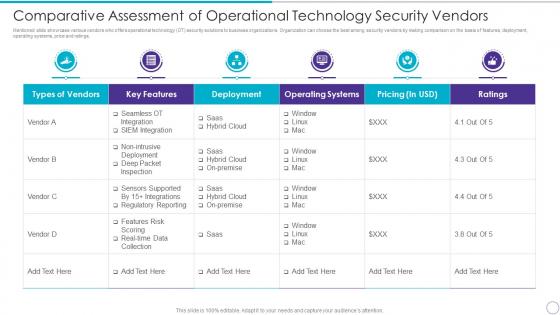
Mentioned slide showcase various vendors who offers operational technology OT security solutions to business organizations. Organization can choose the best among security vendors by making comparison on the basis of features, deployment, operating systems, price and ratings.
People who downloaded this PowerPoint presentation also viewed the following :
Comparative Assessment Of Operational Technology Security Vendors with all 6 slides:
Use our Comparative Assessment Of Operational Technology Security Vendors to effectively help you save your valuable time. They are readymade to fit into any presentation structure.






FAQs for Comparative Assessment Of Operational
IT security focuses on data protection, network access, and information confidentiality, while operational technology security prioritizes physical system safety, industrial process continuity, and equipment reliability. OT environments like manufacturing plants, power grids, and water treatment facilities require specialized protocols that balance cybersecurity with operational uptime, ultimately ensuring both digital protection and physical infrastructure safety.
Organizations can effectively assess their OT cybersecurity posture through comprehensive network discovery, vulnerability scanning, risk assessments, security audits, and continuous monitoring protocols. These methodologies enable identification of legacy system vulnerabilities, network segmentation gaps, and unauthorized access points, with many manufacturing and energy companies finding that regular assessments streamline incident response while ultimately delivering enhanced operational resilience and regulatory compliance.
Threat intelligence strengthens OT security by providing real-time insights into emerging vulnerabilities, attack patterns, and sector-specific threats targeting industrial systems. Through comprehensive threat feeds and analysis, organizations can proactively identify risks, enhance incident response capabilities, and implement targeted defenses, with manufacturing and energy sectors finding that intelligence-driven security approaches significantly reduce breach likelihood and operational disruptions.
Regulatory frameworks significantly enhance operational technology security by establishing mandatory cybersecurity standards, requiring regular vulnerability assessments, and mandating incident reporting protocols across critical infrastructure sectors. These regulations, particularly in energy, manufacturing, and utilities, enable organizations to implement comprehensive security measures, accelerate threat detection capabilities, and maintain operational resilience, ultimately delivering standardized protection and competitive advantage in an increasingly regulated environment.
Legacy OT systems present unique cybersecurity challenges including outdated software without security patches, proprietary protocols lacking encryption, air-gapped networks now connected to IT systems, and extended lifecycles spanning decades. These aging infrastructures, common in manufacturing plants and utilities, create vulnerabilities through unmonitored network connections and legacy authentication methods, ultimately requiring specialized security approaches that balance operational continuity with modern threat protection.
Best practices for OT incident response include establishing dedicated response teams, implementing network segmentation protocols, creating offline backup systems, developing safety-first containment procedures, and maintaining detailed asset inventories. These approaches streamline recovery by prioritizing operational continuity, minimizing production downtime, and ensuring worker safety, with many manufacturing and energy organizations finding that coordinated IT-OT response teams deliver faster containment and reduced business impact.
Organizations ensure secure remote access to OT systems through multi-factor authentication, encrypted VPN connections, network segmentation, zero-trust architecture, and privileged access management controls. These security measures enable remote monitoring and maintenance while minimizing cyber risks, with manufacturing and energy companies finding that layered security approaches deliver operational continuity and enhanced protection against potential threats.
Network segmentation, endpoint detection and response (EDR), industrial firewalls, security information and event management (SIEM), and anomaly detection systems are most effective for monitoring OT networks. These technologies enhance operational security by providing real-time threat visibility, isolating critical systems, and detecting unusual behavioral patterns, with many manufacturing and energy organizations finding that this strategic combination ultimately delivers improved cyber resilience and operational continuity.
Employee training programs enhance operational technology security by educating staff on recognizing social engineering attacks, implementing proper access protocols, and following incident response procedures. Through comprehensive cybersecurity awareness programs, manufacturing facilities, power plants, and water treatment systems significantly reduce human error vulnerabilities, improve threat detection capabilities, and ensure faster incident containment, ultimately strengthening their overall security posture.
Organizations should track network segmentation effectiveness, anomaly detection accuracy, incident response times, vulnerability patch rates, and compliance audit scores to evaluate OT security measures. Through continuous monitoring of these metrics, manufacturers and utilities can identify security gaps, reduce downtime risks, and strengthen critical infrastructure protection, ultimately delivering enhanced operational resilience and regulatory compliance.
Organizations integrate IT and OT security strategies through unified governance frameworks, convergent security platforms, shared threat intelligence systems, and cross-functional security teams. This strategic combination enables comprehensive asset visibility, coordinated incident response, and streamlined compliance management, with many manufacturing and energy companies finding that integrated approaches significantly reduce attack surfaces while enhancing operational resilience.
Emerging threats include sophisticated ransomware targeting industrial systems, supply chain attacks compromising equipment firmware, insider threats from remote access vulnerabilities, AI-powered attacks adapting to security measures, and IoT device exploits creating network entry points. These evolving risks challenge traditional OT security approaches, with manufacturing plants, power grids, and water treatment facilities increasingly implementing zero-trust frameworks and advanced monitoring solutions.
Segmentation enhances OT security by isolating critical operational networks from corporate IT systems, limiting attack propagation, and creating controlled access points for monitoring threats. This approach enables organizations to contain potential breaches within specific zones, implement targeted security controls, and maintain operational continuity, with manufacturing and energy sectors finding significant risk reduction.
Supply chain vulnerabilities can significantly compromise operational technology security by introducing malicious code through third-party components, creating backdoors in industrial systems, and enabling unauthorized access to critical infrastructure. Manufacturing plants, power grids, and water treatment facilities increasingly face risks from compromised hardware and software suppliers, with attackers leveraging these entry points to disrupt operations, steal sensitive data, and potentially cause physical damage to equipment.
Automation enhances OT security by enabling real-time threat detection, automated incident response, and continuous monitoring across industrial networks. These systems streamline security operations by reducing manual oversight, accelerating threat mitigation, and maintaining consistent security protocols, with manufacturing and energy sectors finding that automated solutions deliver faster response times and minimize operational disruptions.
-
Colors used are bright and distinctive.
-
Editable templates with innovative design and color combination.